
How to Choose the Right AI Development Company: A Founder’s Guide
It seems as if choosing an AI development company is the same as selecting a co-founder for a particular issue. If you do it right, your product will be able to move at a faster pace, have enhanced performance, and be able to attract the markets that you did not anticipate. On the other hand, if you make a mistake, you end up throwing away months and a significant amount of money that could be tens or hundreds of thousands, or in a worse scenario, releasing a product that loses the trust of your customers.
I'm writing this for founders, CTOs, product leaders, and non-technical owners who need a practical playbook. I've worked with startups and seen both clean wins and avoidable messes. This guide keeps the strategy simple, skips marketing fluff, and gives you concrete questions, red flags, and a repeatable process for selecting an AI development partner.
Why this decision matters
AI development is different from regular software work. You're not just shipping features. You are developing the models, pipelines, and data contracts that will be operationally available. This, in turn, entails data engineering, model training, evaluation, deployment, monitoring, and continuous iteration.
In case you are a founder, consider the collaboration in three aspects: technical competence, product sense, and operational reliability. A dev shop that merely understands models but is unable to deliver scalable infrastructure will be a source of troubles. Likewise, a company that excels at container orchestration but lacks domain expertise won't design the right model for your users.
Types of AI development companies
AI consulting firms. They advise, architect, and sometimes manage. Good for strategy, complex enterprise AI, or hybrid approaches.
Custom AI development shops. They build end-to-end solutions, often for startups. Expect hands-on engineers, architects, and product managers.
Product-focused AI vendors. They sell prebuilt components or APIs. Fast to integrate, less flexible for unique needs.
Large system integrators. Good for enterprise AI development at scale, but often expensive and slow.
Specialized boutiques. They focus on narrow domains like NLP, computer vision, or recommender systems. Great when you need deep domain expertise.
Each type has tradeoffs. For a curious founder, the question is not which is best, but which fits your stage, budget, and timeline.
Core criteria to evaluate
When you're deciding how to choose an AI development company, use these criteria as your compass. I list them roughly in order of importance for early-stage startups. You can reorder for enterprise procurement.
1. Relevant expertise
Look for teams that have developed technologies similar to yours. For instance, if you are developing AI for healthcare, then companies with clinical or regulatory experience should be your first choice. On the other hand, if it is a chatbot, then you should focus on conversational AI case studies.
Prompt parties to present case studies, technical write-ups, or code samples. A competent AI solution provider will be able to explain architecture tradeoffs, why they chose a model, and how they validated it. If they refrain from providing technical depth and only use vague buzzwords, then it is a red flag.
2.Technical stack and tools
Inquire about the frameworks, cloud providers, and MLOps tools they use. Some of the common, well-supported, and popular choices are PyTorch, TensorFlow, scikit-learn, Kubernetes, Docker, and cloud platforms like AWS, GCP, or Azure. If a vendor is willing to let you be dependent on a proprietary stack without giving you good reasons, then you should find out the reason why.
Also ask about model deployment and monitoring. Do they use feature stores? How do they handle model versioning? How do they alert on data drift? These are the practical problems that show maturity.
3. Data engineering and data quality
Models live and die on data. I can't stress that enough. Ask how they source, clean, label, and version data. Do they have experience with data pipelines, batch and streaming processes, or ground truth generation?
For startups, low-cost options like active learning and data augmentation can deliver big wins. A smart partner will propose efficient ways to build labeled datasets without thousands of manual hours.
4. Security, privacy, and compliance
Data often includes sensitive information. Confirm the company has security practices, encryption for data in transit and at rest, access control, and audit logging. For regulated industries, ask about HIPAA, GDPR, or SOC 2 experience.
Also ask how they isolate development and production environments. I once saw a team merge test and prod data stores. It looked like shortcut, but it became a painful compliance issue later.
5. Scalability and operations
Can they build a system that scales? It's not just about adding more GPU hours. It includes autoscaling inference, caching, cost controls, and observability. Ask for real-world load tests, latency numbers, and cost estimates for expected traffic.
Think about your growth curve. Will the architecture handle 10x traffic with modest changes? If they can demonstrate elastic infrastructure and a reasonable cost plan, that's a green sign.
6. Team composition and continuity
Find out who will actually work on your project. Will you get senior ML engineers, data engineers, and product managers, or mostly junior staff? Continuity matters. Frequent staff churn slows progress.
Ask about key person risk. Who owns the architecture, and is that person likely to stay through delivery and beyond? Contract clauses that guarantee staffing levels and named resources are reasonable.
7. Communication and product sense
Good AI development partners speak product, not just tech. They should help shape scope, set realistic milestones, and prioritize features that move metrics. Look for clear communication cadence, documentation practices, and empathy for your customers.
I've noticed the best partners ask questions about success metrics early. They want to measure impact, not just deliver artifacts.
8. Cost and pricing model
Cost arrangements differ. Some companies charge by the hour, others have fixed-price sprints, and some suggest outcome-based pricing. For startups, a combination of fixed milestones with a provision for incentivizing the achievement of KPIs can be a good way to align the parties' interests.
Be careful with hidden costs. GPU time, data labeling, cloud bills, and continuous model retraining can become quite expensive. Take a Total Cost of Ownership estimate for the first 12 to 24 months.
9. Intellectual property and contracts
Ensure contracts clearly specify the ownership of intellectual property, licensing, and third-party components. In case you want to have complete ownership of the models and code, indicate it from the very beginning. There are some vendors who decide to keep the rights to certain components. In case that conflicts with your product strategy, you should have it negotiated at an early stage.
10. Post-launch support and maintenance
AI models need regular care. Data changes, models drift, and new edge cases crop up. Ask about SLAs, monitoring dashboards, bug fix windows, and plans for model retraining. If the company disappears after launch, you need to know how you'll maintain the system.
Questions to ask during vendor conversations
Here are practical, specific questions you should bring to vendor calls. They usually separate experienced partners from the rest.
Could you demonstrate a project that you have built similar, through 10 to 15 minutes of a video walkthrough?
Will you introduce us to the team? Could you please provide us with the information about their qualifications?
What different modeling approaches have you experimented with? Why did you choose the final one?
How do you assess the quality of the model that is in production? What metrics do you follow?
What ways of data labeling and ground truth do you use? Is it part of your active learning process?
What are your strategies for deployment and rollback of model updates?
What measures do you take to protect the data and to be in line with the privacy rules?
Would you be able to share the performance and cost estimate for the first year?
What does handoff look like? Will you train my team to operate the system?
These questions force concrete answers, not buzzword bingo.
Red flags to watch for
Vague answers about technical choices. If they can't explain why they picked a model, walk away.
Over-promising accuracy without baseline comparisons. Look for A/B tests and clear benchmarks.
Ignoring data engineering. If they treat data as an afterthought, you will pay later.
Refusal to commit to IP or transparency around code and models.
No post-launch support model. AI is never "done."
Claims of proprietary magic that can't be demonstrated. Skepticism is healthy.
Build vs partner vs buy: a practical rule of thumb
Deciding whether to build in-house, buy a product, or partner with a company depends on stage and core competency.
Build in-house if AI is core to your product and you can hire the talent. This is common for well-funded startups or companies with long-term AI roadmaps.
Buy a product if your need is well served by existing software and you want speed. Examples may be off-the-shelf NLP APIs or vision APIs.
Partner In case you need a custom solution quickly, or if you lack the required expertise, partner with a company. Most seed-stage founders working with a bespoke AI development company is the fastest way to achieve product-market fit.
As per my start-up development progression is from buying to partnering to building. At first, they implement ready-made tools, then partner for custom features, and finally, when the product gets mature, they bring core capabilities in-house.
How to structure the engagement
This is a simple, low-risk approach that I would suggest to founders. It keeps the expenses predictable and lessens the technical risk.
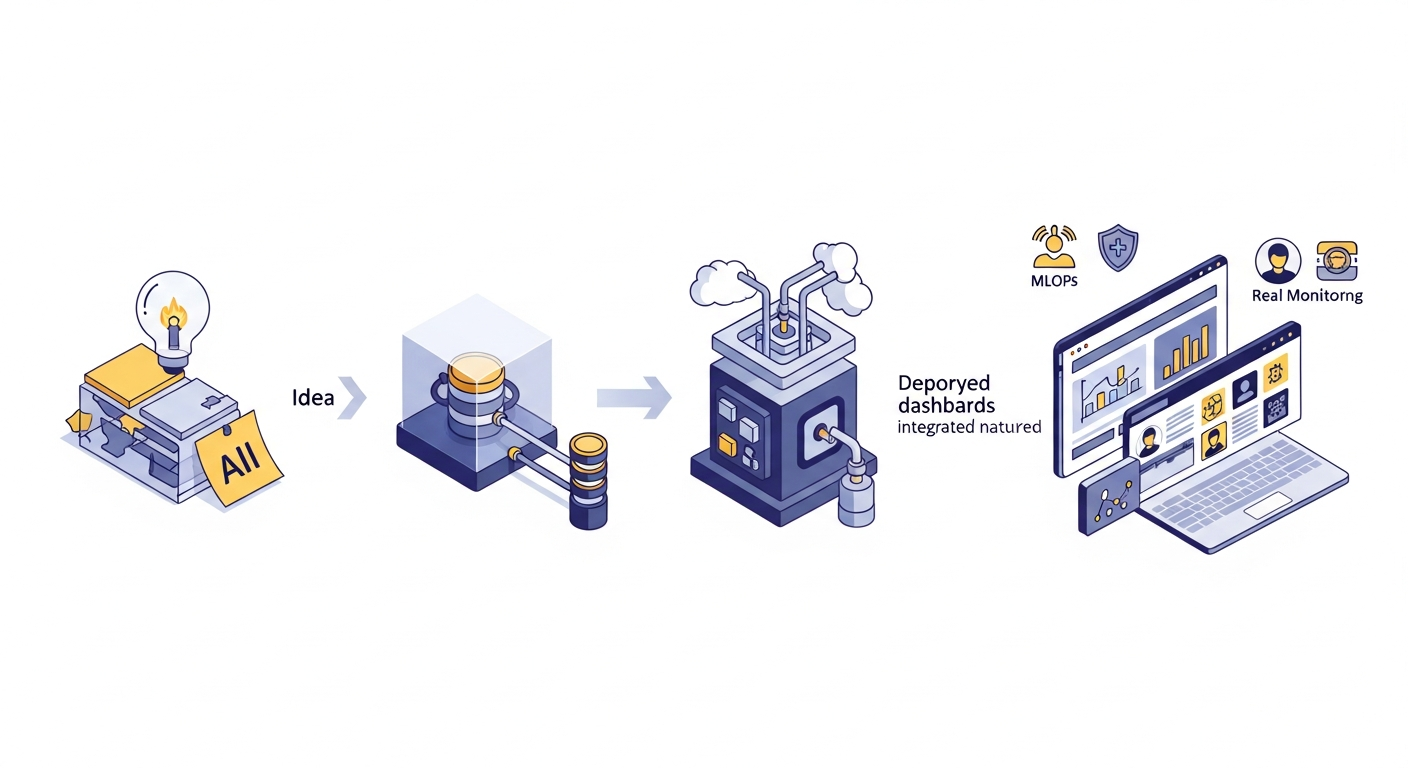
Discovery and scoping. Two to four weeks. Work together to define success metrics, available data, and a minimal viable model. Expect a short architecture diagram and a delivery plan.
Proof of concept. Four to eight weeks. Build a lightweight, end-to-end flow that proves your core hypothesis. Keep it limited to one or two use cases.
Pilot and iterate. Three to six months. Improve model quality, add monitoring, and test with real users. This phase should include retraining pipelines and deployment automation.
Scale and handoff. Ongoing. Move to production grade reliability, cost optimization, and team onboarding. Decide whether to retain the partner for maintenance or transition in-house.
This phased model reduces commitment and lets you evaluate the vendor based on deliveries, not promises.
Scoring framework you can use right now
Make vendor evaluation easier by scoring each candidate on the key criteria. Here is a straightforward structure that you can replicate.
Technical expertise: 1 to 5
Relevant domain experience: 1 to 5
Data engineering capabilities: 1 to 5
Security and compliance: 1 to 5
Scalability and devops: 1 to 5
Communication and product sense: 1 to 5
Total cost and transparency: 1 to 5
Post-launch support: 1 to 5
Assess each vendor with a numerical value and decide the importance of each category based on your priorities. For example, a healthcare startup should give more weight to compliance and domain experience.
Common mistakes founders make
Here are pitfalls I see again and again. Avoid these and you'll save time and money.
Trying to build everything at once. Start with one metric and one use case.
Ignoring data quality. Bad labels make good models useless.
Picking a vendor based on price alone. The cheapest quote rarely yields the fastest or most reliable results.
Not planning for ops. Models need monitoring and retraining budgets.
Assuming the vendor will handle stakeholder alignment. You still own product decisions.
As a quick example, I worked with a founder who wanted a “smart search” feature. They handed the task to a cheap freelancer who tuned an embedding model, but skipped a relevance feedback loop. Users complained, adoption stalled, and the founder ended up rebuilding the system with a proper ranking model and a light feedback pipeline. If they'd invested in the right partner earlier, they would have launched faster.
Realistic timelines and budgets
Timelines and budgets vary a lot, but here are rough ranges you can expect.
Discovery and POC: 4 to 12 weeks, $20k to $100k depending on the complexity of the data.
Pilot MVP: 3 to 6 months, $50k to $250k. It also includes production deployment and basic monitoring.
Scaling and enterprise readiness: 6 to 12 months, $150k to $1M+. It also includes optimization, compliance, and full MLOps.
These are rough figures. If a vendor is promising you a fully-featured enterprise AI solution for just a few thousand dollars, consider that as not being possible. However, if your problem is simple and your data is clean, you can make a good model quickly and at a low cost.
Onboarding and running the project smoothly
Once you pick a partner, how you run the engagement matters. These are some of the effective ways which I utilize in order to keep my activities going.
Clearly outline one single source which will be used for product decisions, such as a shared Notion or Confluence page.
Set up weekly demos and biweekly roadmap reviews. Don’t keep it silent, show up your work regularly.
Exactly to which extent the acceptance criteria should be agreed upon? They must be quite measurable rather than being only subjective.
Employ small, time-boxed sprints with explicit deliverables. No open-ended tasks should be allowed.
Arrange fast feedback from the end-users or domain experts. Small, frequent feedback is better than long review cycles.
Keep the focus on measurable improvement. For instance, say "reduce false positives by 20 percent in two months" instead of "improve accuracy."
Working with non-technical founders
If you're a non-technical founder, you're not at a disadvantage. You just need a slightly different checklist. Focus on outcomes and communication.
Ask for visual explanations of architecture and data flow.
Request a simple dashboard that shows progress on key metrics.
Make sure the vendor can explain technical tradeoffs in plain language.
Get clear estimates on business impact, not just technical milestones.
Insist on a training plan so your team can take over operations when ready.
I once coached a founder who couldn't code and was worried about getting locked into a vendor. She asked for a "takeout plan" that spelled how to migrate data and models. That gave her confidence and kept the vendor honest.
Negotiating contracts and IP
Contracts are where founders often lose leverage. Here are negotiation points that matter.
IP ownership. If you want full ownership, say so. Consider a work-for-hire clause.
Source code access. Agree on escrow or repository access on delivery milestones.
Data ownership and deletion. Clarify who owns training data and how it will be deleted if needed.
Service levels for production issues. Define response times and remediation steps.
Termination clauses and exit plan. Make sure you can get artifacts and data if you end the engagement.
Vendors may resist some points, but many are reasonable. Push on the details that affect your future ability to own and evolve the product.
Example scenario: choosing a partner for a recommendation engine
Let's walk through a short, real-feeling example. You run a startup that sells curated products. Your CTO thinks personalized recommendations could boost purchases by 15 percent. You have transaction logs and some browsing data, but it is messy.
Here is a simple approach for choosing an AI development company.
Scope a two-week discovery to map available data, define success metrics, and sketch a baseline. Ask vendors for a one-page plan on how they'd do it.
Run a four-week POC with 3 vendors in parallel, each given the same subset of data and the same target metric. Ask for a working demo and a report with results, costs, and assumptions.
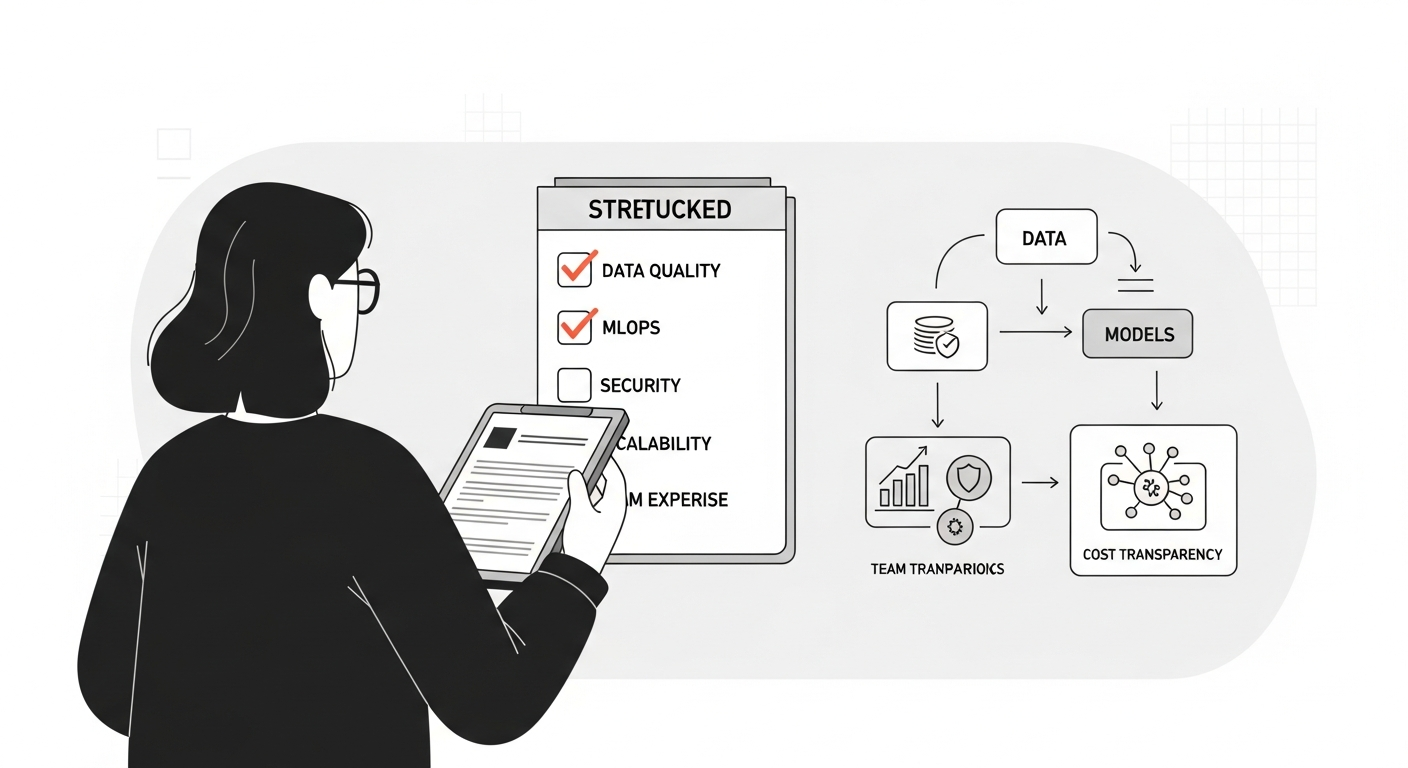
Score the vendors on a small rubric: model quality, data approach, ops, and cost transparency. Pick the top scorer for a three-month pilot with clear acceptance criteria.
After the pilot, decide whether to scale with the vendor, hire the vendor's engineers, or transition in-house. Negotiate IP and handoff terms up front.
This approach gives you data to make the decision, not just promises. It keeps the risk manageable and helps you choose a partner who can actually deliver results.
How Agami Technologies can help
At Agami Technologies, we build custom AI solutions for startups and enterprises. We focus on practical impact, not academic benchmarks. We help with discovery, POC, production deployment, and ongoing MLOps. If you want a partner that pairs engineering discipline with product sense, we can jump in at any phase of your journey.
I've seen projects succeed when partners understand the business and measure impact from day one. If you're evaluating AI development companies, consider asking for a short engagement to prove the relationship. That small step often tells you more than a three hour sales deck.
Quick vendor checklist
Use this when you screen companies. Read it during calls or paste it into your RFP.
Can you provide a short case study of similar work?
Who will be on the team and what are their roles?
Which tools, frameworks, and cloud platforms do you use?
How do you handle data labeling and ground truth?
What are your security practices and compliance experience?
How do you measure model performance in production?
What's your pricing model and what is included in TCO?
What does post-launch support look like?
How do you handle IP, code access, and handoff?
Final thoughts
Choosing an AI development partner doesn't have to be mystifying. The best vendors show technical depth, product thinking, and operational rigor. They ask about your success metrics early and give realistic timelines and costs. They care about data quality and plan for production operations from day one.
Trust but verify. Ask for a small proof of value, score objectively, and keep the initial scope tight. If a vendor fits the technical and business needs, they become a multiplier for your team.
When you are ready, look for partners who will treat your product like their own. That mindset makes all the difference.
Read more: AI Development Services That Transform Your Business In 2025: Complete Guide
Helpful Links & Next Steps