Why Every Startup Needs an Agile Software Development Life Cycle Approach
If you are building a product under time and budget pressure, you already know the rules keep changing. Customers give unexpected feedback. Market assumptions get invalidated. Investors want traction yesterday. In my experience, the single biggest factor that separates startups that survive from those that stall is how they build software. That is where the agile software development life cycle for startups comes in.
This post is aimed at founders, CTOs, tech leads, product managers, and even non-technical co-founders who wish to grasp a practical method of delivering value quickly. I will clarify the reasons that an agile SDLC is important, how it is different from older approaches such as the waterfall method, and how you can gradually transition to Agile without the need to change your team into a ritual factory. I will also reveal some definite tips, typical mistakes, and a few instances that you can implement immediately while moving towards your goal.
Startups face unique engineering problems
Startups are not small versions of big companies. You move fast. You change direction based on a single customer conversation. You cannot afford slow engineering cycles that lock in bad decisions. I've seen teams spend months building features nobody wanted because the process treated requirements as immutable. That kills momentum.
Here are the reality checks I see most often:
Requirements change weekly or even daily.
You're often trying to validate a business model and a product at the same time.
Resources are limited. Time and cash are the real constraints.
Early user feedback matters more than internal opinions.
Given those constraints, a startup needs a development approach that supports rapid learning, fast course corrections, and efficient use of resources. That is exactly what the agile development methodology does when applied as a software development life cycle for startups.
What is the Agile Software Development Life Cycle?
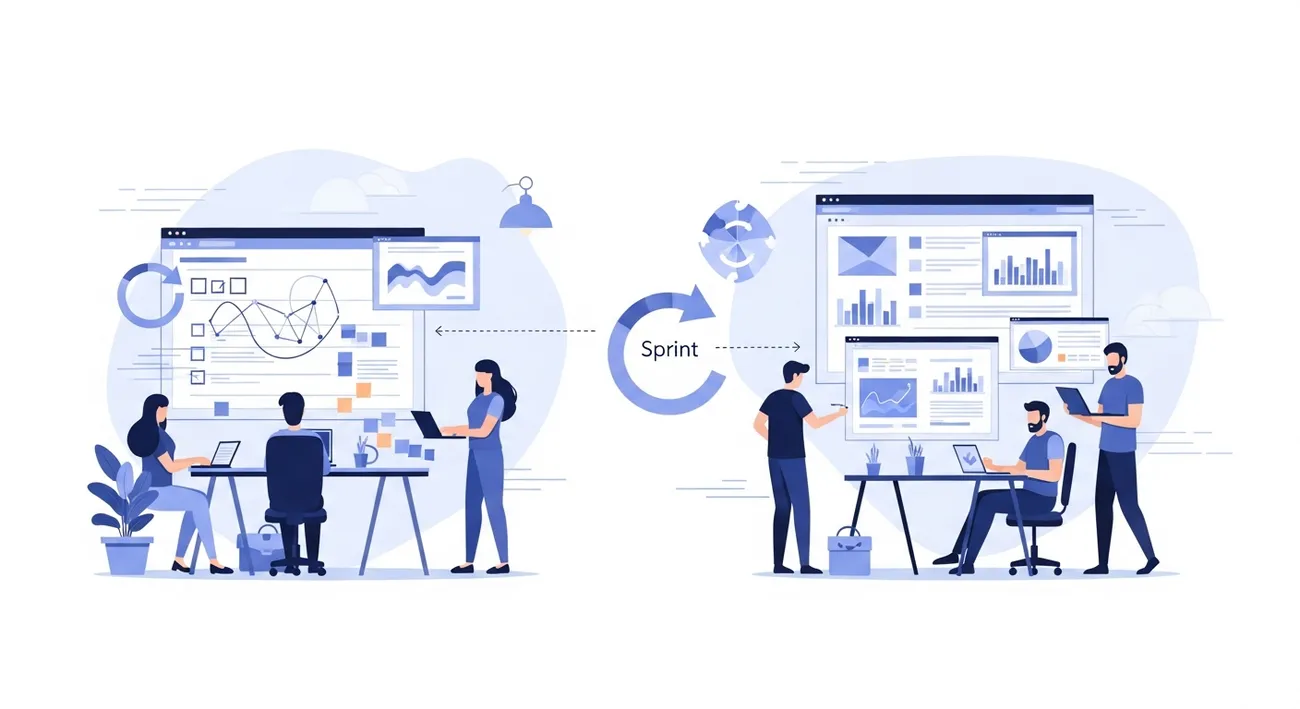
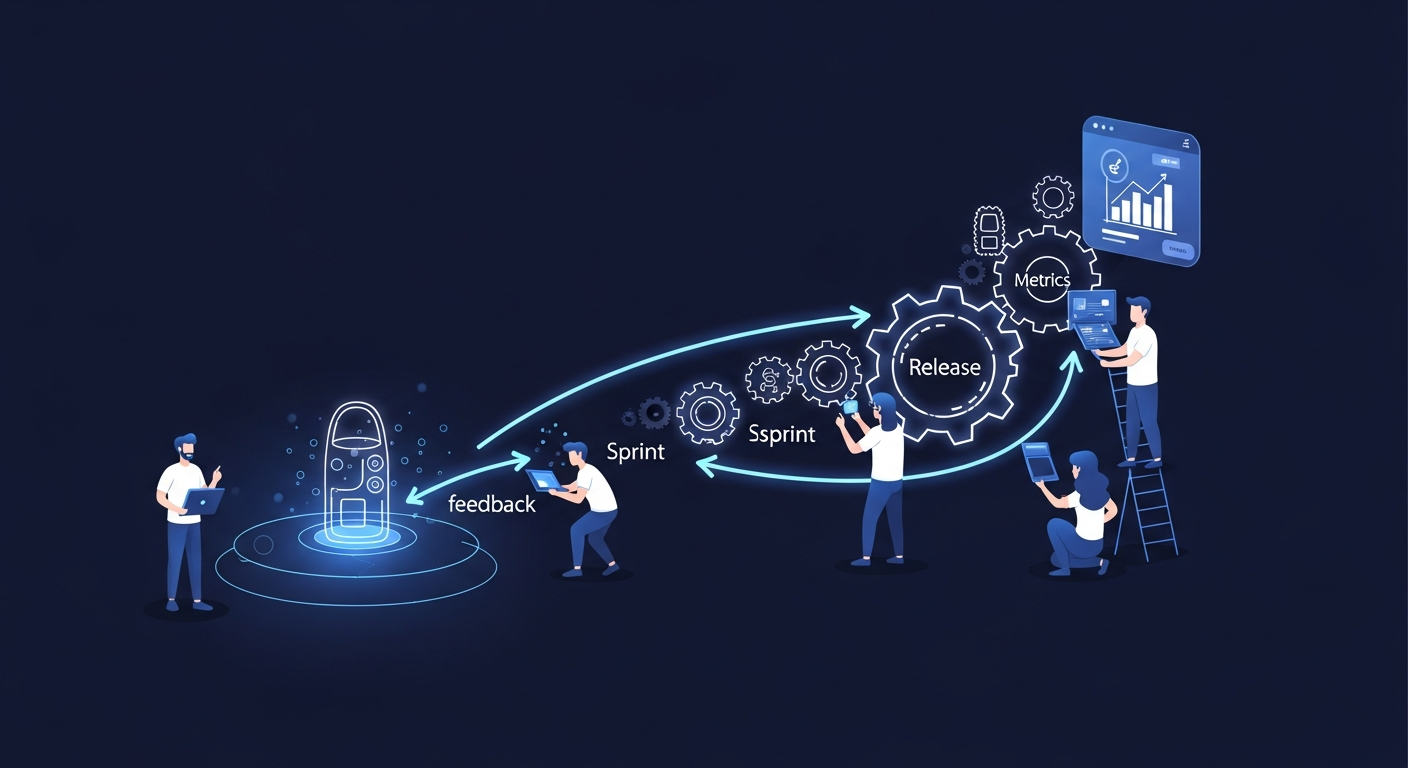
An Agile SDLC can be envisaged as a loop that allows teams to constantly design, build, measure, and learn. It doesn't refer to a single tool or a specific ritual but is rather a set of principles and practices that ensure the product stays in line with actual user needs.
Agile, at its heart, stands for short delivery cycles, close collaboration between product and engineering teams, and frequent customer feedback. Instead of doing a long release all at once, you release in small increments. Each increment confirms or rejects a hypothesis about your product or market. Some of the widely used agile methods are the following: breaking work into short iterations, keeping a prioritized backlog, continuous integration and testing, regular demos, and learning from metrics and user feedback. In other words, agile is about delivering the smallest thing that can teach you something meaningful.

Why Agile beats Waterfall for startups
Waterfall is a linear, phase based approach where you define requirements, design, build, test, and then release. It works well when requirements are stable and change is costly. But in startups, change is constant.
Compare the two in practical terms:
Speed. Agile gives you usable software faster. Waterfall often results in a long delivery window with little validated learning in between.
Risk. Agile reduces the risk of building the wrong thing by validating assumptions early. Waterfall increases that risk because feedback comes too late.
Cost. Agile helps you prioritize high impact work and stop building low value features. With waterfall you might spend a lot before discovering a product market mismatch.
So when people ask about agile vs waterfall for startups, my answer is almost always agile. There are rare exceptions, like regulatory projects where requirements are fixed. For most early stage products, agile is the right fit.
Key benefits of Agile development for startups
I could list a dozen advantages but these are the ones that matter most in practice.
Faster time to market. With short sprints you get a usable product into users hands quickly. That lets you start learning and generating traction.
Flexibility. You can pivot without throwing away months of work because each iteration delivers incremental value.
Lower cost of change. Small, frequent releases mean changes are cheaper and safer to implement.
Better alignment. Product, design and engineering stay connected through constant collaboration and shared goals.
Higher quality. Continuous integration and automated testing catch problems early, not at the end of a long cycle.
Faster feedback loops. You learn what matters from real users and can prioritize the work that moves metrics.
Those are not just buzzwords. In the last two startups I worked with, shipping weekly iterations meant we could test three pricing experiments and two onboarding flows in the time a waterfall project would have delivered one big release. That led to a measurable increase in conversion and a faster path to product market fit.
How to adopt an Agile SDLC methodology without overcomplicating things
Startups do not need heavy process. They need lightweight, repeatable practices that help the team move reliably. Here is a straightforward way to set up an agile product development flow that fits small teams.
1. Define outcomes, not features
Most groups decide to feature first. I, on the other hand, would rather think of the results first. What metric are you aiming to change? More signups, lower churn, faster onboarding. When you are focusing on results, a team can go for several solutions to test and then choose the one that is the most effective.
A quick example: instead of "build a referral widget" simply state "increase weekly invitations sent by 30 percent". Then it would be possible to try a referral widget, social login prompts, or even an email nudge to see what works.
2. Work in short iterations
Two week sprints suit most startups very well. They are long enough to achieve something substantial and short enough to be able to change a direction if necessary. If your team consists of only a few people, then perhaps one-week iterations would be feasible. The main thing is to make deliverables predictable and frequent.
At the beginning of each sprint, select a very small number of experiments which are in line with your outcomes. At the end, show what you have created, gather the feedback, and decide whether to continue, change direction, or disengage.
3. Keep a prioritized backlog
Your backlog is only a list of items to be done, sorted by their value. Always keep it visible and frequently review it. Prioritization should be a result of impact and cost. The formula I prefer is: Impact divided by Effort. That gives you a quick way to focus on high value, low effort experiments.
4. Use continuous integration and automated testing
Without automated builds and tests, every release will be a gamble. Install a CI pipeline on your first day. It doesn't have to be very good. A pipeline that runs tests, builds the app, and deploys to a staging environment is sufficient to save a lot of manual work and a few gray hairs.
Over time add automated smoke tests and a few regression checks. Those will catch the common mistakes before they reach users.
5. Deploy frequently
Frequent deployment reduces the size of each change and makes rollbacks easier. I recommend at least weekly deploys for early stage products and daily deploys for teams with mature automation.
Frequent deployments also help with learning. You can release an A B test or a small UX tweak and get metrics within days, not months.
6. Put product and engineering in one room
Collaboration beats handoffs. When product managers and engineers plan together, estimates are more realistic and the team builds the right thing. If physical co location is not possible, have daily standups and an always on chat channel for quick clarifications.
7. Make decisions with data
Put in place the tools needed to quantify the things that have the greatest impact. Monitor conversion funnels, engagement, retention, and error rates. Data serves as a basis for prioritization and diminishes disputes that are opinion-based.
8. Run lightweight retrospectives
After each sprint, reflect on: what was successful, what failed, and what shall we alter next? These meetings should be concise and focused on taking action. Select one or two changes and, in fact, going through with them.
Practical roles and responsibilities for a small startup team
Many startups try to copy enterprise role charts and end up with too many cooks. For early teams, keep roles flexible but clear.
Founder or Product Lead. Owns the vision and outcomes, prioritizes the backlog, talks to customers.
Tech Lead or CTO. Owns the architecture, helps break down work, and removes technical roadblocks.
Engineers. Deliver incremental value, automate tests, and keep the codebase healthy.
Designer. Rapidly prototypes UX, validates flows with users, and supports engineering with assets.
QA / Automation. In very small teams this role is shared. Aim for test automation as a team responsibility.
Everyone should be involved in prioritization conversations. That avoids surprises and creates shared ownership of outcomes.
Common pitfalls and how to avoid them
Agile can be misapplied. Here are mistakes I see startups make, plus quick fixes.
Pitfall: Ritual without purpose. Running daily standups and sprint planning with no real outcomes. Fix it by tying each meeting to a decision or a deliverable.
Pitfall: Over planning. Trying to predict six months of features. Fix it by planning just enough for the next two sprints and keeping a roadmap at the outcome level.
Pitfall: No measurement. Building features without tracking impact. Fix it by instrumenting key metrics before you ship.
Pitfall: Too many priorities. Each and every one is shouting their feature to be next. You can solve it by restricting the work that is in progress and by utilizing a clear prioritization rule such as Impact/Effort.
Pitfall: Neglecting technical debt. On the whole, shipping fast is amazing until your codebase becomes unstable. You solve it by setting aside a portion of each sprint to refactor and stabilize.
Pitfall: Mistaking speed for quality. Quicker releases have no value if they break. You solve it by putting money into automated testing and staging environments.
How to design an MVP using the agile SDLC methodology
MVPs are not minimal features. They are minimal experiments that prove a hypothesis. Start by defining the hypothesis, then design the smallest thing that can validate it.
Step by step:
Write the hypothesis. Example: "If we reduce sign up steps to two screens, conversion will increase by 20 percent."
List the assumptions required to prove the hypothesis.
First, test the riskiest assumption with the smallest possible experiment.
Carry out the work in one or two sprints at most and use simple telemetry.
Record the outcomes and then decide whether to repeat the experiment or try a different approach.
Always keep the size of work to be done small and measurable. A six-month MVP makes no sense.
Try to come up with something that can be done in a couple of weeks.
Metrics that matter for startups
Not every metric helps make decisions. Focus on a small set of metrics tied to your current stage.
Acquisition. How many new users arrive and through which channels?
Activation. Do users complete the first meaningful action?
Retention. Do users come back after the first visit?
Revenue. If you have monetization, how much are users willing to pay?
Quality. Error rates, crash frequency and performance.
Pick one north star metric and two supporting metrics. Keep dashboards simple and check them weekly with the team.
Scaling Agile as your startup grows
Agile practices must evolve as the team grows. What works for a 5 person team will be strained at 50. Here are practical steps to scale without losing agility.
Organize around outcomes. Create small cross functional squads focused on a specific metric or area of the product.
Keep communication channels clear. Use lightweight documentation and regular demos to share learnings across teams.
Invest in platform engineering. A team dedicated to developer experience, CI pipelines and common services speeds up feature teams.
Governance, not control. Set rules for architecture and security, but avoid micromanaging how teams deliver.
Standardize tooling. Shared tools for CI, monitoring and deployments reduce cognitive overhead and onboarding time.
Scaling is not about process complexity. It is about creating predictable teams that can move independently while still aligning to business goals.
Agami Technologies: an experienced Agile partner for startups
As someone who has partnered with small product teams, I have found that the right external partner is often a force multiplier. At Agami Technologies we focus on pragmatic agile product development. We do not sell boxes of process. We help teams set up the right agile SDLC methodology, build an MVP, and implement the engineering practices that keep delivery predictable.
Here is how we typically work with startups:
Discovery sprint to align on outcomes and risks.
Roadmap that prioritizes experiments over features.
Two week delivery cycles with demos and measurable objectives.
Continuous integration and staged deployments to reduce release risk.
Tracking and analytics setup to validate hypotheses quickly.
We have helped teams go from idea to first paying customers in a few months by keeping the build lean, focusing on measurable impact, and iterating fast. If you want hands on support to implement an agile SDLC methodology without the corporate baggage, there is a practical path forward.
Case example: a realistic startup scenario
Let me share a simplified example that I have seen multiple times. Imagine a B2B marketplace startup that needs to validate supplier onboarding and buyer conversion simultaneously. The founders have a wishlist of features, but no data.
We start with two outcomes: increase supplier listings by 50 percent in three months and improve buyer trial conversion by 15 percent in the same time window. With those targets, the team runs focused sprints.
Week 1 to 2: Build a simplified supplier onboarding flow and instrument the sign up funnel. Release to a small pilot group.
Week 3 to 4: Run an activation experiment for buyers with a guided tour. Measure conversion.
Week 5: Compare results. The supplier flow yielded a 40 percent increase but buyer conversion stayed flat. Time to pivot buyer experiment instead of building more marketplace features.
Because each change was small and measurable, the team was able to learn quickly and allocate engineering time where it mattered. They did not waste six months building an all singing, all dancing product that nobody used.
Tools and practices I recommend
You do not need enterprise tooling to be effective.
These are some of the practical ways that I have employed in the early stage teams:
Backlog and sprint tracking: Jira or Trello for very small teams. Keep boards clean.
CI/CD: GitHub Actions, GitLab CI, or CircleCI—just choose one and make sure that your builds and tests are automated.
Feature flags: LaunchDarkly or an open source alternative to control the rollout and run the experiment in a safe way.
Monitoring and analytics: Sentry for errors, Google Analytics or Mixpanel for product metrics, Prometheus for infrastructure.
Collaboration: Slack for async comms and a shared Confluence or Notion for lightweight docs.
Tooling is a multiplier. Choose tools that reduce friction, not add process overhead.
Quick checklist to move from idea to an Agile SDLC
Use this checklist as a starter pack. It takes you from noisy idea to a working loop of build, measure and learn.
Define one clear outcome you want to improve in the next 30 days.
Break the work into sprint sized experiments. Aim for one to two week cycles.
Set up a basic CI pipeline with automated builds and tests.
Instrument the key metric before you ship.
Run the experiment, collect data, demo results to the team.
Decide to persevere, pivot, or kill the experiment based on data.
Document the decision and the assumptions you tested.
Final thoughts and common questions
People often ask: can I be Agile without a formal Scrum certification? Absolutely. Agile is more about mindset than ceremonies. I have seen teams adopt only three things and get impressive results: prioritize ruthlessly, ship small increments, and measure impact. Those three habits will change how your startup learns and moves.
Another frequent question: how much technical debt is acceptable? My rule of thumb is this. If technical debt slows down feature delivery and increases bugs, it is too high. Reserve at least 10 to 20 percent of engineering time for maintenance and refactor until you regain speed.
Finally, what about non technical founders who feel out of their depth? Learn the language of outcomes and metrics. You do not need to know how to write code, but you should be able to ask: what are we testing this sprint and how will we measure success? That will make your conversations with engineers far more productive.
Conclusion
Adopting an agile SDLC methodology is not a silver bullet, but for startups it is the best framework I know for learning fast and preserving runway. It turns product development into a disciplined experiment that reduces risk and increases speed. When you focus on outcomes, ship small increments, and measure like crazy, you build products that solve real problems.
If you want help putting this into practice, Agami Technologies focuses on pragmatic agile product development for startups. We help teams set up an agile software development life cycle, build MVPs that test critical assumptions, and create the engineering practices that keep delivery reliable.