
Microservices vs Monolith: What Enterprises Should Choose Today
In today’s digital landscape, enterprise software architects face a crucial decision: should new applications be built as a monolith or using a microservices architecture? Both approaches have distinct strengths and trade-offs, and the right choice depends on business needs, team capabilities, long-term goals, and the desired pace of innovation.
A monolithic architecture is a traditional design where all application components are packaged and deployed as a single unit. This simplifies development, testing, and deployment because there is one codebase and one runtime environment. For early-stage products or organizations with smaller engineering teams, monoliths offer speed of delivery and straightforward operational practices. They reduce overhead in deployment and are often easier to debug and manage as a single system. However, as complexity grows, monoliths can limit scalability, slow down release cycles, and make it difficult to adopt new technologies because changes to one part of the system affect the whole application.
In contrast, microservices architecture structures an application as a suite of independently deployable services. Each service encapsulates a specific business capability and can be developed, scaled, updated, and deployed on its own. This decoupling enhances flexibility, enables autonomous teams to work in parallel, and supports cloud-native scalability and resilience—features that modern enterprises targeting rapid innovation and global delivery often require. It also aligns well with practices like DevOps and continuous delivery, which support faster iteration based on real user feedback. However, microservices introduce operational complexity, necessitating advanced infrastructure automation, robust monitoring, and mature team practices to handle distributed communication, data consistency, and service orchestration.
Microservices vs Monolith: What Enterprises Should Choose Today
Picking the right architecture is one of the biggest decisions an enterprise CTO or CIO will make. It affects release cadence, operational costs, hiring, compliance, and ultimately how fast the business can respond to change. I've seen teams rush into microservices because it's trendy. I’ve also watched companies stay stuck in fragile monoliths long after those systems started slowing innovation. Both extremes carry real risks.
This post breaks down monolithic architecture and microservices architecture in a pragmatic way for enterprise decision-makers. I'll explain the trade-offs, common pitfalls, migration strategies, and the operational requirements that determine success. You'll get a practical decision framework to help you choose the right path for your organization, not just what sounds modern.
Why this matters to your company
Architectural choices ripple through product strategy, enterprise software development budgets, and cloud spend. The wrong choice can increase time-to-market, create security gaps, and make regulatory compliance painful. The right choice can unlock rapid scaling, reduce risk, and enable continuous delivery.
In my experience, the question isn't simply "monolith or microservices?" It's "what outcome do we need faster feature delivery, lower operational cost, easier scaling, stronger resilience and which architecture helps us achieve that with acceptable risk?"
Quick definitions
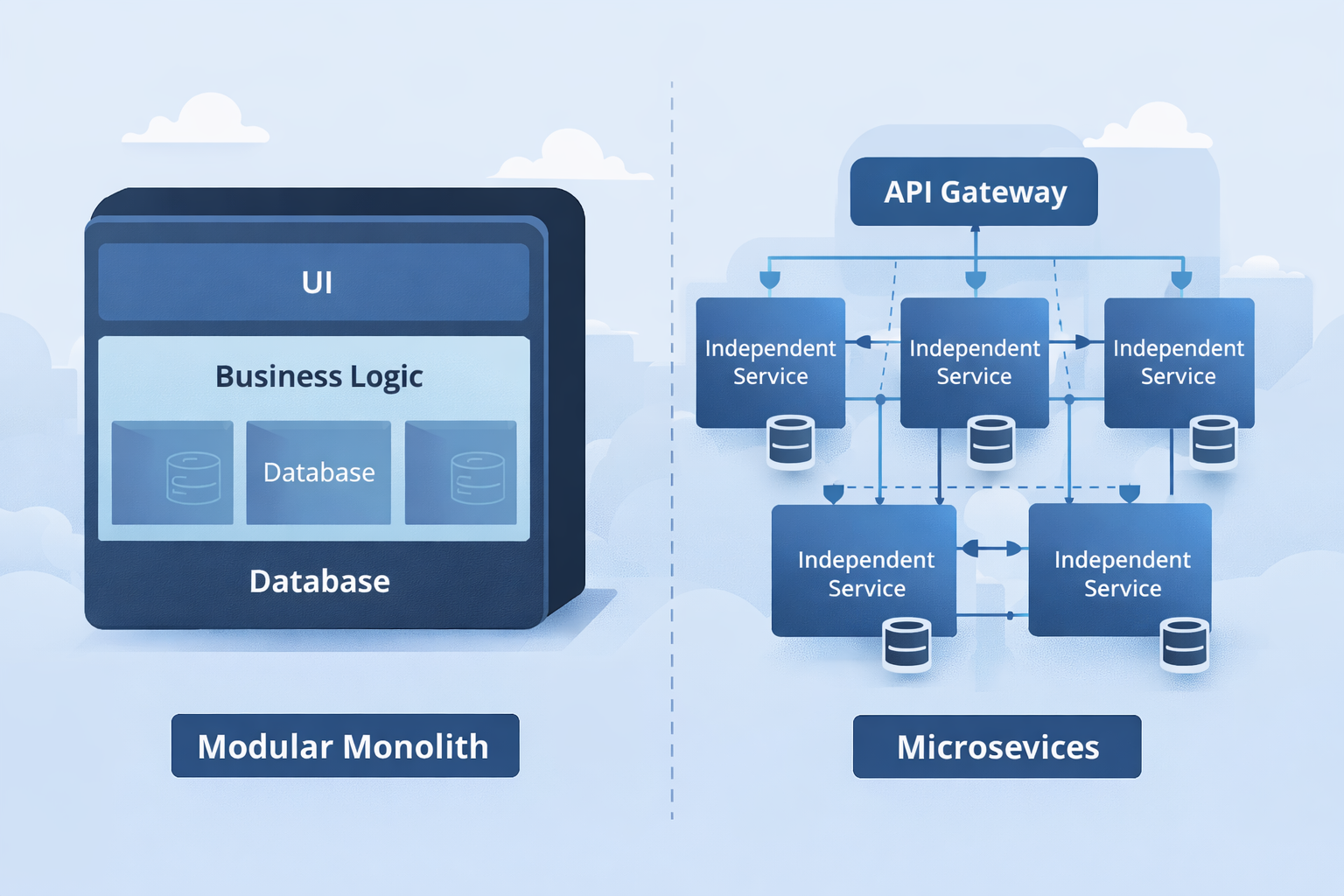
- Monolithic architecture: A single deployable unit where UI, business logic, and data access layers are packaged and deployed together. It's often easier to develop and test at first, but can become a bottleneck as teams and features scale.
- Microservices architecture: An approach that splits functionality into small, independently deployable services. Each service owns its data and usually communicates over network APIsThis supports scalable applications and distributed systems, but introduces operational complexity.
The modern nuance: modular monoliths and hybrid patterns
Before we go on, note that "monolith" doesn't have to mean spaghetti code. A modular monolith with clear module boundaries and good internal APIs can deliver most early benefits without the distributed complexity of microservices.
And you can run a hybrid: a core modular monolith for stable, performance-sensitive areas and microservices for new, fast-moving features. That's a pattern I recommend a lot it's pragmatic and less risky for many enterprises.
Monolithic architecture: strengths and when to choose it
Monoliths shine for teams that need simplicity and speed during early product-market fit. Here are the advantages I see most often:
- Simpler development and testing: One codebase, one deployable. Unit testing, integration testing, and local dev are easier to orchestrate.
- Lower operational overhead: No distributed tracing, service discovery, or complex CI pipelines required—at least not initially.
- Performance predictability: In-process calls are faster and easier to optimize than network calls between services.
- Easier hiring and onboarding: Developers can be productive faster because they only need to understand one stack and deployment model.
When to pick a monolith
- You're in early product-market fit and need to iterate fast.
- You want to constrain early engineering costs and complexity.
- Your domain isn't large or complex enough to require independent scaling by component.
- Your team prefers focusing on features instead of platform ops or distributed systems.
Common monolith pitfalls
- Codebase grows monolithic and hard to change—deploy risk increases.
- Cross-team coordination becomes painful as many teams touch the same code.
- Scaling becomes blunt: you scale the whole application when only one piece needs resources.
I've noticed that many enterprises treat a monolith as a permanent state rather than a sensible starting point. That mistake makes later migrations harder.
Microservices architecture: strengths and when to choose it
Microservices architecture enables decoupling and independent scaling. But it's not a free lunch. You trade internal simplicity for operational complexity. Still, when used correctly, microservices let organizations scale teams, velocity, and resiliency in ways monoliths struggle to match.
- Independent deploys: Teams can release services without coordinating large, risky monolith deployments.
- Technology freedom: Each service can use the right tech stack for the problem (within sensible governance).
- Resilience and fault isolation: Failures can be contained to a small service instead of taking down the whole app.
- Fine-grained scaling: Scale only the services that need more resources, improving cost-efficiency for many workloads.
When microservices are the right choice
- Your system needs to scale horizontally with independent load characteristics across areas (e.g., billing vs. catalog).
- You have multiple, autonomous teams that need to iterate quickly without blocking each other.
- You operate in a complex domain where bounded contexts (from domain-driven design) map naturally to services.
- You're ready to invest in DevOps, observability, and platform engineering.
Common microservices pitfalls
- Poorly defined service boundaries cause chatty APIs and distributed coupling.
- Lack of platform capabilities leads to skyrocketing operational burden.
- Testing becomes brittle without contract tests and environment parity.
- Data consistency issues surface; eventual consistency patterns are hard to get right.
I've helped teams where microservices were introduced without attention to API design or governance—those projects quickly turned into "distributed monoliths." That's a trap to avoid.
Key technical trade-offs
Here are the technical areas you should evaluate explicitly, not just high-level pros and cons.
- Data ownership: Microservices favor decentralized data; monoliths usually centralize it. If you split data, you'll need to design for eventual consistency (sagas, compensation patterns).
- Deployment and CI/CD: Microservices require more sophisticated pipelines, versioning, and rollback strategies. Monoliths can get by with simpler CI/CD at first.
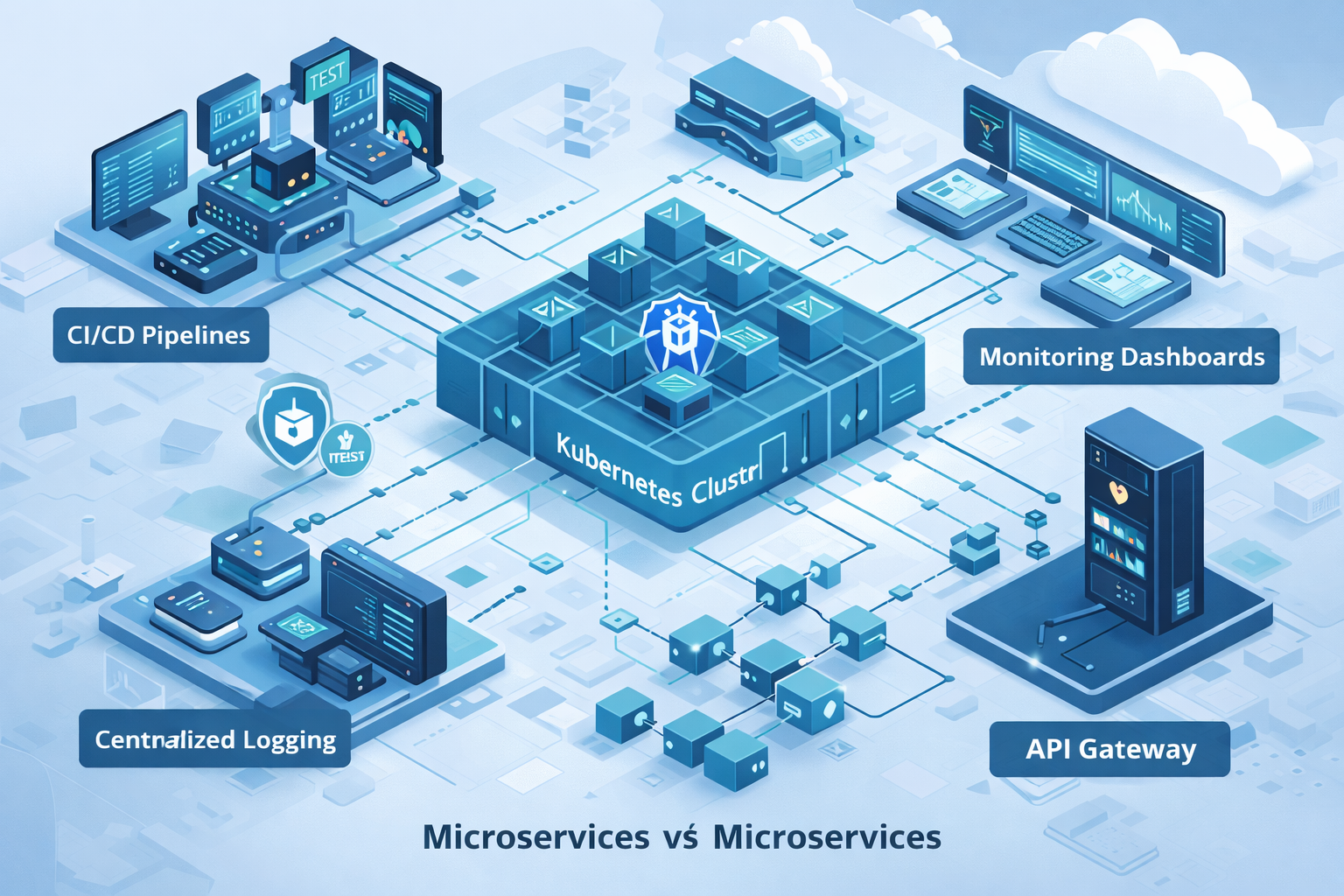
- Observability: Distributed tracing, centralized logging, and metrics are essential for microservices. Without them, troubleshooting becomes a nightmare.
- Security and compliance: Microservices increase the attack surface. You need service-to-service auth (mTLS), secrets management, and strict IAM—especially for regulated industries.
- Network overhead: Network calls are slower and less reliable than in-process calls. Design APIs and caching carefully.
Organizational considerations
The architecture you choose affects people, processes, and hiring. I often tell leaders: architecture is as much organizational as it is technical.
- Team structure: Conway’s Law matters. If your org is siloed, microservices can reinforce silos unless you explicitly design cross-functional, product-aligned teams.
- Platform capabilities: You need a platform team that can provide reusable infrastructure: CI/CD, observability stacks, service discovery, and deployment templates.
- Skill set: Microservices require SRE, DevOps, and distributed systems expertise. Hiring and training take time and money.
- Governance: You still need standards for APIs, security, and data. Microservices without governance devolve into chaos.
Making the organizational case is often the hardest part. I've seen technically sound architectures fail because leadership didn't invest in the platform or people.
Common migration strategies
Most enterprises start with a monolith and later decide to move parts to microservices. Below are practical strategies I've used or recommended.
1. Strangler Fig / Incremental extraction
Move functionality out of the monolith piece-by-piece. You route traffic to new services while keeping the old system running. This reduces risk and lets teams learn gradually.
Typical steps:
- Identify a bounded context or low-risk feature to extract (e.g., user profiles).
- Implement the service and add an adapter in the monolith to route calls.
- Gradually move read/write responsibilities and cut the old code.
Why it works: you avoid a big-bang rewrite and can deliver visible wins early.
2. Greenfield for new capabilities
Build new features as microservices, leaving the monolith intact. Over time, adopt microservices where they bring real benefits.
This is especially useful if you need new scalability or different compliance boundaries.
3. Split by traffic or scale needs
If one area of the monolith consumes most resources (e.g., search), extract it to microservices for independent scaling. This provides cost savings and performance improvements.
4. Modular monolith first
Before jumping to a distributed system, refactor the monolith into well-defined modules with internal APIs. You can extract modules to services later, substantially reducing migration pain.
Decision framework: questions to ask
Here’s a checklist to help decide which architecture is right for you. Answer these honestly with your leadership and engineering teams.
- What business outcomes are we after? Faster releases, better scalability, or lower cost?
- Do we have multiple teams that need independence or one central team owning the product?
- Are there components that require independent scaling or different security/compliance controls?
- Do we have platform engineering capabilities or are we ready to build them?
- What's our tolerance for operational complexity and run-rate cost?
- Is there a clear bounded context that maps to a service boundary?
If most answers point to speed and low ops cost now, a modular monolith is a strong bet. If answers point to independent scaling, multiple autonomous teams, and long-term platform investment, microservices may be worth the upfront cost.
Operational requirements for successful microservices
Microservices demand a mature operational posture. Plan for these capabilities before committing:
- CI/CD pipelines with automated testing, blue/green or canary deployments, and reliable rollbacks.
- Observability: distributed tracing (Jaeger/Zipkin), metrics (Prometheus), centralized logs (ELK/Opensearch), and alerting.
- Service mesh and API gateway to enforce routing, rate limiting, retries, and observability.
- Platform automation using IaC (Terraform/CloudFormation) and automated cluster management (Kubernetes/EKS/AKS/GKE).
- Security and governance: mTLS, OIDC, secrets management (Vault), RBAC, and compliance controls.
- Contract testing and consumer-driven contract tools (Pact) to avoid integration regressions.
Without these, operational costs and incidents will spike. That’s the difference between a successful distributed systems rollout and a year of toil and firefighting.
Costs: development vs operational run-rate
Many enterprises focus on engineering headcount when choosing an architecture. But you should look at total cost of ownership (TCO): development, infrastructure, and operational staffing.
- Monoliths often have lower short-term TCO—fewer infra resources and simpler ops.
- Microservices can increase infrastructure cost (more instances, more networking, more logging/metrics) and require SRE/Platform engineers.
- Over time, microservices can reduce cost by enabling targeted scaling and faster time-to-market—but that depends on good design and platform automation.
Do the math. I recommend building a conservative TCO model covering three years and factoring in hiring, cloud spend, and platform investments.
Security and compliance considerations
Security often dictates architecture choices for regulated enterprises. Microservices increase surface area but also allow better isolation if done right.
- Network segmentation: Microservices enable finer network controls, but you need mTLS and strict ingress/egress policies.
- Data residency: Services can isolate sensitive data to meet compliance (PCI, HIPAA), rather than spreading it across a monolith.
- Auditability: Centralized logging and immutable audit trails are essential. A microservices setup must make audits easier, not harder.
Common mistakes include not planning for secrets management or assuming perimeter security is enough in a distributed system. Zero trust principles and defense-in-depth are non-negotiable.
Testing strategies
Testing changes significantly when you move to microservices. Here's how to stay confident:
- Unit tests remain important for individual services.
- Integration tests should validate service contracts and common platform glue.
- Contract tests (consumer-driven) protect service boundaries.
- End-to-end tests should be limited; rely more on contract and integration tests for speed.
- Chaos and resilience testing help verify graceful degradation and fallbacks.
Testing is an area where teams often skimp, then pay dearly in production incidents. Invest early in automated tests and pipeline gating.
Patterns and technical best practices
Here are patterns that reduce migration risk and improve long-term outcomes.
- Bounded contexts: Use domain-driven design to identify service boundaries that align with business capabilities.
- API-first design: Design APIs with clear contracts, versioning strategy, and backward compatibility.
- Strangler pattern: Extract functionality incrementally from the monolith.
- Event-driven communication: Use async messaging and events for decoupling, but plan for ordering and idempotency.
- Saga pattern: Manage distributed transactions where strong consistency isn't feasible.
- Platform as a product: Treat platform services (CI, observability, deployment) as a product with SLAs and UX for developer productivity.
Follow these and you lessen the likelihood of dumping operational debt into production.
Real-world case examples (anonymized)
Example 1: An e-commerce enterprise with seasonal traffic
They started as a monolith. During peak sales the payment and search subsystems were the bottlenecks. We extracted search as a microservice and introduced caching and autoscaling. Result: lower cloud costs during non-peak months and better user experience during high traffic.
Example 2: A regulated healthcare platform
Regulatory constraints forced isolation of certain patient-data workflows. A hybrid approach worked best: core workflows stayed in a modular monolith while patient-data processing became microservices with dedicated compliance controls and enhanced logging. This limited the compliance scope and reduced audit complexity.
Example 3: A fintech rapid-iteration use case
The company needed multiple teams to innovate rapidly. After investing in platform engineering (CI/CD, service mesh, automated compliance checks), microservices enabled independent teams to ship safely. However, it took 12–18 months of platform investment before teams achieved the velocity gains they expected.
Common mistakes and how to avoid them
Here are mistakes I've seen repeatedly—and the fixes that work.
- Mistake: Moving to microservices without a platform. Fix: Build the platform first (or accept slower velocity until it exists).
- Mistake: Poorly defined service boundaries. Fix: Use domain-driven design and start with small, well-bounded services.
- Mistake: Treating microservices as an excuse for loose governance. Fix: Define API standards, security policies, and SDKs that reduce duplication.
- Mistake: Rewriting the entire system. Fix: Use incremental migration patterns like the strangler fig.
- Mistake: Neglecting observability and testing. Fix: Invest early in distributed tracing, logs, metrics, and contract tests.
Checklist for a successful architecture decision
Use this checklist to align stakeholders and reduce second-guessing:
- Define business outcomes and timelines.
- Identify bounded contexts and scalability hotspots.
- Assess platform readiness and required investments.
- Estimate total cost of ownership for three years.
- Plan a phased migration strategy (if moving away from a monolith).
- Define security, compliance, and audit requirements up front.
- Commit to observability, contract testing, and resilience testing.
- Set up governance and platform SLAs for teams.
How Agami Technologies can help
At Agami Technologies, we help enterprise teams evaluate and execute architecture strategies that match their business goals. We’ve led projects that moved monolithic applications to scalable microservices architecture, modernized monoliths into modular systems, and built cloud-native platforms that support continuous delivery.
Ready to modernize your architecture? Our enterprise software development services help enterprises design scalable, secure, and future-ready systems.
We bring practical experience in:
- Designing scalable applications and distributed systems
- Implementing DevOps strategy and platform engineering
- Cloud-native development and infrastructure automation
- Software modernization and digital transformation services
- Compliance-focused architectures for regulated industries
If you're weighing the trade-offs between a monolithic architecture and microservices architecture, we can provide an independent assessment, a migration roadmap, or help implement the platform capabilities you need.
Decision scenarios and recommended approaches
To summarize practical recommendations by scenario:
- Early-stage product, single team: Start with a modular monolith. Focus on product/market fit before investing in distributed systems.
- Large product with independent teams: Consider microservices if you also invest in platform engineering and observability.
- High-scale, variable traffic (e.g., retail, streaming): Microservices (or at least service extraction for hot paths) will pay off over time.
- Regulated industries: Hybrid approach—keep core compliance-sensitive flows isolated and extract other services as needed.
- Legacy monolith with high technical debt: Refactor into a modular monolith first, then selectively extract using the strangler pattern.
Implementation timeline and milestones
Here’s a realistic, high-level timeline for an enterprise moving from monolith to microservices over 12–24 months. Adjust based on team size and risk tolerance.
- Month 0–3: Assessment and planning. Identify bounded contexts, TCO, and pilot use case.
- Month 3–6: Platform and tooling setup. CI/CD, observability, secrets management, and baseline automation.
- Month 6–12: Pilot extraction. Implement first microservice and validate patterns (deploy, monitor, test).
- Month 12–18: Scale the pattern across a few more services. Harden governance and developer experience.
- Month 18–24+: Ongoing migration and optimization. Continue automating, cost-tuning, and improving resilience.
Expect to allocate 20–40% of initial effort to platform work before you see velocity gains from independent service teams.
Final thoughts
Monolithic architecture and microservices architecture each have their place. There's no one-size-fits-all answer. The right choice depends on your business goals, team structure, regulatory needs, and your willingness to invest in platform capabilities.
Start with clear business outcomes. Use pragmatic patterns (modular monoliths, strangler fig) to reduce risk. Invest in platform, observability, and testing early. And above all, align architecture decisions with organizational readiness.
If you take anything away from this article, let it be this: architecture is a tool to deliver business outcomes, not an end in itself. Choose the path that helps your teams deliver value predictably and securely.
Helpful Links & Next Steps
Talk to Our Software Architecture Experts
If you’re evaluating microservices vs monolith for your enterprise, we can help you map risk to outcome and build a practical roadmap. Schedule a one-on-one conversation with our software architecture team: