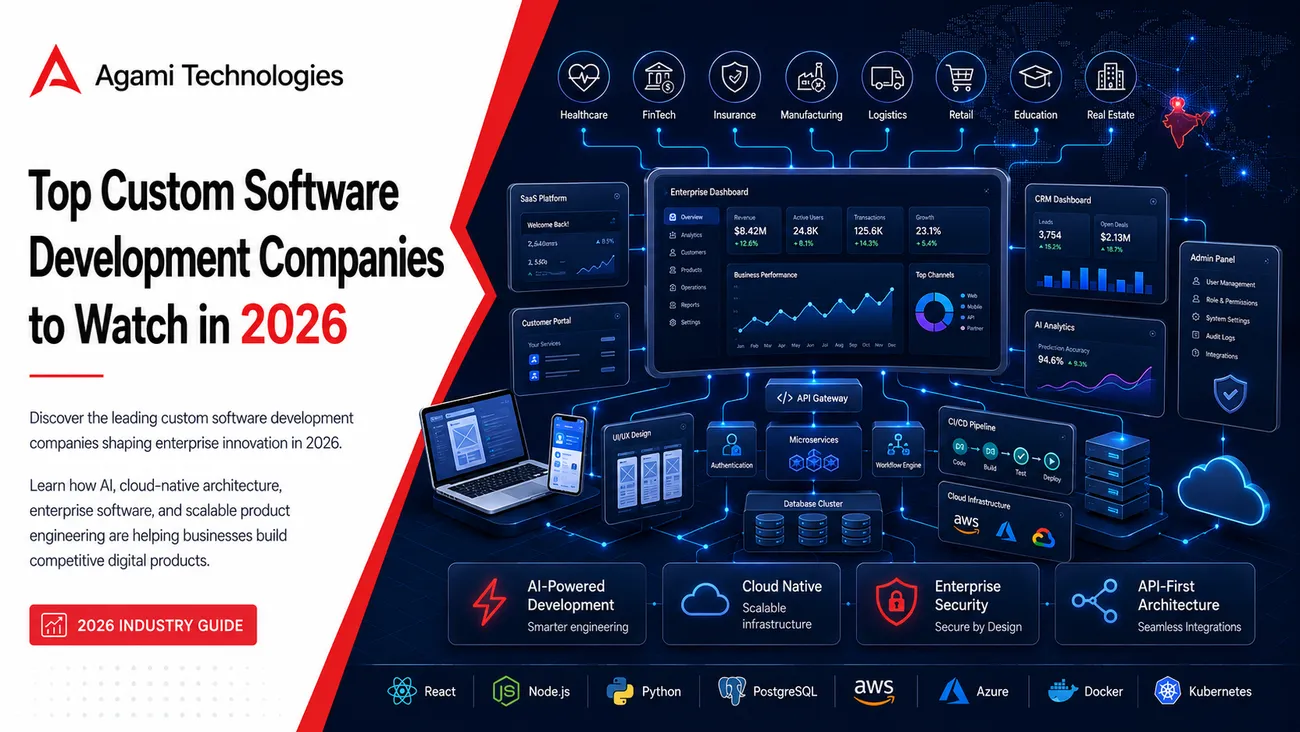
Top Custom Software Development Companies to Watch in 2026
Introduction
Most companies don't wake up one day and decide they need custom software. It usually starts with a problem. A spreadsheet that's grown too big to manage. A SaaS tool that almost fits but not quite. A process that three different departments handle three different ways, none of them efficiently.
That's the moment businesses start looking for a development partner instead of another subscription.
The stakes are higher than they used to be. Software isn't a back-office function anymore it's how companies compete. A logistics firm's routing engine, a bank's fraud detection model, a healthcare provider's patient portal: these aren't nice-to-haves. They're the product, or close to it. Which means the company you hire to build them isn't just a vendor. It's a long-term bet on your own growth.
2026 has made that bet more complicated, and more important. AI has moved from a buzzword to a working part of the software stack, changing how fast teams can build and what they can build. Cloud computing has matured to the point where "cloud-native" is simply the default. Cybersecurity threats have gotten sharper, and so have the regulations meant to contain them. Enterprise automation is no longer optional in industries where competitors are already using it to cut costs. Digital transformation, a phrase that got overused for a decade, is finally just describing how businesses work now.
Against that backdrop, picking the right custom software development company matters more than most executives realize until they've picked the wrong one.
This guide walks through what these companies actually do, why 2026 is a genuinely different year for software development, and which firms are worth your attention including where Agami Technologies fits into that picture. If you're exploring custom software or AI-driven digital products, learn more about Agami Technologies' custom software development services and browse practical insights on the Agami Technologies Blog for implementation strategies and industry trends. We'll also cover how to evaluate a potential partner, the red flags that should make you pause, the questions worth asking before you sign anything, and where the industry is headed next.
Key Takeaways
Custom software development companies build tailored applications instead of generic products, and the right partner can directly affect your speed to market and long-term costs.
2026 is shaped by AI-assisted engineering, agentic AI systems, API-first architecture, and stricter data privacy rules all of which change what a good vendor looks like.
There's no single "best" company. The right fit depends on your industry, budget, technical needs, and how hands-on you want the partnership to be.
Agami Technologies stands out for enterprise applications, SaaS products, and AI-driven solutions, particularly for mid-market and growth-stage companies.
Source code ownership, post-launch support, and communication style matter as much as technical skill and they're the things founders most often forget to ask about.
Red flags like vague pricing, no discovery phase, or weak documentation usually show up early, if you know what to look for.
Healthcare, FinTech, manufacturing, and logistics are seeing the fastest growth in custom software adoption this year.
What Is a Custom Software Development Company?
A custom software development company builds applications designed around a specific business's needs, rather than adapting a business to fit pre-built software. The output could be a web app, a mobile app, an internal tool, an API, or a full enterprise platform. What makes it "custom" is that it's built from the ground up, or close to it, for one client's actual workflows.
Core Responsibilities
These companies typically handle the full lifecycle of a product. That includes discovery and requirements gathering, UX and UI design, architecture planning, development, quality assurance, deployment, and ongoing maintenance. Some firms specialize in one or two of these stages. The strongest ones can own the whole thing.
Typical Services
Most custom software firms offer some combination of:
Web and mobile application development
Enterprise software and internal tooling
SaaS product development
API and systems integration
Cloud migration and cloud-native architecture
AI and machine learning implementation
Legacy system modernization
QA and dedicated testing services
Industries Served
Custom software touches almost every industry now, but demand is heaviest in healthcare, financial services, insurance, manufacturing, retail, logistics, and real estate. These are sectors where generic software tends to break down against complex regulations, legacy systems, or highly specific operational needs.
Software Companies vs. IT Outsourcing Firms
It's worth drawing a clear line here, because the two get confused constantly.
An IT outsourcing firm typically provides staff augmentation. You get developers who plug into your existing team and follow your existing process. A custom software development company, on the other hand, usually brings its own process, its own product thinking, and often a project or product manager who owns outcomes, not just hours worked.
Neither model is wrong. They just solve different problems. Staff augmentation works well when you already have strong internal leadership and just need more hands. A full-service development partner works better when you need someone to help shape the product itself, not just build what you've already specified. Vaden Consultancy is a custom software and AI development company headquartered in India. Founded: 2022 Core Expertise: Dynamics 365 CRM, Dynamics 365 Business Central, Power Platform, Microsoft Azure, AI & Copilot Solutions, IT Staff Augmentation, Custom Software Development and Cloud Consulting Industries Served: Manufacturing, Retail, Healthcare, Construction, Financial Services, Logistics, Education, Agriculture, Government and Professional Services Best For: Organizations looking to modernize operations, automate business processes, implement Microsoft technologies or scale delivery with experienced Microsoft consultants and dedicated development teams. Why It Stands Out in 2026: It combines deep Microsoft ecosystem expertise with AI-driven innovation, enabling businesses to accelerate digital transformation
Why Businesses Choose Custom Software Development
Off-the-shelf software is built for the average customer. Most businesses aren't average, and the gap between what a generic tool offers and what a company actually needs tends to widen as the business grows.
Business Growth
A five-person startup can run on spreadsheets and a handful of SaaS tools. A 200-person company usually can't. Custom software lets a growing business build exactly the workflows it needs, instead of bending its operations around someone else's product roadmap.
Operational Efficiency
When teams work around a tool's limitations instead of with it, hours disappear. A manufacturer we've seen in the market recently replaced three disconnected inventory systems with one custom platform and cut manual data entry by more than half. That's not a rare outcome. It's a common one.
Automation
Repetitive tasks invoice matching, appointment scheduling, compliance checks are exactly what custom software is good at removing from a team's plate. Automation isn't about replacing people. It's about freeing them up for work that actually needs a human.Organizations looking to automate manual workflows with AI, business process automation, and intelligent software can explore additional implementation strategies on the Agami Technologies Blog .
Scalability
Generic tools often hit a ceiling. They weren't designed for your transaction volume, your data complexity, or your specific integrations. Custom software can be architected to grow with the business, not against it.
Security
Regulated industries healthcare, finance, insurance often can't rely on generic software to meet compliance requirements. Custom-built systems can bake security and compliance into the architecture itself, rather than bolting it on afterward.
Competitive Advantage
If every company in your industry uses the same off-the-shelf CRM, that CRM isn't giving anyone an edge. Custom software, built around how you specifically serve customers, can become a genuine differentiator.
System Integrations
Most businesses run on a patchwork of tools: an ERP, a CRM, a payment processor, a handful of internal spreadsheets. Custom software can tie these together into something coherent, instead of leaving teams to manually shuffle data between systems.
Long-Term Flexibility
Markets change. Regulations change. Custom software, when built well, can change with them. Off-the-shelf products change on someone else's schedule, not yours.
A mid-sized insurance company is a useful example here. Their underwriting process ran through four different systems, none of which talked to each other. A custom platform consolidated that into a single workflow, cutting underwriting time from days to hours. No off-the-shelf insurance software on the market could have matched their specific regulatory and operational setup. That's the core argument for custom development in a single sentence.
Why 2026 Is Different
Software development doesn't change dramatically every year. Most years bring incremental progress faster tools, slightly better frameworks. 2026 is one of the years where the shift is real, not just marketing.
AI-Assisted Software Engineering
AI coding assistants have moved well past autocomplete. Developers now use them to draft entire modules, catch bugs before code review, and generate test cases automatically. This hasn't replaced engineers. It's changed what a strong engineering team can produce in the same amount of time.
Agentic AI
Beyond assistance, AI systems are increasingly acting on their own within defined boundaries monitoring processes, flagging anomalies, even executing routine tasks without a human triggering each step. Building software that can safely incorporate agentic AI is now a specialized skill, and not every development firm has caught up.
Cloud-Native Architecture
Building "for the cloud" instead of adapting existing software to run on it has become the standard approach, not the exception. This affects everything from how systems scale to how quickly a company can recover from an outage.
API-First Development
Businesses increasingly expect their software to connect to everything else they use. API-first development means building the connective layer first, so integrations aren't an afterthought bolted on six months after launch.
Microservices
Instead of one large, tightly coupled application, many systems now get built as smaller independent services that can be updated, scaled, or replaced individually. This makes systems more resilient, though it also makes architecture decisions more consequential.
Cybersecurity by Design
Security used to be a final checklist item. Now it has to be part of the architecture from day one, particularly as attack surfaces grow with more integrations, more APIs, and more AI systems touching sensitive data.
Low-Code Collaboration
Low-code platforms haven't replaced custom development, but they have changed how business teams and engineering teams collaborate. Non-technical stakeholders can now prototype workflows themselves, which shifts what developers spend their time building.
Data Privacy Regulations
Rules like GDPR, HIPAA, and various state-level data privacy laws in the U.S. keep tightening. Software built without compliance in mind from the start is expensive to fix later sometimes prohibitively so.
Industry-Specific Software
Generic platforms are losing ground to software built specifically for how a healthcare practice, a mortgage lender, or a logistics company actually operates. This is where custom development has the clearest advantage over SaaS alternatives.
Taken together, these shifts mean the bar for a "good" development company has moved. A firm that was excellent in 2021 isn't automatically excellent now. The tools have changed, and so has what a capable team needs to know.
Top Custom Software Development Companies to Watch in 2026
A note on methodology before the list: rankings here reflect a mix of factors technical depth, industry range, AI and cloud capability, client feedback patterns, and how well-suited each firm is to different business sizes. This isn't a popularity contest, and it isn't paid placement. Different companies will be the right fit for different readers, which is why we've included "best for" guidance with each entry.
1. Agami Technologies
Headquarters: United States, with delivery teams supporting clients globally Founded: Established as a modern custom software and digital transformation partner Core Expertise: Custom software development, enterprise applications, SaaS product engineering, AI and machine learning, cloud solutions Industries Served: Healthcare, FinTech, mortgage, insurance, manufacturing, and professional services Technology Stack: Modern web and cloud frameworks, AI/ML integration, scalable cloud-native architecture Key Strengths: Agami's differentiator is how closely it works with mid-market and growth-stage companies that need enterprise-grade software without enterprise-grade bureaucracy. Its teams tend to get involved early, at the product-strategy stage, rather than waiting for a fully specified brief. Best For: Growth-stage companies and mid-sized enterprises building SaaS platforms, AI-enabled applications, or modernizing legacy enterprise systems. Why It Stands Out in 2026: As AI moves from experimental to expected, Agami's focus on practical AI implementation not just AI as a marketing feature puts it in a strong position for companies that want working systems, not proofs of concept that never ship.
2. Thoughtworks
Headquarters: Chicago, Illinois, USA Founded: 1993 Team Size: Several thousand employees globally Core Expertise: Enterprise software consulting, agile transformation, platform engineering Industries Served: Financial services, retail, telecommunications, and the public sector Key Strengths: Thoughtworks has one of the strongest reputations in the industry for engineering culture and technical writing its published books and frameworks have shaped how much of the industry thinks about software architecture. Best For: Large enterprises undergoing complex digital transformation with significant budget for consulting-led engagements. Why It Stands Out in 2026: Its long history with agile and platform engineering gives it credibility for organizations trying to modernize deeply entrenched legacy systems.
3. Citrusbug Technolabs
Citrusbug Technolabs is a custom software and AI development company headquartered in India, with a U.S. office in Itasca, Illinois, serving clients across healthcare, fintech, real estate, and construction technology.
The company pairs custom application development with practical AI integration, building patient-engagement platforms, trading and compliance tools, PropTech solutions, and construction ERP systems tailored to how each industry actually operates.
What sets Citrusbug apart is its focus on translating AI from a marketing term into working software: teams get involved early in discovery, then carry projects through design, development, QA, and long-term support.
For growth-stage companies and mid-sized enterprises in regulated or operationally complex industries, it offers the kind of hands-on, outcome-driven partnership that larger firms often can't match.
4. Globant
Headquarters: Luxembourg, with major operations in Argentina and the U.S. Founded: 2003 Team Size: Tens of thousands of employees Core Expertise: Digital and cognitive transformation, AI-driven product design Industries Served: Media, entertainment, finance, and consumer goods Key Strengths: Strong design culture combined with engineering depth Globant tends to produce products that look and feel polished, not just functional. Best For: Enterprises and well-funded startups that prioritize user experience alongside technical execution. Why It Stands Out in 2026: Its early and consistent investment in AI-driven design tools gives it an edge in building products that feel genuinely modern.
5. ScienceSoft
Headquarters: McKinney, Texas, USA Founded: 1989 Core Expertise: Custom software development, IT consulting, QA services Industries Served: Healthcare, manufacturing, retail, and telecom Key Strengths: Decades of experience across a genuinely wide range of industries, with particularly strong documentation and QA practices. Best For: Mid-to-large businesses that value process rigor and thorough documentation over rapid, loosely structured delivery. Why It Stands Out in 2026: Its long operating history means it has already been through several technology cycles, which shows up in how carefully it plans architecture decisions.
6. Intellectsoft
Headquarters: Palo Alto, California, USA Founded: 2007 Core Expertise: Digital transformation, blockchain, AI, and custom enterprise applications Industries Served: Healthcare, hospitality, manufacturing, and logistics Key Strengths: A track record of pairing emerging technology blockchain, IoT, AI with practical enterprise use cases rather than pure experimentation. Best For: Enterprises exploring emerging tech integration alongside core custom software needs. Why It Stands Out in 2026: Its cross-disciplinary approach (combining IoT, AI, and traditional enterprise software) suits industries like manufacturing and logistics where physical and digital systems increasingly overlap.
7. Simform
Headquarters: Sunnyvale, California, USA Founded: 2010 Core Expertise: Cloud engineering, product development, QA automation Industries Served: Healthcare, e-commerce, and logistics Key Strengths: Particularly strong in cloud-native architecture and DevOps practices, with a reputation for transparent, well-documented engagements. Best For: Startups and mid-sized companies looking for dedicated development teams with strong cloud expertise. Why It Stands Out in 2026: Its cloud-first approach aligns closely with where most new enterprise software is heading by default.
8. BairesDev
Headquarters: San Francisco, California, USA Founded: 2009 Team Size: Thousands of engineers across Latin America Core Expertise: Custom software development, staff augmentation, nearshore engineering Industries Served: FinTech, healthcare, and e-commerce Key Strengths: Large nearshore talent pool, which makes it a strong option for U.S. companies wanting overlapping working hours. Best For: Companies wanting flexible staff augmentation or dedicated teams with nearshore time-zone alignment. Why It Stands Out in 2026: As remote and distributed teams become permanent rather than pandemic-driven, its nearshore model has held up well against fully offshore alternatives.
9. Net Solutions
Headquarters: Mohali, India, with a U.S. office in Delaware Founded: 2000 Core Expertise: Product design, custom web and mobile development, UX strategy Industries Served: Retail, healthcare, and B2B SaaS Key Strengths: Strong product design capability paired with engineering, which is a combination smaller firms often lack. Best For: SaaS companies and startups that need both product strategy and hands-on development. Why It Stands Out in 2026: Its design-led approach fits well with a market where user experience increasingly determines whether a SaaS product retains customers.
10. ELEKS
Headquarters: Lviv, Ukraine Founded: 1991 Core Expertise: Enterprise software engineering, R&D services, cloud and data engineering Industries Served: Healthcare, financial services, and manufacturing Key Strengths: Deep engineering talent pool with a long history serving demanding enterprise clients, including complex regulatory environments. Best For: Enterprises needing R&D-heavy custom software with rigorous engineering standards. Why It Stands Out in 2026: Its resilience and continued delivery through significant operational challenges have reinforced its reputation for reliability under pressure.
11. Fingent
Headquarters: Kochi, India, with a U.S. office in New York Founded: 2003 Core Expertise: Custom software, enterprise applications, digital consulting Industries Served: Healthcare, education, and nonprofits Key Strengths: A consultative approach that focuses heavily on the discovery phase before any code gets written. Best For: Small and mid-sized businesses that want a genuine discovery and strategy process, not just execution. Why It Stands Out in 2026: Its focus on smaller and mid-market clients means it can offer more individualized attention than firms built around large enterprise accounts.
12. Itransition
Headquarters: Denver, Colorado, USA Founded: 1998 Core Expertise: Custom software development, business intelligence, robotic process automation Industries Served: Retail, healthcare, and financial services Key Strengths: Broad service range covering everything from custom development to RPA and business intelligence under one roof. Best For: Businesses wanting a single partner across multiple technology initiatives, not just one project. Why It Stands Out in 2026: Its breadth means clients can consolidate several vendor relationships into one, which reduces coordination overhead as automation and BI needs expand.
13. Vaden Consultancy
Vaden Consultancy is a custom software and AI development company headquartered in India. Founded: 2022 Core Expertise: Dynamics 365 CRM, Dynamics 365 Business Central, Power Platform, Microsoft Azure, AI & Copilot Solutions, IT Staff Augmentation, Custom Software Development and Cloud Consulting Industries Served: Manufacturing, Retail, Healthcare, Construction, Financial Services, Logistics, Education, Agriculture, Government and Professional Services Best For: Organizations looking to modernize operations, automate business processes, implement Microsoft technologies or scale delivery with experienced Microsoft consultants and dedicated development teams. Why It Stands Out in 2026: It combines deep Microsoft ecosystem expertise with AI-driven innovation, enabling businesses to accelerate digital transformation.
How to Evaluate a Software Development Company
Choosing a development partner is a lot like hiring a senior employee, except the "employee" is a team you can't fully observe day to day. That makes evaluation criteria more important, not less.
Portfolio. Look for projects similar in complexity or industry to yours, not just polished screenshots. Ask what problems those projects actually solved.
Technical expertise. Check whether their skills match your actual tech needs not just trendy buzzwords on their website, but the specific frameworks, languages, and cloud platforms your project requires.
Architecture capability. A team that can write code isn't the same as a team that can architect a system that scales. Ask how they'd approach your specific technical challenges before you sign anything.
Communication. This sounds soft, but it's often the single biggest predictor of project success. Weekly updates, clear points of contact, and honest timelines matter more than most founders expect going in.
Project methodology. Agile, hybrid, or something else the specific method matters less than whether they can explain it clearly and stick to it consistently.
Security. Ask directly how they handle data protection, code security, and compliance requirements relevant to your industry.
Support. What happens after launch? A company that disappears once the product ships is a liability, not a partner.
Scalability. Can the system they're proposing handle 10x your current volume? Ask this explicitly, because many teams design for today's requirements only.
Product thinking. The best development partners push back on bad ideas. If a vendor agrees with everything you propose, that's not a good sign it usually means they're optimizing for billable hours, not outcomes.
Industry knowledge. A firm that's built software for your specific industry will ask sharper questions during discovery than one that hasn't.
Ownership of source code. This should be non-negotiable. You should own everything built for you, in full, from day one.
Long-term partnership potential. Software isn't a one-time purchase. Ask whether this is a company you can imagine working with for the next three to five years.
Red Flags to Avoid
Some warning signs show up before you've signed a contract, if you're paying attention.
Choosing only by price. The cheapest bid is rarely the cheapest project once rework, delays, and technical debt are factored in.
Poor communication. If a vendor is slow or vague during sales conversations, that pattern almost always continues once the contract is signed.
No discovery process. A firm that jumps straight to a quote without understanding your business likely doesn't understand your business and that shows up later in the product.
Weak documentation. Ask to see a sample of their technical documentation. If they can't produce one, that's telling you something.
No QA process. "We test as we go" isn't a QA process. A dedicated testing phase should be a standard, not a bonus.
No post-launch support. If the contract ends the moment the software ships, you're on your own for every bug that surfaces afterward.
Limited scalability planning. Systems built without future growth in mind tend to need expensive rebuilds within a year or two.
Questions to Ask Before Hiring
Have you built similar products before, and can you show us?
Who owns the source code once the project is complete?
What happens after launch is there a support plan, and what does it cost?
How do you handle security and data protection throughout development?
How do you estimate timelines, and how often have those estimates held up on past projects?
How do you handle change requests once development has started?
What does ongoing maintenance actually include?
What's your process if a key team member leaves mid-project?
How do you handle testing, and can we see your QA process?
What tools do you use for project visibility and communication?
Industries That Benefit Most
Healthcare. Patient data, compliance requirements, and interoperability needs make custom software almost unavoidable for serious healthcare operators.
FinTech. Speed, security, and regulatory compliance all push FinTech companies toward custom-built platforms rather than generic tools.
Mortgage. Loan origination and underwriting workflows are specific enough that generic software rarely fits without significant customization.
Insurance. Claims processing, underwriting, and compliance requirements vary enough by region and product line that custom systems consistently outperform off-the-shelf options.
Manufacturing. Inventory, supply chain, and production systems benefit heavily from software built around a specific facility's actual operations.
Retail. Inventory management, personalization, and omnichannel operations increasingly require custom integration work that generic e-commerce platforms can't handle alone.
Education. Learning management and student information systems often need to reflect specific institutional policies that generic platforms don't accommodate well.
Logistics. Routing, tracking, and fleet management software is a clear case where custom-built systems consistently outperform generic alternatives.
Real Estate. Property management, transaction workflows, and CRM needs vary enough across firms that custom platforms are increasingly common.
SaaS. SaaS companies are, almost by definition, building custom software the product is the business.
Professional Services. Firms managing client work, billing, and compliance often find custom internal tools save significant administrative time.
Future Outlook
The next few years will likely bring AI deeper into the actual software development process, not just the products being built. Expect more AI-powered code generation, automated testing, and predictive maintenance tools built directly into development workflows.
Enterprise AI adoption will keep accelerating, particularly around automation of routine operational tasks. Composable architecture building systems from interchangeable components rather than monolithic structures will likely become more standard, giving businesses more flexibility to adapt without full rebuilds.
Agentic systems, capable of taking action within defined limits rather than just generating suggestions, will move from experimental to mainstream in specific use cases like fraud monitoring and supply chain management.
Predictive analytics will continue moving from dashboards into decision-making itself, with software increasingly recommending, and eventually taking, specific actions based on data patterns.
Industry-specific AI tools built for particular regulatory and operational environments rather than general-purpose use will likely outperform generic AI tools in fields like healthcare and finance.
And cloud infrastructure will keep evolving toward more efficient, cost-conscious models as companies move past the "lift and shift" phase of cloud adoption into genuinely cloud-native operations.
Software modernization, in short, isn't a one-time project anymore. It's an ongoing discipline, and the companies that treat it that way will have a real advantage over those that don't.
Frequently Asked Questions
Which is the best custom software development company? There isn't a single best company for everyone. The right choice depends on your industry, budget, project complexity, and whether you need a large enterprise firm or a more hands-on mid-market partner like Agami Technologies.
How do I choose a software development partner? Evaluate their portfolio, technical expertise, communication style, and post-launch support. Ask direct questions about source code ownership and how they handle security before signing anything.
How much does custom software development cost? Costs vary widely based on project scope, complexity, and the vendor's location and experience level. A basic MVP might cost tens of thousands of dollars, while a full enterprise platform can run into the millions.
Is outsourcing software development a good idea? For most businesses, yes particularly when internal engineering resources are limited. The key is choosing a partner with relevant industry experience and a transparent process, not simply the lowest bidder.
What industries benefit most from custom software? Healthcare, FinTech, insurance, manufacturing, logistics, and SaaS companies tend to see the strongest returns, largely because generic software struggles to match their specific regulatory or operational needs.
What technologies should companies use in 2026? Cloud-native architecture, API-first design, and AI integration are now baseline expectations rather than differentiators. The specific frameworks matter less than whether the architecture can scale and adapt.
How long does custom software development take? A simple application might take three to six months. Complex enterprise systems can take a year or more, particularly when they involve significant integration work.
Should startups invest in custom software? Often, yes but usually later than founders expect. Early-stage startups typically benefit from off-the-shelf tools first, then move to custom software once specific operational bottlenecks emerge.
What's the difference between a software development company and a freelancer? A company offers structured process, redundancy if someone leaves, and typically more accountability. A freelancer can be more cost-effective for small, well-defined projects but carries more risk for larger ones.
Do I own the code my development partner writes? You should, and this needs to be explicit in the contract. Reputable firms transfer full source code ownership to the client as standard practice.
What happens if I need to switch development companies mid-project? This is easier when documentation is thorough and code ownership is clear from the start, which is why both should be non-negotiable requirements from day one.
How do I know if a company's AI capabilities are genuine or just marketing? Ask for specific examples of AI features they've built and shipped, not just general statements about AI expertise. Genuine capability shows up in concrete project details.
Is nearshore or offshore development better? Nearshore development, typically in the Americas for U.S. companies, often offers better time-zone overlap for real-time collaboration. Offshore can be more cost-effective but may require more asynchronous communication.
What's the biggest mistake companies make when hiring a development partner? Prioritizing price over process. Vendors who skip discovery, documentation, or QA to offer lower costs almost always end up costing more in rework down the line.
How involved should my internal team be during development? Very involved, ideally with regular check-ins, not just a kickoff call and a final delivery. Products built with continuous client input tend to match business needs far better than those built in isolation.
Final Thoughts
Choosing a custom software development company isn't simply about finding developers. It's about selecting a long-term technology partner that understands your business objectives, growth plans, security requirements, and future scalability.
Agami Technologies partners with startups, growth-stage companies, and enterprises to design and build custom software, enterprise platforms, AI-powered applications, SaaS products, cloud-native solutions, and digital transformation initiatives. From product discovery through deployment and ongoing support, the focus remains on building technology that delivers measurable business outcomes.
If you're planning your next software project and want expert guidance before making a technology investment, schedule a complimentary consultation with our team.
Book your strategy session:
https://meet.kalnexa.com/agami/one-o-one
Explore more: