Best Real Estate Software in 2026: How to Choose the Right Platform

Real estate runs on relationships. But behind every closed deal, there's a mess of spreadsheets, follow-up emails, maintenance requests, and rent rolls that someone has to manage. In 2026, the agents and firms pulling ahead aren't necessarily the ones working harder. They're the ones using software that does the busywork for them.
Real estate software refers to digital tools that help agents, brokers, landlords, and investors manage their business, covering CRM systems for leads, property management platforms for tenants, transaction software for closings, and accounting tools for finances.
The problem is, "real estate software" isn't one thing anymore. It's a crowded, overlapping market of CRMs, property management systems, transaction management tools, and accounting platforms, all claiming to be the answer. The global proptech market backs up just how fast this space is moving. It was valued at roughly $45 billion in 2025 and is projected to climb past $50 billion in 2026, with software making up the largest slice of that spend. Cloud-based deployment already accounts for more than half the market, and mobile has become the default way agents work: 71% of real estate professionals now access their CRM from a phone rather than a desktop.
Pick the wrong platform and you'll spend the next year fighting your own tools instead of closing deals. This guide breaks down what actually matters when choosing one, and where the market stands right now.
Looking for software that's built around your business instead of forcing you into a one-size-fits-all platform? Explore how Agami Technologies develops custom real estate software for agencies, brokers, property managers, and PropTech startups.
What Do We Actually Mean by "Real Estate Software"?
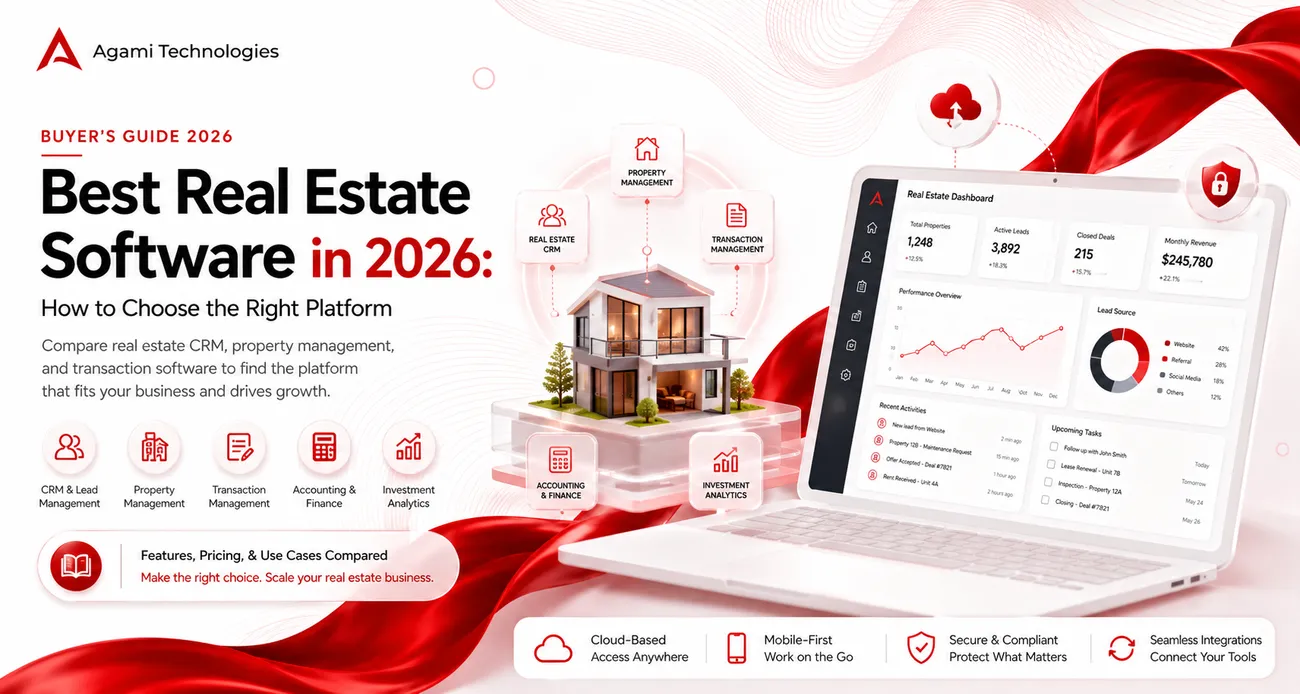
It's a broad label, and that's part of the confusion. Under that umbrella you'll find:
Real estate CRM software: built for lead capture, follow-ups, and client relationships
Property management software: for landlords and property managers handling rent collection, maintenance, and tenant communication
Real estate transaction management software: tracks deals from offer to closing, keeping documents and deadlines in one place
Real estate accounting software: handles bookkeeping, trust accounts, and financial reporting
Real estate investment software: analyzes deals, tracks portfolio performance, models returns
Most firms end up using two or three of these together. A broker might run real estate CRM software for leads, a property management system for the units they oversee, and separate real estate accounting software for the books. The trouble starts when they don't talk to each other.
CRM vs. Property Management vs. Transaction Management
Let's clear up the confusion, because these three get mixed up constantly.
A real estate CRM is about people. It stores contacts, logs calls, automates drip campaigns, and reminds you to follow up before a lead goes cold. If you're an agent or broker focused on generating and nurturing leads, this is your bread and butter.
A property management system is about assets. It handles the operational side once a tenant signs a lease. Rent collection, maintenance tickets, lease renewals, vacancy tracking. Landlords and property managers live in these tools daily.
Real estate transaction management software sits in the middle. It tracks a deal itself from the first showing to the final signature: document storage, e-signatures, compliance checklists, deadline alerts.
Some platforms try to do all three. Few do all three well. That's worth remembering when a vendor promises an "all-in-one" solution.

Features That Actually Matter in 2026
Feature lists are long and mostly noise. Here's what's worth paying attention to.
Automation That's Actually Smart
Basic email sequences aren't impressive anymore. Look for platforms that can score leads, flag at-risk tenants, or predict which listings need a price adjustment based on market activity. Industry data shows nearly half of real estate CRM platforms now build AI features like chatbots and automated lead prioritization directly into the product, so this is quickly becoming table stakes rather than a premium add-on.
Want to see how AI is changing business software beyond real estate? Read: AI Automation for Mortgage Companies
Mobile-First Design
Agents aren't sitting at desks. If the mobile app feels like an afterthought, that's a red flag, not a minor inconvenience, especially given how many real estate professionals now manage client communication entirely from their phones.
Integration Depth
Your real estate CRM should talk to your real estate accounting software. Your listing platform should sync with your marketing tools. Check what integrates natively versus what needs a third-party connector, and check if that connector comes with an extra monthly fee.
Reporting You Can Actually Use
Dashboards look nice in a demo. What matters is whether you can pull the specific report you need, say, tenant turnover by property, or lead source ROI, without emailing support.
Compliance and Security
Real estate deals with sensitive financial data and, in property management, trust accounting rules that vary by state. Make sure the platform is built for that, not bolted on after the fact.
Cloud-Based vs. On-Premise: Is There Still a Debate?
Not really, not anymore. Cloud-based property management software has become the default, and for good reason. Automatic updates, remote access, no server maintenance headaches. On-premise systems still exist, mostly in larger commercial real estate firms with strict data control requirements, but for most agencies and property managers, cloud is the practical choice, and market data backs this up: cloud deployment now holds more than half of the global proptech market.
The real question in 2026 isn't cloud versus on-premise. Most modern property management systems live entirely online now, syncing rent payments and maintenance updates across devices in real time. What actually matters is which cloud platform fits your workflow, and whether your data stays secure and portable if you ever want to switch.
Read: Top Custom Software Development Companies to Watch in 2026
Choosing Software by Use Case
Different segments of real estate need different tools, and buying based on brand recognition alone is how firms end up paying for features they never touch.
Residential Agents and Brokers
Usually want strong real estate CRM software first: lead capture, automated follow-up, and integration with listing sites.
Landlords and Residential Property Managers
Need rent collection, maintenance tracking, and tenant screening baked in. Rental property management software built specifically for smaller portfolios often works better than an enterprise tool scaled down. If you're only managing a handful of units, look for rental property management software with a simple dashboard rather than a bloated enterprise system. Good rental property management software should also make it easy to run background checks before a lease is signed.
Commercial Real Estate Teams
Deal with longer sales cycles, more complex lease structures, and higher-stakes deals. Commercial real estate software tends to prioritize deal tracking, valuation tools, and detailed financial modeling over marketing automation. Anyone shopping for commercial real estate software should pay close attention to how it handles lease abstraction and multi-tenant rent rolls. A lot of commercial real estate software also plugs directly into real estate accounting software, so financials update without double entry. This segment carries real weight in the market too: commercial real estate is projected to account for the majority share of real estate software spend in 2026, driven by the sheer complexity of managing large portfolios and multi-party transactions.
Investors and Portfolio Managers
Care less about lead follow-up and more about the numbers. Real estate investment software helps them run cap rate calculations, project returns, and track performance across a portfolio before a deal ever reaches a property management system. Some real estate investment software even connects straight to real estate accounting software, so return calculations line up with actual bookkeeping.
Short-Term Rental Hosts
Managing Airbnb-style properties need something different again: dynamic pricing, calendar syncing across platforms, and guest communication tools.
Trying to force one platform to serve all five is usually where things fall apart.

Pricing: What Should You Expect to Pay?
Pricing in this space varies wildly, and vendors aren't always upfront about it. Here's a general breakdown by category:
Software Type | Typical Price Range | Best For |
Basic CRM | $20 to $50/month per user | Individual agents |
Property management platform | $1 to $2/unit/month, with minimums | Landlords, property managers |
Real estate investment software | Above basic CRM tier | Investors, portfolio managers |
Commercial real estate software | Into the thousands/month | Enterprise commercial teams |
Free property management software | $0, features capped | Small landlords, handful of units |
Free property management software does exist, and it's worth trying if you're managing a handful of units. Some landlords stick with free property management software for years before their portfolio grows enough to justify paying for a dedicated property management platform. A small landlord running rental property management software on a free tier might only need it to send rent reminders and log repair requests. Just know that most free tiers cap out fast, either in the number of units, users, or features, and the upgrade path to a full property management platform can get expensive quickly.
How to Choose the Right Platform: A Practical Checklist
Skip the marketing pages for a minute and ask yourself these questions instead.
What's your actual workflow? Map out how a lead becomes a client, or how a maintenance request gets resolved, before you shop. Even free property management software should match that workflow, not the other way around.
How many units or deals are you handling? A property management system built for 500-unit portfolios will feel bloated for a 10-unit landlord, and vice versa.
What do you already use that this needs to connect to? Accounting software, email marketing, listing syndication, maybe even real estate transaction management software for closings. Check integration compatibility before you commit.
Can your team actually use it? The most feature-rich platform is worthless if your agents or property managers won't log into it. Ask for a trial, not just a demo.
What happens if you outgrow it? Look at whether the property management platform scales with you or whether you'll be migrating everything again in two years.
What's the real cost? Add up per-user fees, integration costs, and onboarding charges, even for free property management software. The sticker price rarely tells the whole story.
The Bottom Line
There's no single "best" real estate software in 2026, no matter what the top-10 listicles claim. The right platform depends on whether you're chasing leads, managing tenants, closing commercial deals, or all three at once.
<blockquote>The firms getting the most out of their tech stack aren't the ones with the flashiest software. They're the ones who took the time to match the tool to the actual job.</blockquote>
If you're evaluating platforms right now, start with your workflow, not the feature list. Whether that means real estate CRM software for your pipeline, a property management system for your units, or real estate transaction management software for your closings, everything else follows from there.
Frequently Asked Questions
What is the difference between a real estate CRM and property management software? A real estate CRM manages people and leads before a deal closes. Property management software manages the property itself after a tenant moves in, covering rent, maintenance, and lease renewals.
How much does real estate software cost in 2026? Basic CRMs start around $20 to $50 a month per user. Property management platforms typically run $1 to $2 per unit monthly. Enterprise commercial real estate software can run into the thousands, depending on portfolio size.
Is cloud-based property management software better than on-premise? For most agencies and landlords, yes. Cloud-based systems update automatically, work from any device, and skip the server maintenance that on-premise setups require. On-premise still makes sense for large commercial firms with strict data control needs.
Can one platform handle CRM, property management, and accounting together? Some platforms try, but very few do all three well. Most firms end up running a CRM, a property management system, and a separate accounting tool, then connecting them through integrations.
Not sure which platform fits your business? Agami Technologies builds custom real estate software, from CRM to property management to transaction tools, tailored to how your team actually works. Book a free consultation and we'll map out the right stack for you.
Need software that fits your business instead of forcing your business to fit the software?
Agami Technologies designs custom real estate CRM, property management, transaction management, accounting, and AI-powered automation solutions.
Book a free consultation: https://agamitechnologies.com/contact-us
Explore: https://agamitechnologies.com/