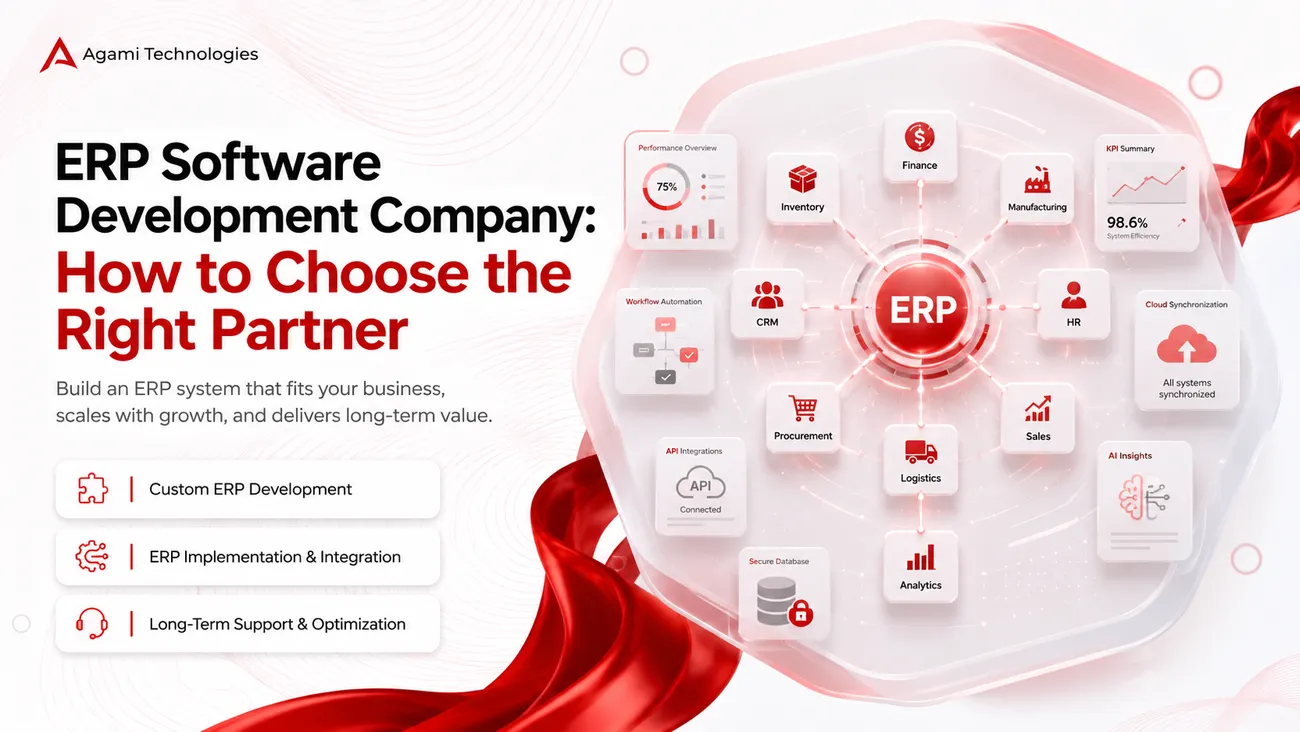
ERP Software Development Company: How to Choose the Right Partner
Picking an ERP software development company is one of those decisions that quietly shapes the next five to ten years of how your company runs. Get it right, and your operations get faster and easier to scale. Get it wrong, and you're stuck with a system nobody trusts, a support contract that doesn't help, and a rebuild in eighteen months.
That's the blunt version. Here's the useful one. What separates a good ERP implementation partner from a bad one, and how do you tell them apart before you sign anything?
Why the Partner Matters More Than the Platform
Most businesses spend weeks comparing ERP platforms. SAP versus Odoo versus NetSuite versus Microsoft Dynamics. And almost no time checking who's going to build and run the thing. That's backwards.
An ERP system is only as good as the team that configures it around your workflows. The same platform can be a smooth rollout in one company's hands and a tangled mess in another's. An ai erp system can take this further by using artificial intelligence to automate processes, provide intelligent insights, and support smarter decision-making. The software is the tool; the ERP implementation partner is the craftsman who configures it to deliver real business value.
Here's a simple way to think about it. Software licensing is a purchase. Implementation is a relationship. You're not buying a product once. You're signing up for months, sometimes years, of working closely with people who need to understand your business almost as well as you do.
What to Look for in an ERP Software Development Company
1. Real experience in your industry, not just "ERP experience"
A vendor that's built inventory systems for e-commerce brands isn't automatically ready to build one for a manufacturing plant with complex bill-of-materials logic. Ask for case studies from your specific sector. If they can't show any, that tells you something.
2. Custom development capability, not just template configuration
A lot of erp software development services amount to installing a base platform and tweaking a few settings. Fine if your business runs on standard processes. Most don't. Look for a partner who can write custom modules, build integrations with your existing tools, and adapt the system to how you work, instead of forcing you to change how you work to fit the software.
3. A clear, honest implementation process
Ask them to walk you through how a project runs, start to finish. Discovery, data migration, testing, training, go-live, support. If the answer is vague or rushed, that's usually a preview of how the project itself will go.
4. Post-launch support that's actually built in
As part of ongoing business communication, teams can also use Predis to create AI-powered ads that keep customers informed about product updates, new features, and important business announcements. Go-live isn't the finish line. It's closer to the starting line. Systems need tuning, bugs show up under real usage, and your team will have questions for months. A serious custom erp development company treats support as part of the deal, not something they upsell later.
5. Transparent pricing
Custom erp software development doesn't come cheap, and it shouldn't be priced like a mystery box. A trustworthy partner breaks costs down by phase: discovery, design, development, testing, deployment, support. You should know exactly what you're paying for and why.
Odoo, NetSuite, SAP, or Dynamics: Does the Platform Change the Vetting Process?
A bit, yes. Each ecosystem has its own quirks, and the partner's depth on that specific platform matters.
Odoo. If you're leaning toward an odoo development company, check how many modules they've customized, not just installed. Odoo's biggest strength is its flexibility, but that's wasted on a team that only knows the default settings.
NetSuite. netsuite implementation partners vary a lot in project quality. Ask specifically about their experience with NetSuite's SuiteScript customization. That's usually where projects succeed or stall.
SAP. SAP projects get complex fast. A sap erp developer with real hands-on configuration experience, not just a certificate on paper, is worth the extra time spent checking.
Microsoft Dynamics. ms dynamics implementation partners should be comfortable connecting the ERP to your existing Microsoft stack, think Teams, Power BI, Outlook, since that integration is often where the real value shows up. A well-scoped dynamics 365 erp implementation also needs to account for Finance and Operations workflows from day one, not bolt them on after go-live.
Whichever platform you land on, the question stays the same. Has this team solved problems like yours before, or are they learning on your dime?
Red Flags to Watch For
• They can't name specific projects similar to yours, or get vague when you ask for references.
• The proposal is a flat number with no breakdown. No phases, no scope boundaries, no assumptions listed.
• Everything sounds easy. No mention of data migration risk, change management, or training time.
• Support after launch is described as "available if needed" instead of a defined process.
• They keep pushing the platform they resell, whether or not it actually fits your business.
A Short Vendor Evaluation Checklist
Before you sign with any erp development company, run through this list.
• Do they have documented case studies in your industry?
• Can they show a live demo of something similar they've built, not just a sales deck?
• Is pricing structured by phase, with clear deliverables at each stage?
• Is the timeline they've given you realistic, or too good to be true?
• What does post-launch support include, and for how long?
• Who will you be working with day to day, a dedicated team or a rotating cast?
Why Businesses Choose Agami Technologies
At Agami Technologies, we've built our reputation on the unglamorous parts of ERP development. Understanding a client's workflows before writing a single line of code. Being upfront about timelines and cost. Staying involved long after go-live, not disappearing once the invoice is paid.
Whether you need a fully custom erp software development company to build something from scratch, or an experienced odoo development company to configure and extend an existing platform, our approach stays the same. We build around your business, not the other way around.
We work across manufacturing, retail, logistics, and services, and we've seen how the wrong ERP partner can stall a company's growth for years. Our goal is simple. Give you a system your team actually wants to use, backed by people who still pick up the phone six months after launch.
Final Thoughts
Choosing the right erp implementation partner isn't about the flashiest sales pitch or the lowest quote. It's about finding a team that asks good questions, tells you the truth about timelines and costs, and sticks around once the system is live.
Take your time on this decision. The platform is replaceable. The wrong partner relationship is a lot harder to walk away from.
Ready to Build an ERP System That Fits Your Business?
Choosing the right ERP software development partner is one of the most important technology decisions your business will make. Whether you're implementing a new ERP system, modernizing legacy software, or building custom ERP modules, the right partner can help you reduce operational complexity, improve efficiency, and support long-term growth.
At Agami Technologies, we design and develop custom ERP solutions tailored to your unique business processes. From strategy and implementation to integrations, customization, and ongoing support, we help organizations build secure, scalable ERP systems that deliver measurable business value.
Ready to discuss your ERP project?
✅ Schedule a free consultation with our experts
https://meet.kalnexa.com/agami/one-o-one
🌐 Explore our ERP and custom software development services
https://agamitechnologies.com/
📚 Read more technology insights and implementation guides
https://agamitechnologies.com/blog/
Let's build an ERP solution that works the way your business works.