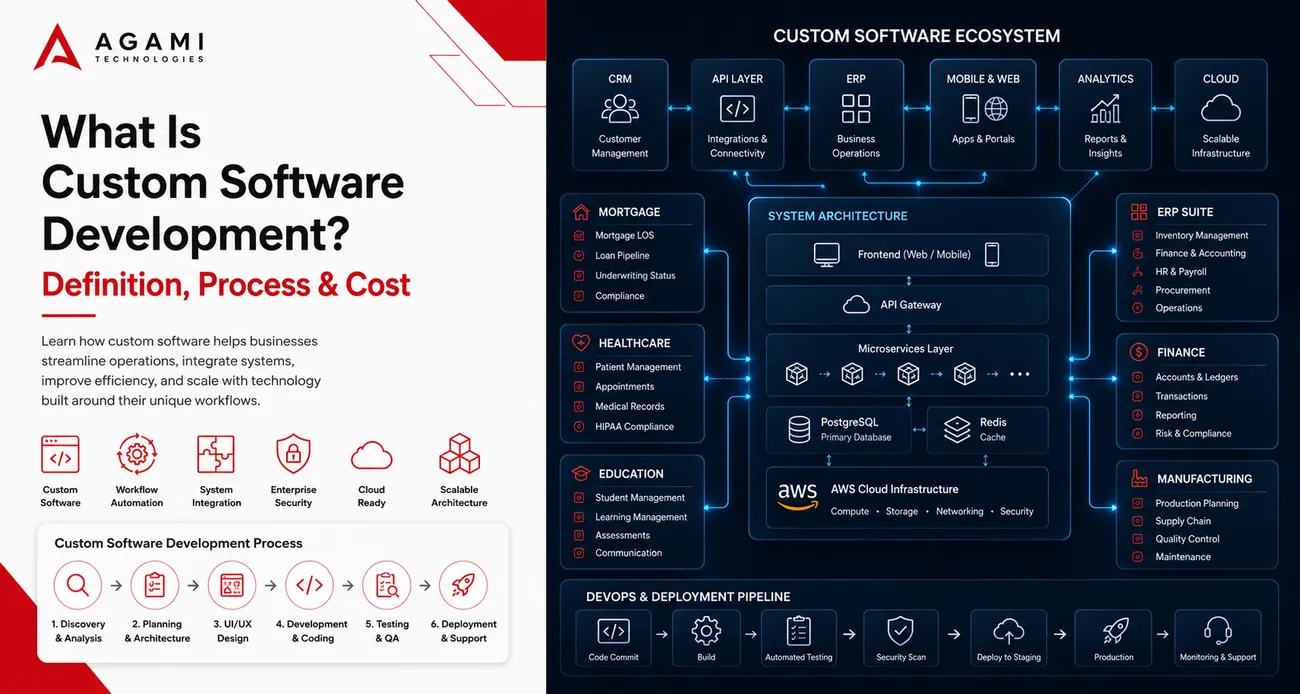
What Is Custom Software Development? Definition, Process & Cost
Introduction
Every growing business reaches a point where its software starts creating more work than it solves.
At first, everything seems manageable. A CRM handles customer data, accounting software manages finances, spreadsheets fill reporting gaps, and a handful of third-party tools connect daily operations. As the business expands, those tools often stop working together. Employees switch between multiple systems, duplicate information, manually update records, and spend valuable hours on administrative tasks instead of meaningful work.
This pattern is common across industries.
A mortgage lender may use separate platforms for loan origination, document management, compliance, and customer communication. A healthcare provider often relies on different systems for patient records, appointments, billing, and reporting. A SaaS company may outgrow its original platform as customer expectations evolve and new product capabilities become essential.
The software itself is not necessarily the problem.
The problem is that it was designed for thousands of businesses, not yours.
That is where custom software development becomes a strategic business decision rather than a technical one.
Instead of forcing your organization to adapt to generic software, custom solutions are built around your processes, your customers, your compliance requirements, and your long-term goals.
For founders and business leaders, the conversation is rarely about writing code. It is about removing operational bottlenecks, improving visibility, reducing manual work, and creating systems that can support future growth.
This guide explains what custom software development is, how it differs from commercial software, where it delivers the most value, how the development process works, what it typically costs, and how to determine whether it is the right investment for your business.
Key Takeaways
Custom software is designed specifically for your organization's workflows, goals, and operational requirements.
Businesses often invest in custom software when off-the-shelf tools create inefficiencies, data silos, or scalability challenges.
A successful custom software development process starts with business discovery rather than coding.
Development costs vary depending on project complexity, integrations, security requirements, and long-term maintenance.
Industries such as mortgage, healthcare, education, finance, manufacturing, and SaaS often benefit significantly from tailored software solutions.
Choosing the right software development company is just as important as choosing the right technology.
The best software investment is one that supports long-term business growth rather than simply solving today's problems.
What Is Custom Software Development?
Custom software development is the process of creating software specifically for a single business or organization rather than building a product intended for the general market.
Unlike commercial software, which is designed to meet the needs of thousands of businesses, custom software focuses on solving a particular company's operational challenges, workflows, integrations, and long-term objectives.
Think of it this way.
Buying off-the-shelf software is similar to renting an office space. It works for many businesses, but you'll likely need to adapt your operations to fit the available layout.
Custom software is like designing and constructing your own office. Every room, workflow, and process is planned around how your team actually works.
That distinction becomes increasingly important as organizations grow.
A startup with ten employees may operate comfortably using a handful of cloud applications. Five years later, those same applications may require employees to manually transfer data, duplicate customer information, or maintain multiple versions of the same report.
At that stage, software begins slowing the business instead of supporting it.
Custom software development addresses these challenges by creating systems that reflect the organization's existing processes while remaining flexible enough to support future growth.
These solutions may include:
Customer Relationship Management (CRM) platforms
Enterprise Resource Planning (ERP) systems
Mortgage loan management platforms
Healthcare management systems
Patient portals
Learning management platforms
Customer self-service portals
Inventory management systems
Business intelligence dashboards
Workflow automation platforms
Mobile applications
SaaS products
Internal employee portals
Unlike traditional packaged software, these applications are built around business objectives rather than predefined feature lists.
One pattern we've consistently seen across enterprise software projects is that businesses rarely request custom software because they want something unique. They invest because existing systems have become operational constraints. The goal is almost always greater efficiency, better visibility, and a technology foundation that can evolve alongside the business.
Custom Software vs. Off-the-Shelf Software
Both custom software and commercial software have their place.
The right choice depends on your organization's size, complexity, growth plans, and operational requirements.
For many small businesses, commercially available software provides excellent value. It is affordable, easy to implement, and supported by large vendors.
As operations become more specialized, however, organizations often discover that standard software cannot fully accommodate their workflows.
Instead of supporting the business, employees begin creating workarounds.
That usually means more spreadsheets.
More manual data entry.
More disconnected systems.
More room for costly mistakes.
The question is no longer whether the software works. The question becomes whether it still works for the business.
Comparison: Custom Software vs. Off-the-Shelf Software
| Feature | Off-the-Shelf Software | Custom Software |
|---|---|---|
| Purpose | Designed for a broad market | Built around a specific business |
| Customization | Limited configuration | Fully tailored workflows |
| Integrations | Depends on vendor support | Designed around existing systems |
| Scalability | May require replacing as the business grows | Expands with business needs |
| Ownership | Controlled by the software vendor | Controlled by the organization |
| Updates | Vendor decides the roadmap | Business prioritizes enhancements |
| Long-Term Flexibility | Moderate | High |
Practical Example
Consider a regional mortgage lender processing several hundred applications every month.
The company may rely on one system for customer relationships, another for document collection, a separate compliance platform, electronic signature software, and spreadsheet-based reporting.
Individually, each application performs well.
Collectively, they create friction.
Loan officers switch between multiple interfaces throughout the day. Operations teams manually reconcile reports. Managers struggle to obtain real-time visibility into pipeline performance.
A custom platform could centralize these activities into a single workflow, reducing repetitive tasks while improving reporting accuracy and operational efficiency.
The same principle applies across healthcare, education, manufacturing, logistics, and professional services.
The more unique your operations become, the greater the value of software designed specifically around them.
Why Businesses Invest in Custom Software Development
Businesses rarely decide to build software because it's fashionable.
Most investments begin with operational problems that become too costly to ignore.
Existing Software No Longer Supports Growth
Software that worked perfectly for a small organization may become increasingly restrictive as the business expands.
Adding more users, locations, products, or services often exposes limitations that were never apparent during the early stages of growth.
Instead of enabling expansion, technology begins slowing decision-making and increasing operational complexity.
Teams Spend Too Much Time on Manual Work
One of the clearest indicators that a business has outgrown its software is excessive manual effort.
Employees export spreadsheets.
Copy information between applications.
Update customer records multiple times.
Prepare reports manually every week.
While each task may seem minor, together they consume hundreds of hours every month.
According to industry research from McKinsey, employees can spend a significant portion of their workweek searching for information or performing repetitive administrative tasks, highlighting the importance of streamlined digital workflows.
Business Systems Don't Communicate
Many organizations rely on dozens of business applications.
CRM.
Finance.
HR.
Operations.
Customer support.
Inventory.
Reporting.
When these systems cannot exchange information automatically, employees become the integration layer.
That creates delays, inconsistent reporting, duplicate records, and unnecessary operational risk.
In practice, we've found that integration challenges often become the strongest business case for custom software development, especially in organizations that have grown through multiple technology investments over several years.
Customer Expectations Continue to Rise
Customers increasingly expect faster responses, self-service capabilities, personalized experiences, and accurate information regardless of which department they contact.
Meeting those expectations becomes difficult when employees must search across multiple systems to answer simple questions.
Custom software helps unify information, allowing teams to respond more efficiently while delivering a more consistent customer experience.
Compliance Requirements Become More Complex
Industries such as healthcare, mortgage lending, financial services, and education operate within strict regulatory environments.
Organizations need detailed audit trails, secure access controls, encrypted data storage, role-based permissions, and comprehensive reporting.
Commercial software may support some of these requirements.
Custom software allows organizations to build compliance directly into their operational workflows rather than treating it as an afterthought.
Businesses Want Greater Control Over Their Technology
Software vendors regularly change pricing models, discontinue features, or adjust their product roadmaps.
Those decisions may not align with your business priorities.
Organizations investing in custom software gain greater control over future enhancements, integrations, user experience, and long-term technology strategy.
Rather than adapting every time a vendor changes direction, the software evolves according to the organization's own objectives.
Expert Insight
One observation that consistently emerges across successful software initiatives is this: companies rarely regret investing time in understanding their processes before building software. They are far more likely to regret rushing into development without clearly defining business requirements. The discovery phase often determines whether a project delivers lasting value or simply replaces one set of problems with another.
https://agamitechnologies.com/blog/digital-transformation-strategies-2026-framework-best-practices
Benefits of Custom Software Development
The biggest advantage of custom software is not that it's unique. Its real value lies in helping businesses operate more efficiently, make better decisions, and scale without constantly working around technology limitations.
When software aligns with how a business actually functions, employees spend less time fighting systems and more time delivering value to customers.
Below are the benefits organizations most commonly experience after investing in custom software development.
https://agamitechnologies.com/blog/ai-automation-for-mortgage
Improved Operational Efficiency
The primary goal of any business software should be to simplify work.
Unfortunately, many organizations accumulate multiple applications over time. Sales teams work in one system, operations rely on another, finance uses separate accounting software, and reporting happens in spreadsheets.
This fragmented approach creates unnecessary manual work.
Custom software eliminates many of these repetitive activities by bringing workflows together in a single platform. Employees no longer need to enter the same information multiple times or move between disconnected systems throughout the day.
Even saving five minutes on a routine process can translate into hundreds of productive hours across an organization over the course of a year.
Software That Matches Your Business
Every business develops its own way of operating.
Approval processes differ.
Reporting requirements vary.
Customer journeys are unique.
Compliance obligations depend on the industry.
Commercial software usually supports common business scenarios, but rarely reflects every organization's operational model.
Custom software is designed around existing business processes rather than forcing employees to adapt to predefined workflows.
That often results in faster adoption because the software feels familiar instead of disruptive.
Better Scalability
Growth introduces complexity.
More employees.
More customers.
Additional products.
New offices.
International expansion.
Software that performs well for a twenty-person company may struggle when the organization grows to two hundred employees.
One of the long-term benefits of custom software development is scalability. New features, integrations, users, and business units can be added without replacing the entire platform.
Instead of restarting with new software every few years, businesses continue building on an existing foundation.
Easier System Integration
Few businesses rely on a single application.
A typical organization may already use CRM software, ERP platforms, payment gateways, accounting systems, HR software, document management tools, communication platforms, and analytics solutions.
The challenge is not owning these systems.
The challenge is making them work together.
Custom software can connect multiple applications through APIs and shared workflows, reducing duplicate data entry while improving data consistency across departments.
This creates a connected digital ecosystem rather than isolated software products.
Enhanced Security and Compliance
Security requirements vary significantly across industries.
Healthcare providers protect sensitive patient information.
Mortgage lenders manage financial records.
Educational institutions store student data.
Insurance companies handle confidential customer information.
Custom software allows businesses to implement security controls based on their own operational and regulatory requirements instead of relying entirely on vendor-defined security features.
Role-based access, encryption, audit logs, multi-factor authentication, and compliance reporting can all be incorporated from the beginning rather than added later.
Greater Flexibility for Future Improvements
One challenge with commercial software is depending on another company's roadmap.
Features may be removed.
Pricing may change.
Integrations can be discontinued.
Development priorities may no longer align with your business goals.
With custom software, organizations decide what gets built next.
That flexibility becomes increasingly valuable as markets evolve and customer expectations change.
Stronger Competitive Advantage
Many businesses use the same commercial software as their competitors.
As a result, technology alone rarely creates differentiation.
Custom software allows organizations to introduce unique workflows, customer experiences, reporting capabilities, or operational efficiencies that competitors cannot easily replicate.
The software becomes part of the business strategy rather than simply supporting day-to-day operations.
Understanding the Custom Software Development Process
Many people assume software development begins when developers start writing code.
In reality, successful projects begin much earlier.
The most effective custom software development process starts by understanding how the business operates, what problems need solving, and how success will be measured.
Skipping these early stages often results in expensive revisions later.
Step 1: Discovery and Business Analysis
Every successful project begins with questions rather than solutions.
Development teams work closely with business stakeholders to understand:
Existing workflows
Operational bottlenecks
Business objectives
User expectations
Compliance requirements
Current software ecosystem
Integration needs
This phase often includes stakeholder interviews, workflow mapping, technical assessments, and business process documentation.
One pattern we've consistently seen across enterprise implementations is that organizations investing more time in discovery usually experience smoother development and fewer costly changes during later stages.
Step 2: Planning and Solution Architecture
Once business requirements are clear, architects begin designing the technical foundation.
This includes selecting the technology stack, defining system architecture, planning integrations, organizing databases, establishing user roles, and outlining security requirements.
Think of this stage as creating architectural drawings before constructing a building.
Good planning reduces technical debt and makes future enhancements easier.
Step 3: User Experience and Interface Design
People adopt software more quickly when it feels intuitive.
Before development begins, designers create wireframes, clickable prototypes, and interface designs that allow stakeholders to visualize the product.
This stage often uncovers usability improvements long before developers write production code.
Small adjustments made during design are significantly less expensive than changes introduced after development.
Step 4: Software Development
Only after the business requirements, architecture, and design have been approved does development begin.
Modern software projects are usually delivered in iterative phases rather than one large release.
Instead of waiting several months before reviewing progress, stakeholders receive regular demonstrations and provide ongoing feedback.
This collaborative approach reduces surprises and keeps development aligned with changing business priorities.
Step 5: Quality Assurance and Testing
Testing is much more than identifying software bugs.
A comprehensive quality assurance process evaluates:
Functional accuracy
Performance under load
Security vulnerabilities
Data integrity
User experience
Compatibility across devices
Integration reliability
Businesses often underestimate the importance of testing.
In practice, investing additional time in quality assurance almost always costs less than fixing production issues after launch.
Step 6: Deployment
After testing is complete, the software moves into the production environment.
Deployment strategies vary depending on business requirements.
Some organizations prefer launching the entire system at once.
Others introduce new functionality gradually, allowing employees to adapt while minimizing operational disruption.
The right approach depends on business size, user adoption, and project complexity.
Step 7: Continuous Support and Improvement
Launching software is not the end of the journey.
It marks the beginning.
Business priorities evolve.
Customer expectations change.
Technology advances.
Regulatory requirements are updated.
Successful organizations continuously refine their software to improve usability, performance, and security.
The best software products are rarely built once and left unchanged.
They evolve alongside the business.
Real-World Custom Software Development Examples
The value of custom software becomes much clearer when viewed through real business scenarios.
Although every organization has different requirements, the underlying challenges are often remarkably similar.
Mortgage Industry
Mortgage companies often rely on multiple platforms for loan origination, underwriting, document collection, compliance, customer communication, and reporting.
As application volumes increase, switching between these systems becomes increasingly inefficient.
A custom platform can centralize the entire lending workflow, enabling teams to track applications, automate document collection, monitor compliance, and generate real-time reports from one interface.
The result is faster processing, improved visibility, and fewer manual errors.
Healthcare
Healthcare organizations manage patient records, appointments, billing, laboratory reports, prescriptions, and insurance claims across numerous applications.
Disconnected systems can delay patient care and increase administrative workload.
A custom healthcare platform integrates these functions into a unified environment, allowing clinicians and administrative staff to access accurate information quickly while supporting regulatory compliance and data security.
Education
Educational institutions often operate separate systems for admissions, student records, attendance, examinations, fee management, and online learning.
Managing these independently creates duplicate work and inconsistent reporting.
Custom software can connect academic, administrative, and financial operations into a single ecosystem, improving efficiency for students, faculty, and administrators alike.
Manufacturing
Manufacturers frequently struggle with disconnected inventory systems, production planning tools, procurement software, and quality management platforms.
Custom software can provide end-to-end visibility across the production lifecycle, helping teams improve scheduling, reduce inventory waste, and monitor operational performance more effectively.
Logistics
Logistics companies coordinate shipments, warehouse operations, fleet management, customer communication, and billing.
Without integrated systems, delays and data inconsistencies become common.
Custom logistics platforms help automate scheduling, optimize routes, improve shipment tracking, and provide customers with real-time updates.
Insurance
Insurance providers process policy management, underwriting, claims, customer support, and regulatory reporting through multiple applications.
A unified platform simplifies policy administration, accelerates claims processing, and improves customer service while maintaining compliance requirements.
SaaS Businesses
As SaaS companies grow, their internal operations become increasingly complex.
Customer onboarding, subscription management, analytics, billing, customer success, and product administration often require multiple systems.
Custom software enables these businesses to build internal platforms tailored to their product strategy, allowing them to move faster while supporting future product growth.
Expert Insight
One misconception about custom software development is that success depends primarily on technology.
In reality, technology is only one part of the equation.
Projects that consistently deliver long-term value usually share three characteristics.
First, business stakeholders remain actively involved throughout development rather than handing requirements to developers and waiting for the finished product.
Second, organizations focus on solving operational problems instead of requesting features simply because competitors have them.
Finally, they view software as an evolving business asset rather than a one-time purchase.
Those principles often determine whether software continues delivering value five years later or becomes another system employees eventually outgrow.
Understanding What Drives Development Costs
One of the first questions every business leader asks is, "How much does custom software development cost?"
There is no universal answer because every project is different.
Two businesses may both request a customer portal, yet one requires simple account management while the other needs advanced reporting, payment processing, document management, third-party integrations, and enterprise-grade security.
Although exact pricing varies, the biggest cost drivers generally include:
Project complexity and overall scope
Number of users and user roles
Required integrations with existing systems
User interface and experience requirements
Security and compliance standards
Cloud infrastructure and hosting
Long-term maintenance and support
Future scalability requirements
From implementation experience, organizations that define clear business objectives before requesting estimates typically receive more accurate budgets and experience fewer unexpected costs during development.
How to Choose the Right Custom Software Development Company
Selecting a software partner is one of the most important decisions you'll make during a digital transformation initiative. The quality of the technology matters, but the quality of the team building it often has an even greater impact on the project's long-term success.
Many organizations compare vendors based primarily on cost. While budget is an important consideration, the least expensive proposal is not always the best investment. A poorly planned project can lead to delays, technical debt, expensive rework, and low user adoption.
Instead, evaluate potential partners based on their ability to understand your business, communicate clearly, and deliver solutions that continue creating value long after deployment.
When evaluating a software development company, consider the following:
Industry Experience
Every industry has unique workflows, regulations, and operational challenges.
A company that has previously built software for healthcare, mortgage, SaaS, education, or finance will typically understand common business processes, compliance requirements, and integration needs much faster than a generalist development team.
Ask for relevant case studies rather than generic portfolios.
Discovery Before Development
Experienced custom software development companies spend significant time understanding the business before discussing technology.
During early conversations they should ask questions about:
Business goals
Current operational challenges
Existing software
User roles
Reporting requirements
Compliance obligations
Future growth plans
If a development company provides a fixed quote after only a brief conversation, it may indicate that the discovery process has not been thorough enough.
Technical Expertise
Modern business software often requires expertise across multiple technologies.
Look for teams experienced in areas such as:
Cloud infrastructure
API integrations
Enterprise architecture
Database design
Mobile applications
Security best practices
Scalable backend development
Performance optimization
Strong technical capabilities reduce future maintenance challenges and make software easier to scale.
Communication and Collaboration
Successful projects involve continuous collaboration rather than one-time requirement gathering.
Regular demonstrations, transparent progress updates, sprint reviews, and open communication help ensure the final product remains aligned with business objectives.
In our experience, communication issues create more project delays than technical challenges.
Long-Term Support
Software continues evolving after launch.
Before choosing a partner, understand:
How ongoing support is provided
Response times for critical issues
Update processes
Maintenance plans
Future enhancement options
Long-term partnerships usually create more value than transactional project relationships.
Decision Framework: Is Custom Software Right for Your Business?
Not every organization needs a custom-built platform.
Commercial software remains an excellent choice for many businesses with standard operational requirements.
However, custom software often becomes the better investment when operational complexity increases.
You should seriously consider custom software development if your business:
Uses multiple disconnected systems that require manual data entry.
Relies heavily on spreadsheets to complete everyday work.
Has unique workflows that commercial software cannot support effectively.
Requires integrations between several business applications.
Operates in a highly regulated industry with strict compliance requirements.
Plans significant business growth over the next few years.
Wants complete ownership over future software enhancements.
Off-the-shelf software may still be the right option if:
Your processes closely match standard industry workflows.
Your organization has simple operational requirements.
You need a solution quickly with minimal customization.
Budget constraints outweigh the need for specialized functionality.
One practical way to evaluate the decision is to compare the ongoing cost of operational inefficiencies against the investment required to build software that eliminates those inefficiencies.
If manual work, disconnected systems, and reporting delays are already affecting productivity, customer experience, or growth, custom software often delivers measurable long-term value.
Best Practices for a Successful Custom Software Project
Organizations that achieve the best outcomes typically follow a few common principles.
Start with Business Goals
Technology should solve business problems, not exist for its own sake.
Clearly define what success looks like before discussing features.
Examples include reducing processing time, improving reporting accuracy, increasing customer satisfaction, or simplifying compliance.
Involve End Users Early
Employees use software every day.
Including them during discovery and design often reveals workflow improvements that leadership may not see.
Their feedback also improves user adoption after launch.
Build in Phases
Large software projects become easier to manage when delivered incrementally.
Launching a minimum viable solution first allows organizations to gather feedback and prioritize future improvements based on real user behavior.
Plan for Growth
Businesses evolve.
Software should evolve with them.
Design systems that can accommodate future users, new services, additional integrations, and changing business requirements.
Measure Success
Define measurable outcomes before development begins.
Track improvements such as:
Reduced manual work
Faster processing times
Improved reporting
Lower operational costs
Increased employee productivity
Better customer satisfaction
Clear metrics help demonstrate return on investment.
Frequently Asked Questions
What is custom software development?
Custom software development is the process of designing, building, deploying, and maintaining software created specifically for a single organization's needs. Unlike commercial software, it is tailored to existing business processes, operational goals, and long-term growth plans.
What are the benefits of custom software development?
The primary benefits include improved efficiency, better scalability, seamless system integration, stronger security, greater flexibility, and software that supports unique business workflows instead of requiring organizations to change how they operate.
How much does custom software development cost?
Costs vary depending on project complexity, required features, integrations, compliance requirements, and ongoing support. Smaller business applications generally require a lower investment than enterprise platforms with advanced functionality.
How long does the custom software development process take?
Development timelines depend on project scope.
Simple internal applications may take a few months, while enterprise platforms often require six to twelve months or longer. A thorough discovery phase usually reduces delays later in the project.
Can custom software integrate with existing systems?
Yes, Most custom software is specifically designed to integrate with CRM platforms, ERP systems, payment gateways, accounting software, healthcare systems, cloud platforms, and third-party APIs.
Is custom software more secure than off-the-shelf software?
Custom software allows businesses to implement security measures that match their operational and compliance requirements. While security ultimately depends on how software is designed and maintained, tailored security controls can provide advantages for organizations handling sensitive data.
Which industries benefit most from custom software?
Industries with specialized workflows typically benefit the most.
These include mortgage lending, healthcare, education, manufacturing, logistics, finance, insurance, retail, professional services, and SaaS businesses.
How do I choose the right software development company?
Look for industry expertise, transparent communication, proven technical capabilities, structured project management, strong security practices, and reliable post-launch support. A development partner should understand your business goals before recommending technical solutions.
Can small businesses benefit from custom software?
Yes, Many growing businesses invest in custom software to automate manual processes, improve customer service, and build scalable systems before operational complexity becomes difficult to manage.
Is custom software worth the investment?
It depends on your business needs.
Organizations with unique workflows, disconnected systems, or long-term growth plans often find that custom software delivers greater value over time than continuously adapting commercial software.
Related Resources
If you're exploring software modernization or digital transformation, these resources can help you dive deeper into related topics:
Explore Custom Software Development Services at Agami Technologies to understand how tailored software can support business growth.
Learn how AI Automation Solutions help reduce manual work and streamline business operations.
Read about Custom Web Application Development and how modern web platforms improve scalability and customer experience.
Discover how Enterprise Software Solutions simplify complex business processes across multiple departments.
Browse the Agami Technologies Blog for practical insights on SaaS development, digital transformation, cloud applications, and emerging technology trends.
Ready to Build Software Around Your Business?
Every business has its own processes, challenges, and long-term goals. While commercial software works well for standardized operations, growing organizations often need technology that reflects how they actually work.
Whether you're replacing legacy systems, integrating multiple platforms, improving operational efficiency, or launching a new digital product, thoughtful planning is the foundation of every successful software initiative.
At Agami Technologies, we work with organizations across mortgage, healthcare, education, finance, SaaS, manufacturing, and other industries to design scalable software solutions aligned with real business objectives.
If you're evaluating your next technology investment, you can:
Explore our services: https://agamitechnologies.com/
Read more technology insights and practical guides: https://agamitechnologies.com/blog/
Schedule a consultation with our team: https://meet.kalnexa.com/agami/one-o-one
Final Thoughts
Custom software development is ultimately about solving business problems, not simply building software.
As organizations grow, disconnected systems, repetitive manual work, and rigid commercial applications often become obstacles to efficiency and innovation. A well-designed custom solution removes those barriers by aligning technology with the way the business actually operates.
The most successful software projects begin with a clear understanding of business goals, involve stakeholders throughout development, and continue evolving after deployment. They are built with scalability, usability, and long-term value in mind rather than short-term convenience.
Whether you're modernizing legacy infrastructure, improving operational efficiency, or creating an entirely new digital product, investing in software that reflects your organization's unique needs can provide a stronger foundation for sustainable growth.
The right technology should adapt to your business, not the other way around.