What Is an AI Agent? A Founder's Guide to Agentic AI in 2026: A Practical Guide
Every founder we talk to at Agami Technologies is asking some version of the same question right now: "Do I actually need an AI agent, or is this just the next word everyone's throwing around in pitch decks?"
Fair question. Because "AI agent" has become one of those terms that gets slapped onto everything a chatbot with a new coat of paint, a Zapier flow with an OpenAI call bolted on, a genuinely autonomous system that can plan, act, and correct itself without a human babysitting every step. If you're a founder trying to decide where to put your engineering budget in 2026, that confusion is expensive.
So let's clear it up properly. No fluff, no recycled definitions copied from a dozen other "what is an AI agent" articles. Just what an AI agent actually is, why the shift is happening now, and how to think about it as someone building or running a company.
What Is an AI Agent, Really?
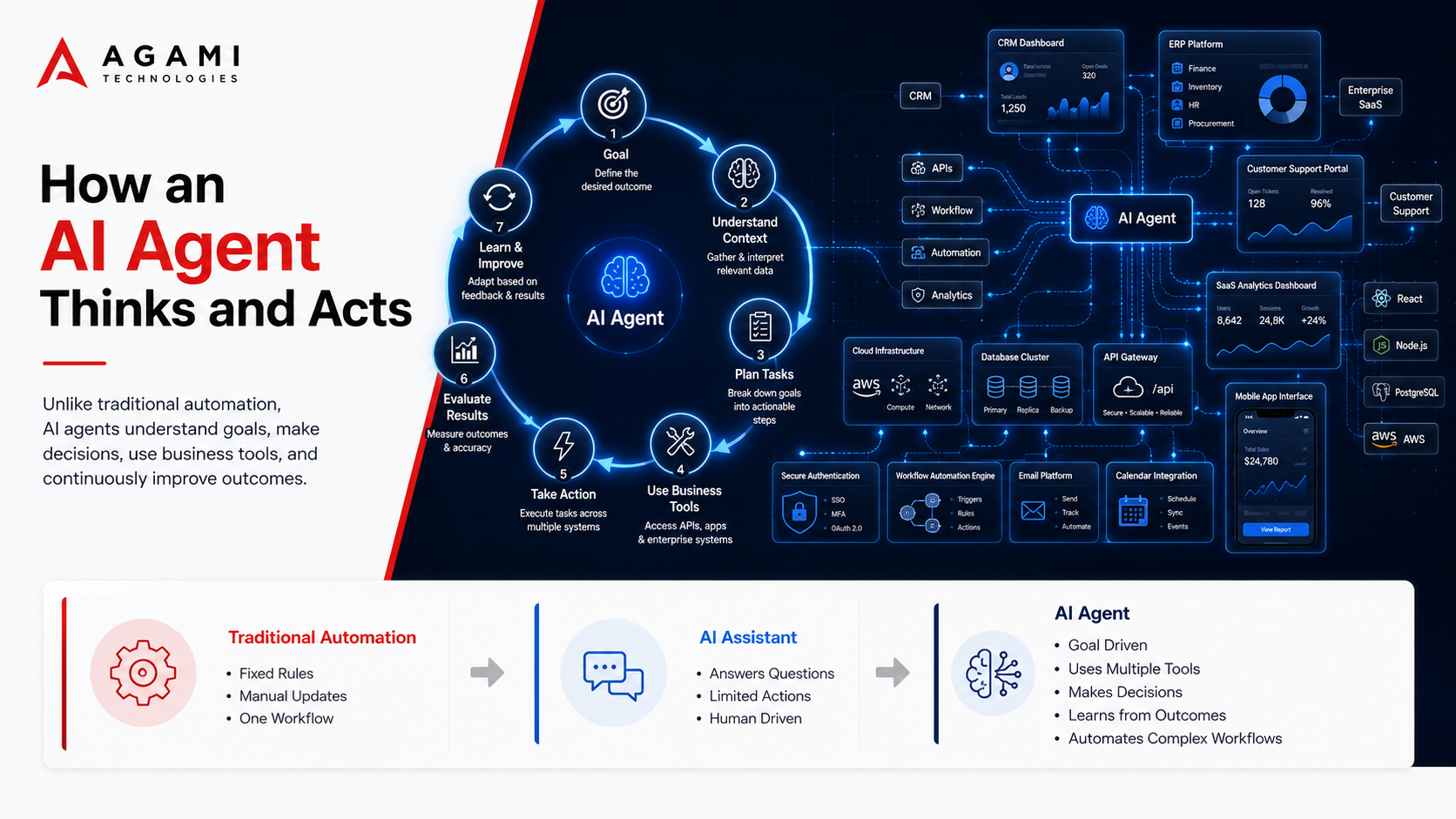
An AI agent is software that can perceive a situation, decide what to do about it, take action using tools or systems, and check whether that action actually worked largely without a human clicking "approve" at every step.
That last part is the whole point. A chatbot answers you. An automation script follows a fixed path you built for it. An AI agent does neither of those things exclusively it holds a goal, breaks it into steps, picks the right tool for each step, and adjusts when something doesn't go as planned.
Here's a simple comparison that tends to make it click for founders:
| Traditional Automation | Chatbot / AI Assistant | AI Agent | |
|---|---|---|---|
| Follows a fixed script | Yes | Mostly | No adapts mid-task |
| Understands natural language | No | Yes | Yes |
| Makes decisions between steps | No | No | Yes |
| Uses external tools/APIs on its own | No | Rarely | Yes |
| Works toward a goal, not just a reply | No | No | Yes |
| Needs a human for every step | Yes | Yes | Only at checkpoints you define |
If you've read our earlier piece on how agentic AI is reshaping education and SaaS, you already know we've been watching this shift for a while — it's not new territory for us, it's the direction the whole SaaS category is heading.
The Difference Between "AI Agent" and "Agentic AI"
Founders use these two terms interchangeably, and honestly, in casual conversation, that's fine. But when you're briefing your product team, it helps to separate them:
- An AI agent is a single system built for a job refunding a customer, qualifying a lead, triaging a support ticket, reconciling an invoice.
- Agentic AI is the broader approach building software where multiple agents, tools, and data sources work together, sometimes handing tasks off to each other, to complete something bigger than any one agent could do alone.
Think of it like the difference between "an employee" and "how your company operates." One agent automating your onboarding emails is useful. A network of agents that pulls a new signup's data, checks it against your CRM, flags fraud risk, sends a personalized welcome sequence, and alerts your sales team if the account looks enterprise-sized that's agentic AI doing what a small ops team used to do manually.
Why 2026 Is the Year This Stopped Being Optional
We're not going to throw a stat at you just to sound credible, but this one's genuinely worth knowing if you're planning next year's roadmap: Gartner expects roughly 40% of enterprise applications to ship with task-specific AI agents built in by the end of 2026 up from under 5% just a year earlier. That's not a gradual curve. That's the fastest jump in enterprise software adoption since the shift to cloud computing.
What changed? A few things converged at once:
Tool-calling got reliable. Two years ago, an agent trying to book a meeting or update a record would fail silently half the time. The underlying models got dramatically better at knowing when to use a tool, how to use it, and when to admit they're stuck.
Building agents stopped requiring a PhD. Before starting an agent project, founders should understand the AI agent development cost involved, including architecture, integrations, testing, deployment, and ongoing operations. What used to take a specialized AI team three months now takes a competent software team a few sprints assuming they're building on solid architecture, which is where most teams still trip up.
The cost of "good enough" automation went up, not down. If your competitor's support agent resolves a ticket in ninety seconds and yours takes a human twenty minutes, that gap compounds. Founders aren't adopting agentic AI because it's trendy they're adopting it because their customers are quietly comparing response times against companies that already have.
We wrote about this shift in more depth in The Future of SaaS: AI, Automation, and Scalable Growth Tactics if you want the fuller picture of where SaaS product strategy is headed alongside this.
What AI Agents Actually Look Like in a Real Business
Forget the sci-fi framing for a second. Here's what agentic AI looks like when it's doing its job inside a company that isn't a tech giant:
Sales and demos. Instead of a rep manually customizing a product walkthrough for every prospect, an agent-driven system can build a personalized demo path based on the prospect's industry, role, and past interactions adjusting the experience in real time instead of running the same static deck for everyone. That's essentially what we built into DemoDazzle, our AI-powered demo platform it's a working example of a single-purpose agent doing a job that used to eat hours of a sales team's week.
Customer support. An agent reads the ticket, checks the order history, decides whether it's a refund, a bug, or a "how do I" question, and either resolves it or routes it to the right human with full context attached not a summary a human has to decode.
Operations and finance. Reconciling invoices, flagging anomalies in expense reports, chasing down missing documentation the unglamorous work that eats a founder's Fridays. Agents are genuinely good at this because the rules are mostly known; it's the volume that's the problem, and volume is exactly what agents handle well.
Onboarding and internal ops. New hire paperwork, access provisioning, welcome sequences small workflows most founders don't think to automate until they've hired their fifteenth person and realize they're still doing it by hand.
None of this requires replacing your team. The founders getting the most out of agentic AI in 2026 are the ones using it to remove the repetitive 60% of a role so their people can spend time on the 40% that actually needs judgment. AI platforms such as Predis.ai can similarly help teams reduce repetitive content and marketing tasks.Common Mistakes Founders Make With AI Agents
We've sat across the table from enough founders evaluating this to see the same three mistakes repeat:
1. Trying to automate a process nobody has actually mapped out.
If your team can't describe the workflow step-by-step, an agent can't either. Messy processes stay messy they just fail faster and more confusingly when you hand them to software.
2. Going for full autonomy on day one.
The agents that build trust fastest are the ones with clear checkpoints early on a human reviews the first hundred decisions, then fifty, then ten, until the agent's earned the room to run on its own for that specific task. Skipping this step is how you end up with an agent that confidently does the wrong thing at scale.
3. Treating "agentic AI" as a single product you can buy off a shelf.
It's an architecture decision, not a plugin. The businesses seeing real ROI are the ones who treated it like the SaaS platform work it actually is with proper data access, security boundaries, and testing not a weekend integration. If you're earlier in that journey, our guide on what SaaS is and how to build a platform is a useful starting point before you layer agents on top.
How to Decide If Your Business Is Ready
Ask yourself three honest questions before you greenlight an AI agent project:
- Is there a task your team repeats often enough that the pattern is obvious not just occasionally, but daily or weekly at volume?
- Do you have clean-ish access to the data and systems that task depends on (CRM, support tool, database), or is everything still living in someone's inbox?
- Can you tolerate the agent being wrong occasionally while you tune it, or is this a task where a single mistake is genuinely costly?
If you answered yes, yes, and "we can tolerate some early mistakes" you're a good candidate to start. If any of those is a hard no, fix that first. Agentic AI amplifies whatever process you feed it, good or bad.
Where Agami Fits Into This
This is exactly the kind of work we do at Agami Technologies. We're not an AI lab chasing research papers we're a SaaS company that builds practical, revenue-tied software for founders, and increasingly that means AI-powered automation baked directly into the products we build, not stapled on as an afterthought. If you've read our take on SaaS startups and how they're using custom platforms to grow, you've already seen a few of these ideas in action across healthcare, education, and mortgage tech.
If you're a founder sitting on a process that's begging to be handed off to an agent support triage, lead qualification, demo personalization, internal ops we'd rather have a straightforward conversation about whether it's actually worth building than sell you something you don't need yet.
Schedule a free consultation with our team and we'll tell you honestly whether an AI agent is the right next step for where your business is today.
Build AI Solutions That Drive Business Growth
AI agents are transforming how businesses automate workflows, improve customer experiences, and streamline day-to-day operations. The key is identifying the right opportunities where AI can deliver measurable value while supporting your long-term business goals.
At Agami Technologies, we help startups, growing businesses, and enterprises build custom AI agents, intelligent automation solutions, SaaS platforms, and AI-powered software tailored to their unique requirements. From strategy and development to deployment and ongoing optimization, our focus is on creating secure, scalable, and practical solutions that solve real business challenges.
Whether you're planning your first AI initiative or looking to scale existing automation, the right technology partner can help you turn AI into a lasting competitive advantage.
Frequently Asked Questions
What is an AI agent in simple terms?
An AI agent is software that can understand a goal, decide the steps needed to reach it, take action using other tools or systems, and adjust if something goes wrong without needing a human to approve each individual step.
Is agentic AI the same as ChatGPT or a chatbot?
No. A chatbot mainly responds to what you type. An AI agent works toward a goal across multiple steps, using tools and data on its own, and can complete a task from start to finish rather than just answering a question about it.
How much does it cost a startup to build an AI agent?
It depends heavily on scope a single-purpose agent handling one workflow (like ticket triage) is far cheaper and faster to build than a multi-agent system spanning several departments. Most founders should start narrow, prove ROI on one workflow, then expand.
What's a good first AI agent project for a small business?
Pick the most repetitive, highest-volume, lowest-judgment task your team does support ticket routing, lead qualification, or invoice reconciliation are common starting points because the rules are fairly predictable and the payoff is measurable quickly.
Are AI agents safe to use with customer data?
They can be, if built with proper access controls, audit trails, and human checkpoints for sensitive actions. This is an architecture and security question as much as an AI question treat it with the same rigor you'd apply to any system touching customer data.