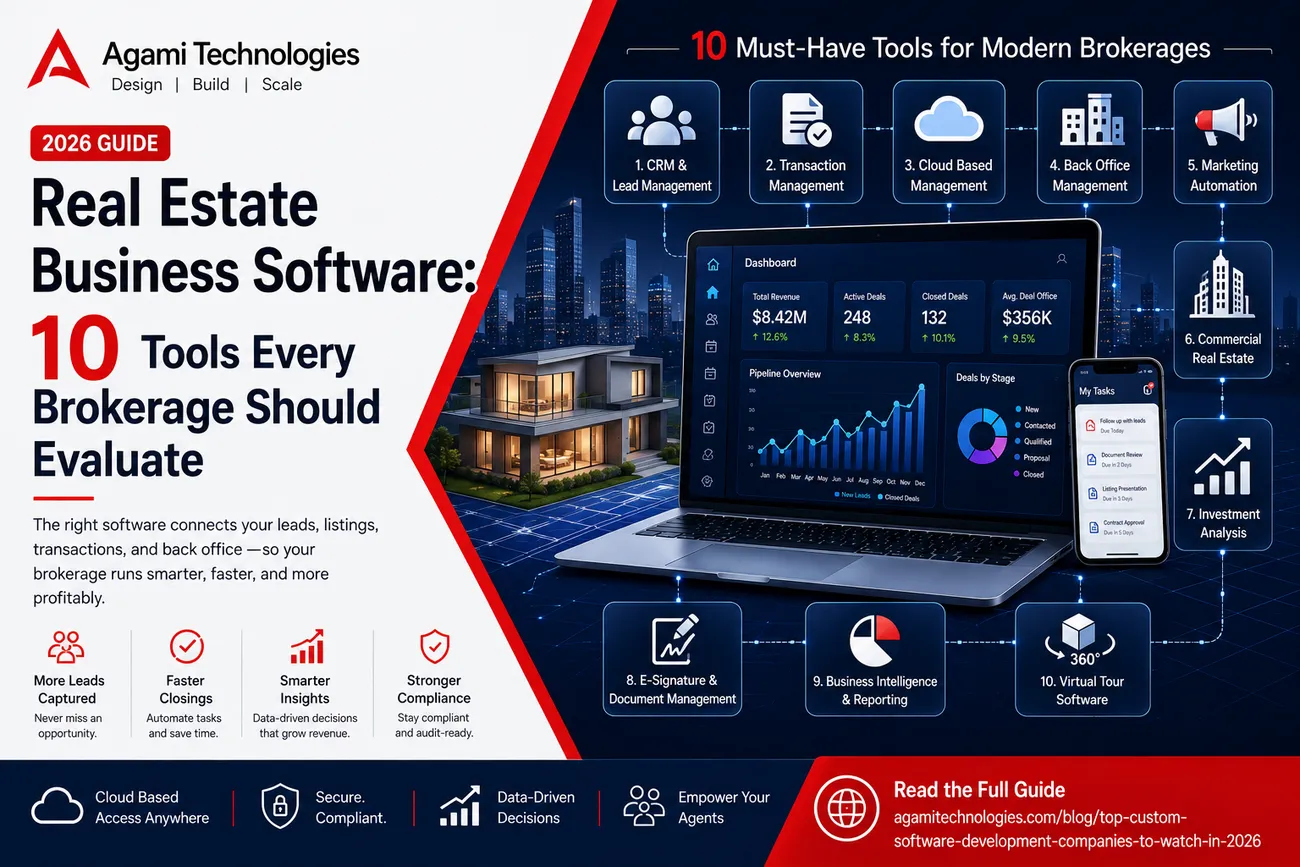
Real Estate Business Software: 10 Tools Every Brokerage Should Evaluate
Running a brokerage today means juggling leads, listings, contracts, agents, and a dozen spreadsheets that never quite agree with each other. If your team is still tracking deals in email threads or sticky notes, you already know the problem. The right real estate business software fixes this. It connects your sales funnel, your back office, and your agents into one system that actually talks to itself.
Real estate business software refers to digital tools brokerages use to manage leads, transactions, listings, and back office operations from one connected system. It typically includes a CRM, transaction management, marketing automation, and reporting tools built specifically for real estate workflows.
This guide breaks down ten categories of tools worth evaluating this year. Some you probably already use in a basic form. Others might be gaps you haven't noticed yet. Either way, by the end you'll have a clear picture of what a modern, well built tech stack looks like for a growing brokerage.
Quick Reference: The 10 Tools at a Glance

Why Brokerage Owners Can't Ignore Real Estate Business Software Anymore
A few years ago, a broker could get by with a CRM and a listing portal. Not anymore. Buyers expect instant responses. Agents expect mobile access. Owners expect real numbers, not gut feelings, when deciding where to invest next.
The gap is bigger than most owners realize. According to the National Association of Realtors' 2025 Technology Survey, only 38 percent of agents agree, and another 29 percent strongly agree, that their brokerage gives them every tech tool they need to do their job well. That still leaves a meaningful share of agents working around outdated or missing systems every day. The same survey found that 82 percent of clients respond positively when technology plays a visible role in the buying or selling process, so the payoff for closing that gap shows up directly in client experience.
Real estate business software isn't a nice-to-have add-on. It's the backbone that lets a small team compete with much larger firms. Brokerages that adopt the right real estate business software early tend to close deals faster, retain agents longer, and scale without hiring an army of admin staff just to keep operations running.
Let's get into the tools.
1. CRM and Lead Management Software
Why Every Brokerage Starts Here
Every deal starts with a lead. If those leads sit in a spreadsheet, you're losing them. A real estate software CRM tracks every contact from first inquiry to closed sale, and it does it automatically.
Key Features to Look For
Automated lead capture from your website, portals, and social ads
Lead scoring so agents know who to call first
Email and text follow-up sequences
Pipeline visibility across every agent on your team
A strong real estate software CRM should feel less like a database and more like a second brain for your sales team. It remembers what a human might forget after the fifteenth call of the day.
2. Transaction Management Software
Why Paperwork Is a Bigger Risk Than It Looks
Missed deadlines, lost documents, and confused compliance checklists cost brokerages real money every single month.
Key Features to Look For
Centralized document storage tied to each transaction
Deadline tracking with automatic reminders
Compliance checklists built for your state or region
Broker level oversight across every open file
This category pairs naturally with your CRM. Once a lead becomes a client, transaction management software takes over and keeps the deal on track from contract to closing.
3. Cloud Based Real Estate Management Software

Why Location Shouldn't Limit Your Team
Your team isn't always in the office. Agents show properties, meet clients at coffee shops, and work weekends. Cloud based real estate management software means your entire operation runs from anywhere, on any device.
Key Features to Look For
Real time syncing across desktop and mobile
Role based access so agents and admins see what they need
Automatic backups and data security
Integration with your CRM and accounting tools
Brokerages that switch to cloud based real estate management software often report a noticeable drop in the small daily friction that used to slow everyone down, like waiting for a file to update or hunting for the latest version of a listing sheet.
4. Real Estate Management Software for Back Office Operations
Why the Back Office Deserves Its Own System
Behind every closed deal is a stack of admin work: commission splits, agent onboarding, license tracking, and reporting. General purpose real estate management software handles all of it in one place instead of five different tools.
Key Features to Look For
Commission calculation and disbursement tracking
Agent roster and license renewal reminders
Custom reporting dashboards for owners and managers
Audit trails for every transaction
Owners who invest in solid real estate management software early tend to spend far less time on month end reconciliation. The numbers are already there, waiting to be reviewed instead of assembled.
5. Marketing Automation and Listing Syndication Tools
Why Visibility Determines Whether a Listing Sells
A great listing means nothing if nobody sees it. Marketing automation tools push your properties across the web automatically and keep your brand consistent everywhere they appear.
Key Features to Look For
One click syndication to major portals and MLS feeds
Social media scheduling built into the same dashboard
Branded email campaigns for open houses and new listings
Performance tracking so you know which channels bring buyers
This is where marketing spend either pays off or quietly disappears. The right platform tells you exactly which listings and campaigns are driving traffic.
6. Commercial Real Estate Software
Why Residential Tools Fall Short for CRE
If your brokerage handles office space, retail, or industrial properties, residential tools won't cut it. Commercial real estate software is built around longer sales cycles, complex lease structures, and multi-party negotiations.
Key Features to Look For
Lease abstraction and tracking
Cap rate and NOI calculators
Tenant and property portfolio management
Deal pipeline tools built for commercial timelines
Firms that mix residential and commercial deals often need commercial real estate software as a dedicated layer on top of their standard CRM. Trying to force commercial deals through a residential tool almost always leads to missing data down the line.
7. Investment Analysis and Financial Modeling Software
Why Investor Clients Expect Hard Numbers
Investor clients want numbers, not opinions. Investment analysis software runs the cash flow projections, cap rates, and return scenarios that used to take hours in a spreadsheet.
Key Features to Look For
Automated ROI and cash flow projections
Scenario comparisons across multiple properties
Market data integration for comps
Shareable investor reports
Brokerages serving investors gain a real edge here. Clients notice when you can hand them a clean, accurate analysis in minutes instead of promising to follow up later.
8. E-Signature and Document Management Software
Why This Is the Easiest Upgrade to Make
Chasing signatures by email is slow and it looks unprofessional. E-signature tools close that gap and keep every document organized and legally binding.
Key Features to Look For
Legally compliant digital signatures
Multi party signing with automatic reminders
Secure cloud storage with version history
Direct integration with your transaction management software
This is one of the simplest upgrades a brokerage can make, and often one of the fastest to pay for itself in saved time.
9. Business Intelligence and Reporting Tools
Why You Can't Improve What You Don't Measure
Business intelligence tools turn scattered data from your CRM, accounting software, and transaction platform into dashboards you can actually act on.
Key Features to Look For
Custom KPI dashboards for owners and team leads
Agent performance tracking
Revenue and expense forecasting
Exportable reports for investors or partners
Owners who check a real dashboard once a week make faster, more confident decisions than owners relying on memory and instinct alone.
10. Virtual Tour and Digital Showing Software
Why Buyers Now Expect to Preview Before They Visit
Buyers now expect to preview a property online before ever booking a showing. Virtual tour software keeps your listings competitive and saves agents time on unqualified walk-throughs.
Key Features to Look For
3D walkthroughs and floor plan generation
Mobile friendly viewing for buyers
Integration with your listing and marketing tools
Analytics on tour views and engagement
This tool category has moved from optional to expected. A listing without a virtual option can feel outdated next to competitors who offer one.
Bringing It All Together
Ten tools sounds like a lot, and it is. Most brokerages won't need every single one on day one. What matters is building toward a connected system where your real estate software CRM talks to your transaction management platform, your cloud based real estate management software keeps everyone synced, and your reporting tools give owners a clear view of the whole operation.
The real estate brokerage software market was valued at roughly 21.3 billion dollars in 2024 and is projected to reach 44.5 billion dollars by 2031, growing at close to a 9.5 percent compound annual rate, according to industry market research. That kind of growth means brokerages of every size are moving in this direction, not just the large franchises with dedicated IT budgets.
The brokerages that scale fastest aren't necessarily the ones with the biggest budgets. They're the ones that picked the right real estate management software early and let it grow with them, instead of duct taping together tools that were never meant to work together.
If your current stack feels like a patchwork of logins and spreadsheets, that's usually a sign it's time for a change. The right real estate business software won't just save time. It will change how your whole team operates, from the first lead to the final closing.
Take the Next Step
Don't wait for a missed deadline or a lost lead to force the decision. Sit down this month and audit your current tech stack. Map out every tool your team touches, note where the gaps are, and compare what you have against the categories above. A focused audit today can save your brokerage thousands in wasted admin hours and missed deals next year.
Frequently Asked Questions
What software does a real estate brokerage actually need? At minimum, a brokerage needs a CRM for lead management, transaction management software for compliance and deadlines, and e-signature tools for documents. As the team grows, marketing automation, business intelligence, and cloud based real estate management software become worth adding.
How much does real estate business software cost for a small brokerage? Costs vary widely by tool and team size, but many individual agents already spend between 50 and 500 dollars a month on technology, according to NAR's 2025 Technology Survey. Brokerage-wide platforms typically scale by seat count or transaction volume, so it pays to compare pricing models before committing.
What's the difference between a real estate CRM and transaction management software? A real estate software CRM manages relationships and leads before a deal is signed. Transaction management software takes over once a deal is under contract, tracking deadlines, documents, and compliance through to closing. Most brokerages need both, ideally integrated.
Is cloud based real estate management software better than on-premise systems? For most brokerages, yes. Cloud based real estate management software gives agents access from any device, reduces IT overhead, and scales more easily as the team grows. On-premise systems can still make sense for firms with very specific data control or compliance requirements.
About the Author
This guide was written by a real estate technology consultant with hands-on experience implementing CRM, transaction management, and back office systems for brokerages managing everything from single-office teams to multi-branch franchises, including MLS and IDX integrations and commission automation workflows. The recommendations here reflect patterns seen across dozens of brokerage tech stack audits, not vendor marketing claims.
Powering the Next Generation of PropTech and Brokerage Software
Brokerages today run on more than agents and listings. They run on data, automation, and systems that work together without friction. At Agami Technologies, we design and build real estate technology that helps brokerages, property managers, and PropTech founders turn daily operations into a competitive advantage.
Whether you're replacing an outdated CRM, connecting your listings to MLS feeds, or building a full SaaS platform for your brokerage network, our team brings real estate domain knowledge together with strong engineering practices.
Our Real Estate Technology Services
Custom Real Estate CRM Development
MLS and IDX API Integrations
Property Management Software Solutions
SaaS Platforms for Brokerages and Real Estate Networks
Transaction Management and Document Automation Tools
Real Estate Data Analytics and Reporting Dashboards
Cloud Migration for Legacy Real Estate Systems
Ongoing Support and Platform Maintenance
Every brokerage has its own workflow, agent structure, and compliance needs. We don't hand you a generic template. We build software around how your business actually operates, so your team adopts it instead of working around it.
Ready to Modernize Your Brokerage's Tech Stack?
If your current systems are slowing your agents down instead of speeding them up, it's worth a conversation. Schedule a consultation with Agami Technologies to walk through your current stack and see where custom real estate software could save your team time and close more deals.
👉 Visit us at: Agami Technologies 👉 Explore our work: Agami Technologies on Whoozit
Continue Reading
How Automated Valuation Models Are Transforming Real Estate Valuation
Turning Raw Data into Strategy with Business Intelligence Software
Best Free Invoicing Software 2025 for Small Businesses & Freelancers
Building Smarter Businesses with Agami Technologies' SaaS Solutions
Primary Blog Hub
Browse more real estate tech, SaaS, and digital transformation insights: 🌐 Agami Technologies Blog