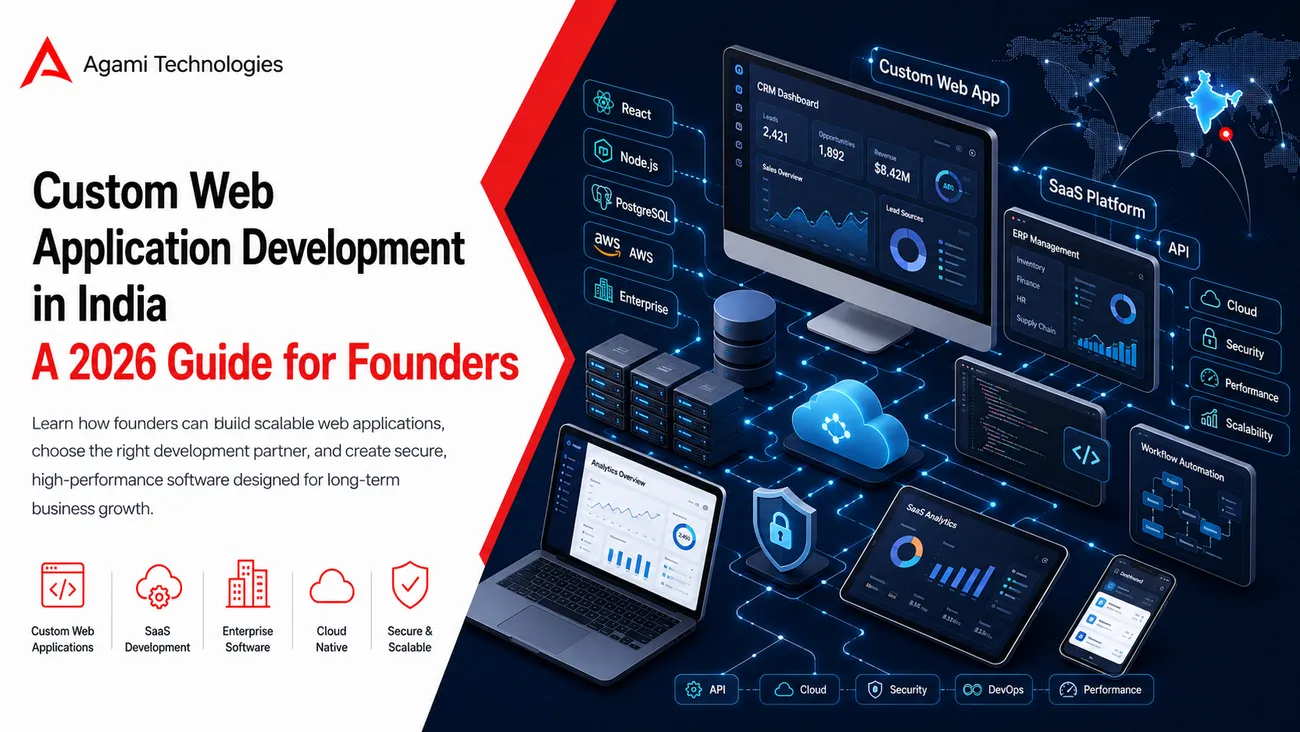
Custom Web Application Development in India: A 2026 Guide for Founders
Launching a business in 2026 looks very different from what it did just a few years ago. Customers expect seamless digital experiences, teams rely on connected workflows, and businesses need software that can evolve as they grow. For many founders, this raises an important question.
Should you build your business around off-the-shelf software, or invest in a custom web application?
There isn't a universal answer. What works for a startup with ten employees may create limitations for a company with ten thousand customers. The right decision depends on your business model, your growth plans, and the kind of experience you want to deliver.
India has become one of the strongest destinations for custom web application development, not simply because development costs are competitive, but because the country's software ecosystem has matured significantly. Product engineering firms now build enterprise platforms, SaaS applications, fintech products, healthcare systems, logistics platforms, and AI-powered business software for companies across the globe.
This guide explains what founders should know before investing in web application development, how to evaluate development partners, what the development process looks like, and why many global companies choose web application development India for long-term product development.
What Is a Custom Web Application?
A web application is software that runs inside a browser instead of requiring users to install it on their devices.
Unlike a traditional website that mainly displays information, a web application allows users to perform actions. They can log in, upload files, manage data, make payments, collaborate with teammates, or automate business processes.
Some familiar examples include:
CRM platforms
Project management systems
Online learning portals
Banking dashboards
Healthcare patient portals
Inventory management systems
Booking platforms
Customer support portals
The word "custom" simply means the software is designed specifically around your business instead of forcing your business to adapt to generic software.
That distinction matters more than many founders initially realize.
Why Off-the-Shelf Software Eventually Creates Friction
Subscription software solves many early-stage problems. It is affordable, quick to set up, and usually requires little technical knowledge.
The challenges appear as the business grows.
A founder may begin using multiple products for CRM, invoicing, inventory, reporting, communication, and customer support. Before long, employees spend time switching between tools instead of completing work.
Information becomes scattered.
Reports don't match.
Processes require manual updates.
Departments create workarounds simply to keep operations moving.
This is often the point where businesses begin exploring custom web application development services.
Instead of fitting business operations around existing software, companies build software that reflects how they actually work.
Why India Continues to Lead Global Web Application Development
When international businesses first outsourced software development to India, cost savings were the primary motivation.
That is no longer the main reason.
Today, many founders choose web application development India because of the country's technical expertise, product engineering experience, and ability to support long-term software evolution.
Several factors contribute to this.
Strong Engineering Talent
India produces one of the world's largest pools of software engineers every year.
Many have experience building products for startups, enterprise organizations, healthcare providers, financial institutions, education platforms, and SaaS businesses.
That cross-industry exposure often helps teams solve problems faster.
Experience With Global Products
Indian software teams rarely work only with local businesses.
Many have delivered platforms used across North America, Europe, Australia, and the Middle East.
As a result, they understand international compliance requirements, cloud infrastructure, scalability challenges, and modern software architecture.
Flexible Engagement Models
Businesses can hire dedicated teams, extend their internal engineering department, or outsource complete product development.
That flexibility allows founders to match development resources with business growth.
Long-Term Product Support
Software rarely ends after launch.
Applications require security updates, feature releases, performance improvements, and infrastructure upgrades.
Many Indian development companies offer continuous support instead of treating development as a one-time project.
When Custom Development Makes Business Sense
Not every company needs custom software.
However, there are clear situations where investing in a tailored solution creates long-term value.
For example:
A logistics company may need route optimization integrated with warehouse systems.
A healthcare provider may require secure patient management workflows that comply with healthcare regulations.
A fintech startup may need approval workflows, identity verification, and financial reporting that standard software cannot easily support.
A SaaS company may need a platform that becomes its primary product rather than an internal tool.
In these situations, building software specifically for the business often becomes more practical than stitching together multiple third-party applications.
What Modern Web Applications Include in 2026
Business software has become far more sophisticated than simple dashboards.
Today's applications often include:
Secure authentication
Role-based permissions
Real-time collaboration
Cloud storage
Payment integration
API connectivity
Analytics dashboards
Workflow automation
Mobile responsiveness
Third-party integrations
Multi-language support
Multi-tenant architecture
Performance monitoring
The exact feature set depends on business objectives rather than technology trends.
Experienced teams start by understanding workflows before recommending features.
Choosing the Right Technology Stack
Founders often ask which technology is best.
The more useful question is whether the technology matches the product's goals.
Modern web development frequently combines frontend frameworks such as React with backend technologies including Node.js, Java, .NET, or Python.
Cloud platforms like AWS, Azure, and Google Cloud provide scalability while databases such as PostgreSQL, MySQL, and MongoDB manage application data.
A good web development company selects technology based on factors like expected traffic, future scalability, maintenance requirements, security, and hiring availability.
Technology choices should support business strategy, not simply follow current trends.
The Development Process Behind Successful Products
Many founders imagine software development as coding from day one.
In reality, the most successful projects spend considerable time understanding the business before writing code.
A typical project includes several stages.
Discovery
The team studies business processes, customer journeys, existing systems, and operational challenges.
This stage often uncovers opportunities that were not obvious at the beginning.
Planning
Features are prioritized.
Technical architecture is designed.
Project timelines and milestones are established.
UX and UI Design
Good software feels intuitive.
Designers create interfaces that reduce confusion and simplify complex workflows.
This is where web design and development work together.
An attractive interface means little if users struggle to complete everyday tasks.
Development
Developers build the frontend and backend while integrating required services such as payment gateways, email systems, CRMs, or ERP platforms.
Testing
Applications undergo functional testing, security testing, compatibility testing, and performance validation before launch.
Skipping this phase often leads to expensive fixes later.
Deployment
The application is released into production with monitoring systems in place.
Ongoing Improvement
Software evolves based on customer feedback, analytics, and changing business priorities.
Successful digital products rarely remain unchanged.
Common Mistakes Founders Make
Many software projects struggle because of planning decisions rather than technical issues.
Some of the most common mistakes include:
Building every feature before validating customer demand.
Choosing the lowest-cost development partner without evaluating technical capability.
Ignoring scalability until performance problems appear.
Treating software as a one-time investment instead of a continuously evolving business asset.
Skipping documentation because the team wants to move quickly.
Each of these decisions usually creates higher costs later.
How to Evaluate a Web Development Company
Choosing the right partner deserves careful attention.
Instead of focusing only on pricing, founders should evaluate how a company approaches product development.
Consider questions like:
Have they built products similar to yours?
Can they explain technical decisions clearly?
Do they understand your industry?
What happens after launch?
How do they manage communication?
Who owns the source code?
How are security updates handled?
Can the software scale as your customer base grows?
Experienced web development services providers spend more time asking questions than making promises.
That is usually a positive sign.
Why Design Has Become a Business Advantage
Many businesses still think design is mostly about appearance.
In reality, design influences customer satisfaction, employee productivity, and conversion rates.
Imagine an insurance platform where users need twenty minutes to complete a claim because forms are confusing.
Now compare that with an interface that guides users step by step.
The second experience reduces support requests, improves completion rates, and builds trust.
This is why custom web design has become an essential part of product development rather than an optional finishing touch.
Security Should Never Be an Afterthought
Security expectations have increased significantly.
Customers expect businesses to protect their personal information regardless of company size.
Modern applications commonly include:
Multi-factor authentication
Data encryption
Secure APIs
Role-based permissions
Regular security updates
Activity logging
Backup and disaster recovery
Security planning should begin during architecture discussions, not after deployment.
The Role of Scalability
One of the biggest advantages of custom software is its ability to grow alongside the business.
Consider a startup serving 500 users.
Within three years, that number may reach 100,000.
If scalability was ignored during development, performance problems become inevitable.
Scalable applications can support increased traffic, larger databases, additional integrations, and expanding teams without requiring complete redevelopment.
That long-term perspective often delivers better value than choosing the cheapest short-term solution.
How Much Does Custom Web Application Development Cost in India?
There is no fixed price because every application has different requirements.
Several factors influence development cost:
Project complexity
Number of features
User roles
Integrations
Security requirements
Design complexity
Infrastructure
Compliance requirements
Maintenance expectations
A simple internal portal differs significantly from an enterprise SaaS platform serving thousands of customers.
Instead of requesting a fixed estimate immediately, founders should first define business objectives and feature priorities.
Accurate planning usually leads to more reliable budgeting.
Future Trends Shaping Web Application Development
Several shifts are influencing how businesses build software in 2026.
Cloud-native architecture has become the default choice for many new products.
Progressive Web Apps continue improving mobile experiences without requiring traditional app installations.
API-first development allows businesses to connect multiple platforms more efficiently.
Real-time collaboration has become a standard expectation rather than a premium feature.
Accessibility standards are receiving greater attention as organizations recognize the importance of serving all users effectively.
Businesses investing in web app development should think beyond immediate needs and consider how their platforms will evolve over the next five years.
Questions to Ask Before Starting Development
Before hiring a web development agency, founders should answer several internal questions.
What business problem are we solving?
Which processes are currently inefficient?
How will success be measured?
Who will use the application daily?
What systems need integration?
How quickly do we expect to grow?
What maintenance resources will we need after launch?
Clear answers reduce project uncertainty and help development teams make better recommendations.
Frequently Asked Questions
What is web application development?
Web application development is the process of building browser-based software that allows users to perform tasks such as managing data, making transactions, collaborating with teams, or accessing business services online.
Why choose web application development in India?
India offers experienced engineering talent, strong product development expertise, flexible engagement models, and cost-effective delivery for businesses ranging from startups to global enterprises.
How long does custom web application development take?
Project timelines vary based on complexity. Smaller business applications may take a few months, while enterprise platforms often require six months or longer with phased releases.
Is custom software better than ready-made software?
It depends on your business needs. Off-the-shelf software works well for standardized processes. Custom software becomes valuable when businesses need unique workflows, advanced integrations, or long-term scalability.
How do I choose a web development company?
Review their technical experience, portfolio, communication process, post-launch support, industry knowledge, and ability to understand your business goals instead of comparing price alone.
Can a web application integrate with existing business software?
Yes. Modern web applications commonly integrate with CRMs, ERPs, payment gateways, accounting systems, cloud storage platforms, and other third-party services through APIs.
Final Thoughts
Building custom software is not simply a technology decision. It is a business decision that influences operations, customer experience, and future growth.
The strongest products rarely begin with complex technology. They begin with a clear understanding of business problems and a disciplined approach to solving them.
For founders evaluating web application development in 2026, success depends less on choosing the latest framework and more on selecting the right development partner, defining realistic priorities, and building software that can evolve alongside the business.
Companies that approach development with that long-term mindset are often better positioned to adapt, scale, and compete, regardless of how quickly the digital landscape changes.
Build Future-Ready Digital Platforms with Agami Technologies
Whether you're launching a startup, modernizing an enterprise platform, or scaling a SaaS product, following modern web development best practices is essential for long-term success.
At Agami Technologies , we help businesses build secure, scalable, and high-performance digital platforms tailored to their growth goals.
Our Services
- Custom Website Development
- Enterprise Web Applications
- SaaS Product Development
- UI/UX Design
- Cloud & API Integration
- Performance Optimization
- Ongoing Support & Maintenance
Ready to build your next digital platform?
Schedule a consultation with Agami Technologies to discuss your project and discover how our experts can help you deliver scalable, secure, and future-ready web solutions.
Explore our services: Agami Technologies
Build custom web applications, enterprise software, SaaS platforms, and scalable digital solutions tailored to your business goals.
Read more technology and business insights: Agami Technologies Blog
Continue Reading
- AI & Machine Learning for Business in 2026: A Plain-English Guide for Decision-Makers
https://agamitechnologies.com/blog/ai-machine-learning-for-business-in-2026-a-plain-english-guide-for-decision-makers - Digital Transformation Strategy: Governance Models That Actually Deliver Results
https://agamitechnologies.com/blog/digital-transformation-strategy-governance-models-that-actually-deliver-results - Digital Transformation Strategies: 2026 Framework & Best Practices
https://agamitechnologies.com/blog/digital-transformation-strategies-2026-framework-best-practices - SDLC Life Cycle Models Explained: The Surprising Frameworks Teams Overlook
https://agamitechnologies.com/blog/sdlc-life-cycle-models-explained-the-surprising-frameworks-teams-overlook - Machine Learning Tools & Solutions: Agami's 2026 Enterprise Tech Stack Guide
https://agamitechnologies.com/blog/machine-learning-tools-solutions-agamis-2026-enterprise-tech-stack-guide
Primary Blog Hub
Browse more technology, SaaS, web development, and digital transformation insights:
Agami Technologies Blog: https://agamitechnologies.com/blog/ Agami Technologies Blog