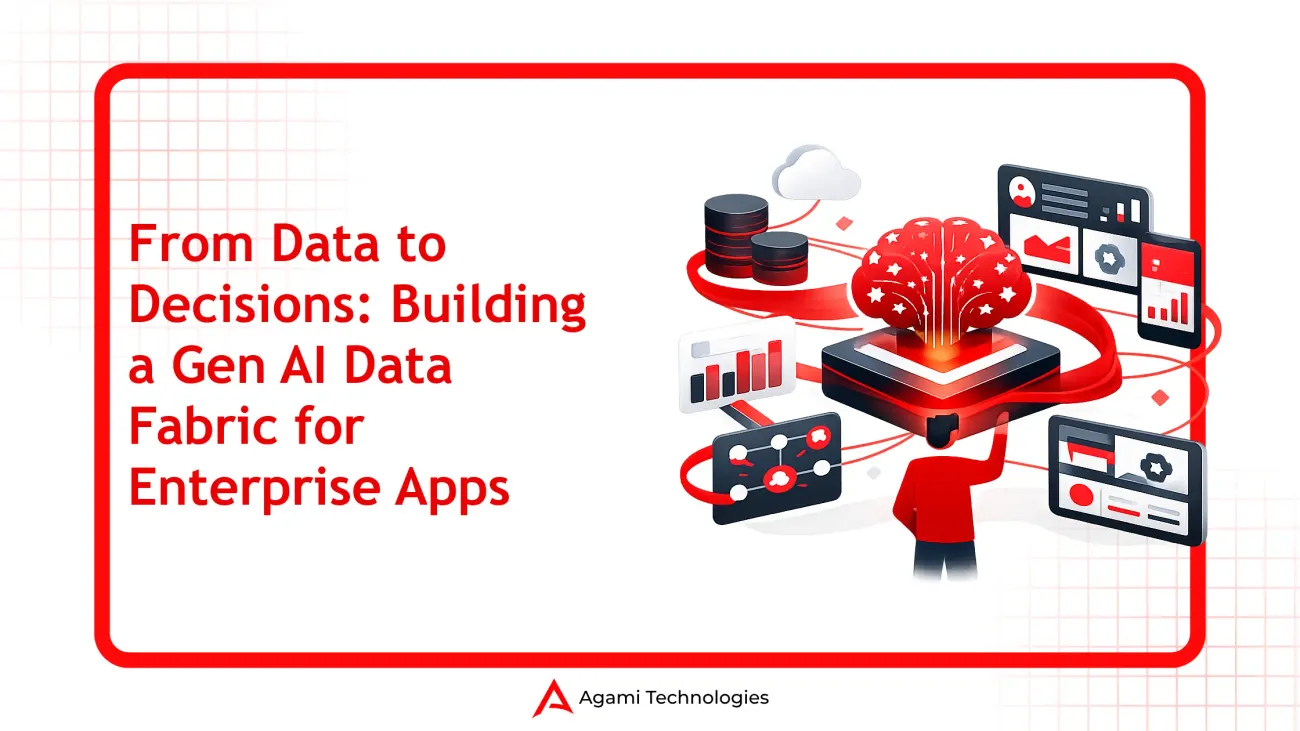
From Data to Decisions: Building a Gen AI Data Fabric for Enterprise Apps | Agami Technologies
Hook: Generative AI won’t transform your enterprise unless you fix the plumbing. Data lives in silos, formats vary, and governance is often an afterthought. A Gen AI data fabric is the architectural pattern that stitches data, metadata, and knowledge into a single, governed airlock for AI inputs and prompts. In this deep-dive, you’ll get a practical blueprint to design, implement, and govern such a fabric for real-world enterprise apps.
This article speaks to CIOs, CTOs, and engineering leaders who want to move from ad hoc AI pilots to scalable, auditable AI-infused software. Expect concrete patterns, checklists, and a worked example you can adapt to healthcare, mortgage, or school-management contexts. No fluff just actionable guidance you can start implementing next quarter.
What is a Gen AI Data Fabric for Enterprise Apps?
A Gen AI data fabric is a layered design that unifies data from heterogeneous sources structured databases, data lakes, APIs, spreadsheets, and legacy systems along with metadata and knowledge graphs. The goal is to provide AI models and prompts with high-quality, timely inputs while preserving lineage, security, and governance. It’s not a single product; it’s an architectural pattern that combines data integration, metadata management, and knowledge synthesis to enable reliable AI-driven decisions across lines of business.
In practice, you’re pairing data fabric capabilities with an intelligent knowledge layer. The fabric surfaces trusted inputs to AI agents, orchestrates data contracts between producers and consumers, and keeps prompts grounded in domain knowledge. When done well, the same data fabric feeds both a model’s training signals and the runtime prompts that drive decision support, conversational interfaces, and automated workflows.
Architectural patterns for Gen AI data fabrics
To avoid a single brittle implementation, consider these patterns as a toolbox rather than a single blueprint. They can be mixed and matched depending on data volume, regulatory constraints, and the maturity of your AI program.
Key Architectural Patterns in a Gen AI Data Fabric| Pattern | What it enables | Pros | Cons |
|---|---|---|---|
| Unified data catalog + metadata layer | Central visibility into data sources, quality, lineage | Faster data discovery, better governance | Requires disciplined metadata discipline |
| Knowledge integration layer | Connects data to domain knowledge (ontologies, terms, taxonomies, NLP-powered linking) | Better prompt grounding and context understanding | Complex to implement; needs domain experts |
| Data contracts + governance-bind prompts | Explicit expectations between data producers and AI consumers | Improved trust and compliance | Overhead to maintain contracts |
| AI-ready data pipelines (data at rest + data in motion) | Timely data for real-time prompts and batch training | Flexibility; supports both streaming and batch | Operational complexity |
In practice, you’ll likely deploy a hybrid: a data lakehouse with a metadata catalog, integrated with a knowledge layer that aligns with business terms and policy constraints. The result is a data fabric that not only stores data but also understands its meaning, provenance, and trustworthiness crucial for governance-heavy domains like healthcare and finance.
Governance, provenance and trust: the backbone of reliable Gen AI
Garbage in, garbage out is not just a saying it's a risk regime for Gen AI. Governance in a data fabric means provenance, access controls, and policy-driven prompt design. Proactive governance avoids data drift, biases, and compliance gaps that can derail an AI initiative.
Track where data originated, how it was transformed, and who touched it. Provenance is essential for auditing prompts and models. Define who can consume which data, in what context, and for which purposes. Contracts help decouple data producers from AI consumers while keeping boundaries clear. Build guardrails, versioned prompts, and test suites to ensure prompts stay aligned with policy and domain constraints. Integrate privacy controls, data masking, and encryption into pipelines and access layers.
Governance is not a one-and-done activity. It requires automation (policy as code), continuous auditing, and a feedback loop from model outcomes back into data quality improvements. The goal is a living fabric that grows with your AI program rather than a static repository of data.
Practical blueprint: a step-by-step approach to building the fabric
Map all data sources, including APIs, internal databases, data warehouses, and external feeds. Document schemas, sensitivities, and update frequencies. Example: a mortgage CRM pulls customer data, appraisal details, and rate feeds from multiple systems; you map each source’s latency and quality expectations. Create explicit agreements between data producers and AI consumers. Contracts specify purpose, freshness, access patterns, and retention. This is the guardrail that keeps AI usage aligned with business intent. Centralize data schemas, lineage, quality metrics, and business terms. Extend it with a knowledge graph that encodes domain concepts (e.g., patient, member, loan, claim) to improve semantic alignment in prompts. Link data with domain knowledge using ontologies and NLP that surface relationships, synonyms, and context. For example, tying patient identifiers to clinical concepts improves prompt relevance in a healthcare app. Implement data flows that support both real-time prompts and batch model ingestion. A common pattern is a streaming path for live alerts and a batched path for model retraining. Version prompts, run automated tests, and attach governance metadata to each prompt. Tie prompts to data contracts and provenance data so you can audit decisions later.
Worked example: Healthcare management platform. Suppose a clinician-facing assistant draws on patient vitals, medication histories, and lab results. The fabric ensures data from the EHR, pharmacy system, and lab feeds are harmonized, governed, and surfaced with clear provenance. The prompts are tied to clinical ontologies and privacy policies, preventing leakage of PHI and enabling compliant decision support.
What goes wrong and how to avoid common traps
You can’t govern what you can’t see. Build a centralized metadata repository early. Data quality and prompt effectiveness drift over time. Establish continuous evaluation loops that compare outputs to ground-truth decisions. Rigid prompts break when data formats change. Use prompt templates with domain-aware fallbacks and guardrails. Ensure data access is role-based, with masking and encryption where needed, especially in regulated sectors. Favor open standards for data contracts and provenance so you’re not locked into a single platform.
These missteps are often symptoms of rushing to an AI pilot without the supporting data architecture. A robust data fabric requires intentional design, not heroic engineering fixes after the fact.
Measuring success: what to track and why it matters
Establish a compact set of leading indicators that tell you if the data fabric is delivering reliable AI outputs and accelerating decision cycles.
Percent of critical data sources connected and updated within the sprint window. Higher coverage reduces blind spots in prompts. Alignment of AI outputs with domain knowledge. Track variance against clinician or broker judgments, and tighten ontologies as needed. Reduction in time-to-decision and improvements in decision quality attributable to AI assistance. Policy compliance, data access requests fulfilled within SLA, and audit trail completeness.
By tying these metrics to business outcomes reduced manual work, faster customer responses, and better risk management you turn an architectural effort into tangible ROI.
Frequently Asked Questions
What distinguishes a Gen AI data fabric from a traditional data fabric?
A Gen AI data fabric adds a knowledge-aware layer and governance guardrails that specifically support AI prompts, AI agents, and generative workflows. It emphasizes domain knowledge, prompt grounding, and governance contracts as core components rather than optional add-ons.
How do you begin migrating to a Gen AI data fabric without disrupting current operations?
Start with a phased approach: inventory and catalog data, establish a pilot data contract, and create a small knowledge graph anchored to a high-value domain. Run parallel streams so existing apps continue to operate while you validate AI outputs and governance practices.
What roles are essential for implementing a Gen AI data fabric?
Key roles include a data architect to design the fabric, a governance lead to manage policies, a knowledge engineer to build the domain graph, data stewards for data quality, and AI engineers to implement prompts and agent orchestration.
How should we measure risk when deploying Gen AI in enterprise apps?
Monitor data provenance, prompt guardrails, access controls, and model outputs against ground-truth decisions. Establish a risk register and run regular red-team exercises to surface potential failure modes in prompts or data inputs.
Helpful Links
Next step: let's design your Gen AI data fabric
Ready to move from idea to implementation? We can help you design an end-to-end Gen AI data fabric tailored to your enterprise, with a plan for data sources, governance, and AI prompts. Book a strategy workshop and start turning data into trusted decisions today.