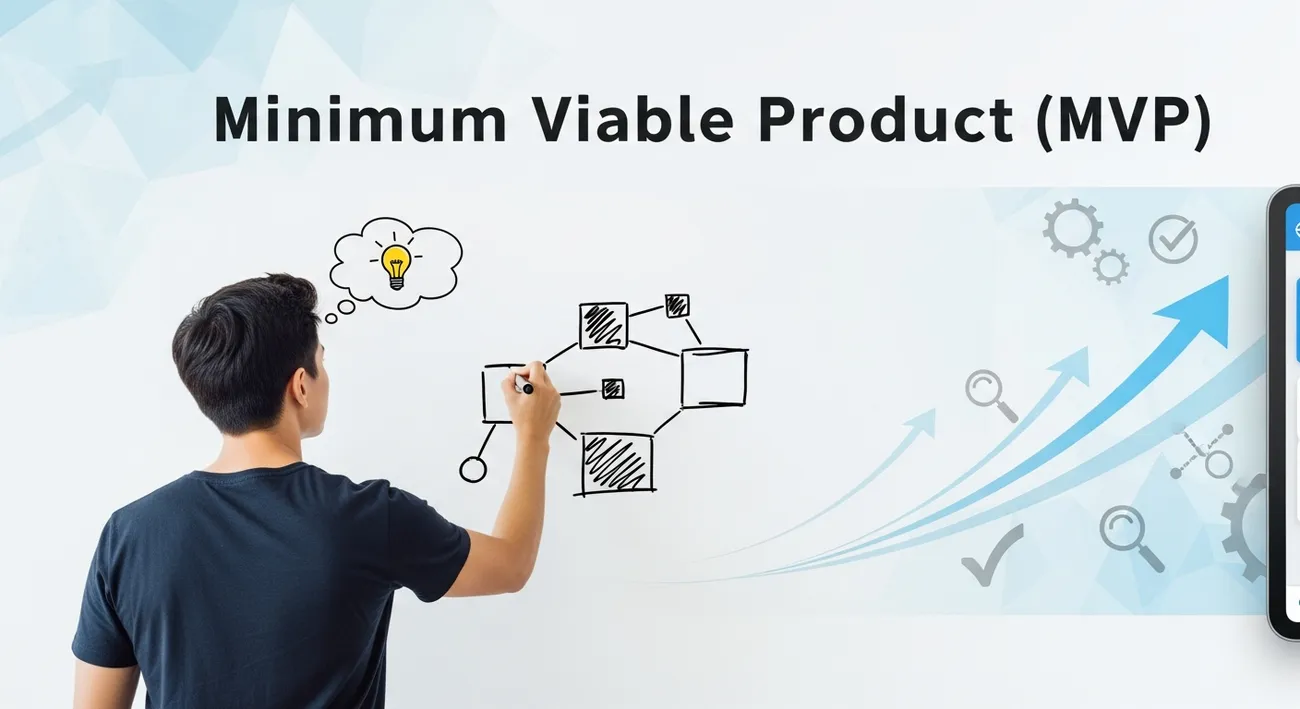
Why Every Startup Needs a Minimum Viable Product
Short Summary
This blog explains why building a Minimum Viable Product (MVP) is the smartest way for startups to validate ideas quickly, reduce risk, and save time and money. It breaks down what an MVP really is, why it matters, common mistakes to avoid, and practical examples like landing pages, concierge MVPs, and single-feature apps. The post also outlines a step-by-step MVP process, key metrics to track, and real-world case studies, showing how startups can learn from real users before scaling. Overall, it positions MVPs as experiments that help teams achieve product–market fit faster with clearer, data-driven decisions.
When I first worked with early-stage founders, I saw the same pattern over and over. Teams built a full feature set, polished every pixel, and launched to crickets. It hurts to watch. The smarter route is simpler. Build a minimum viable product mvp, learn fast, and iterate. That small shift can save months of work and a lot of cash.
If you are a founder, product manager, or part of a startup team, this post is for you. I’ll explain what a minimum viable product is, why it matters, how to build one, common mistakes to avoid, and practical examples you can copy. I’ve included tactical tips that come from real projects I’ve coached, plus simple templates you can use tomorrow.
What is a minimum viable product?
At its core, a minimum viable product is the smallest thing you can build that delivers value to users and teaches you whether your idea has legs. It is not a half-baked app or a feature graveyard. It is a tool for testing a business hypothesis with real people quickly and cheaply.
People often confuse an MVP with a prototype or a final product. A prototype demonstrates a concept. A final product solves many use cases. An MVP sits in between. It proves that a specific solution solves a specific problem for a specific group of users.
Call it an experiment if that helps. You want to learn three things as cheaply as possible. Is there demand? Do users get value? Can you deliver that value at scale? If you answer yes, you’re ready to invest more. If not, you pivot, adapt, or stop before sinking more time and money.
Why every startup should build an MVP
Startup resources are limited. The wrong choice can cost you your runway. Here are the main reasons I push teams toward an MVP approach.
- Reduce risk and cost. Building less up front lowers burn rate. You avoid locking into expensive architecture or features users never use.
- Validate product-market fit early. An MVP gives you proof, not opinions. Real users signing up, returning, or paying tells you you’re solving a real problem.
- Learn fast and iterate. Data from an MVP helps you prioritize the next steps. You can make decisions with evidence, not gut feelings.
- Improve hiring and investment outcomes. Investors and senior hires want traction. An MVP with basic metrics and user stories is easier to sell than a roadmap slide deck.
- Focus the team. Narrow scope keeps engineering, design, and marketing aligned. Teams avoid overbuilding and feature creep.
In my experience, the benefits of mvp are not academic. They translate directly into saved time, fewer burned bridges with customers, and clearer product decisions. I’ve seen startups cut development time in half by committing to a strict MVP scope early on.
Minimum viable product examples you can steal
Want to know what a real MVP looks like? Here are several common and effective minimum viable product examples. These are simple to implement and useful across industries.
- Landing page with waitlist. Describe the product, show mockups, and collect emails. Drive traffic with ads or founder networks. Use conversion rate and signups as demand indicators.
- Concierge MVP. Manually deliver the service behind the scenes. This is great for marketplaces or complex workflows. You learn the real customer steps without building automation first.
- Wizard of Oz MVP. The app looks automated but you fulfill requests manually. For example, a chatbot interface handled by humans in the background.
- Single-feature app. Launch one core feature well rather than ten features poorly. Let that one feature prove value and attract early users.
- Status page or prototype demo. Clickable Figma prototype or a video walkthrough to test buyer interest before coding.
- Crowdfunding campaign. Use Kickstarter or Indiegogo to validate demand and pre-sell your product.
- Email-based MVP. Provide a simple service via email. This is low-cost and fast to iterate.
These minimum viable product examples are not theoretical. I’ve used the concierge approach to validate a local logistics service. We learned the biggest bottlenecks before investing in route optimization software. That one step saved six months of needless development.
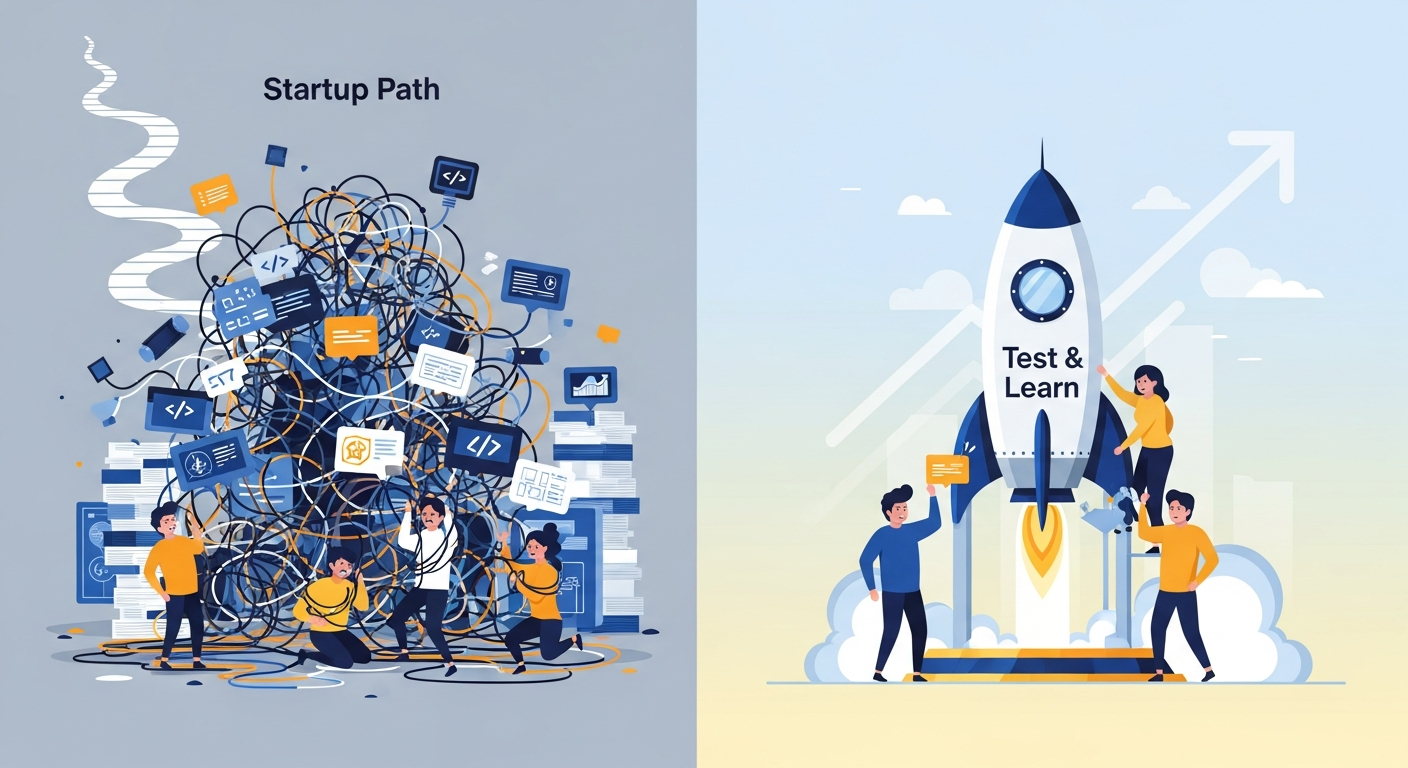
How to decide what to build for your MVP
Start with a clear hypothesis. What problem are you solving and for whom? What behavior would show that people care? Without that, you’re guessing. Here’s a simple framework to pick the right scope.
- Define the core problem. Write one sentence about the problem and who has it.
- Identify the core metric. Choose one number that proves value. Examples: weekly active users, conversion rate from visit to paid, or number of completed transactions.
- Map the minimal user journey. Sketch the steps required to experience the value. Cut everything that does not directly contribute to that journey.
- Prioritize features. Score features by how much they move the core metric and how hard they are to build. Pick the top one or two.
- Decide the implementation pattern. Choose between landing page, manual fulfillment, prototype, or single-feature app based on risk tolerance and learning goals.
Imagine a marketplace for local tutors. The hypothesis could be: "Parents will pay $X per hour for vetted tutors matched within 24 hours." The core metric might be the number of paid lessons booked within the first month. For an MVP, you might build a simple landing page and a manual matching process. That gets you bookings and payments without a full matching algorithm.
Step-by-step MVP development process
Here’s a realistic sequence I recommend. You can compress or expand steps depending on your risk and runway.
- Customer discovery. Talk to customers before writing a line of code. I know it feels awkward, but a dozen conversations will reveal where assumptions die quickly.
- Write your hypotheses. Be explicit. Hypotheses can be about demand, pricing, retention, or acquisition channel.
- Design the minimal experience. Focus on one flow that delivers the core value. Wireframes or a clickable prototype are fine early on.
- Choose the simplest delivery method. Manual work is fine. Use spreadsheets and Slack if you must. The goal is learning, not elegance.
- Build and launch quickly. Aim for days or weeks, not months. Short cycles keep feedback relevant.
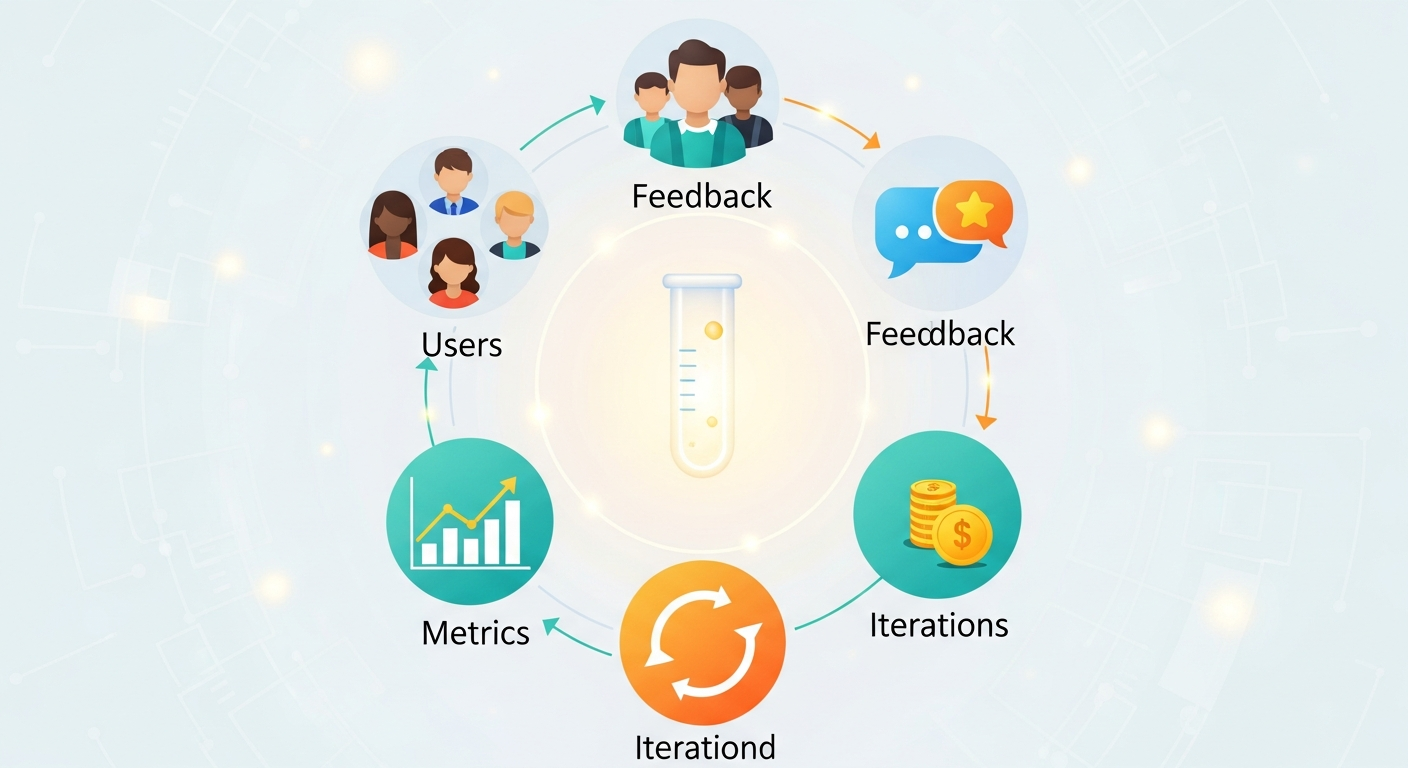
- Measure results and collect qualitative feedback. Numbers tell you what, conversations tell you why.
- Decide based on evidence. Iterate, pivot, or stop. Don’t double down on wishful thinking.
One practical tip: set a time-box. Commit to a two- to six-week MVP sprint. We’re trying to learn, not build a product empire. A time-box prevents scope creep and forces prioritization.
Metrics that matter for an MVP
Metrics help you separate noise from signal. Pick a handful and track them consistently. Here are the ones I care about first.
- Acquisition. Cost per visit or cost per signup. How much are you paying to attract attention?
- Activation. The percent of users who experience the product’s core value. For a marketplace, activation might be a booked session.
- Retention. Are users coming back? Week-one retention is a strong early indicator of value.
- Conversion. Free to paid conversion tells you whether customers will pay for the value.
- Revenue. Monthly recurring revenue or total paid transactions during the MVP period.
- Qualitative feedback. User interviews, NPS, and support conversations that explain why people like or dislike the product.
Don’t try to measure everything. A few clean metrics will make decisions faster. And remember, numbers without context mislead. Follow up with interviews to understand the "why" behind the numbers.
Common MVP mistakes and how to avoid them
I’ve seen teams trip over the same pitfalls. They are avoidable if you watch for them.
- Building a beauty case study instead of an MVP. If you spend months on polish, you risk learning too late. Ship something functional, not flawless.
- Trying to solve multiple problems. Your product will never be good at two things at once early on. Stay laser focused on one problem.
- Confusing prototype with validated MVP. A prototype can show concept, but unless real users pay or consistently use the product, you haven’t validated demand.
- Ignoring qualitative feedback. Metrics are great, but they don’t tell the whole story. Talk to users.
- Over-automating before you understand manual needs. Building automation for processes you do not fully understand wastes time. Automate after you’ve learned common edge cases.
- Not time-boxing. Open-ended projects expand. Set deadlines.
- Letting tech debt explode. You must move fast, but track debt. Document shortcuts so you know what to fix if you scale.
One avoidable mistake I see often is premature optimization. Teams spend months building for 100,000 users while they still have fewer than 100. Optimize when the problem shows up, not before.
Read More : What Are Prompt Engineering Tools? How They Improve AI Model Performance in 2026
Tools and tech for fast MVPs
You do not need to invent your stack. Pick tools that let you move quickly and pivot. Here are options I've used across projects.
- No-code and low-code. Webflow, Bubble, Airtable, Zapier. Great for landing pages, simple marketplaces, or dashboards.
- Backend as a service. Firebase, Supabase, or Hasura for fast authentication and data storage.
- Serverless functions. AWS Lambda, Vercel for quick APIs without managing servers.
- Off-the-shelf components. Authentication, payments, and analytics platforms get you running without rebuilding everything.
- Manual workflows. Use spreadsheets, email, and phone calls to run early operations. This gives you insight into user needs before investing in automation.
Choosing tools matters less than choosing a mindset. You want to ship, measure, and learn. The right tools help you do that quickly and cheaply.
When to scale beyond the MVP
Knowing when to move from MVP to scale is part data and part judgment. Here are signs that it is time to invest more.
- Consistent growth in your core metric over several weeks or months.
- High conversion from free to paid or repeated purchases that show willingness to pay.
- Clear product-market fit signals, such as word-of-mouth referrals or low churn.
- Operational repeatability. You understand key workflows enough to automate them effectively.
- Investor interest based on traction and unit economics that make sense at scale.
Even when these signals appear, proceed incrementally. Upgrading the tech stack, hiring more people, and expanding the roadmap are all big moves. Do them in stages and keep measuring.
How Agami Technologies helps build effective MVPs
At Agami Technologies, we’ve helped several early-stage teams take ideas to validated products fast. We focus on rapid validation, clear metrics, and pragmatic engineering. What that means in practice is simple. We help you define the hypothesis, pick the minimal scope, and build the MVP using the fastest reliable path.
For teams without deep engineering resources, outsourcing parts of the MVP makes sense. You still need to own the product decisions, but a partner can speed up development, advise on tooling, and keep technical debt under control. In my experience working with Agami Technologies, a collaborative approach where founders stay close to the work produces the best learning and fastest iteration.
Simple MVP playbook (one-page)
Here is a short, practical checklist I use with founders. You can paste this into your project board and start today.
- Write your one-line hypothesis.
- Choose the core metric to prove or disprove that hypothesis.
- Create a two-week sprint plan to build the minimal user journey.
- Decide whether to run manual or automated operations for the MVP.
- Prepare a landing page or a prototype to start marketing right away.
- Launch, measure, and interview at least 20 users.
- Discuss results, decide on next steps: iterate, pivot, or stop.
This playbook keeps decisions tied to learning. When you treat an MVP as an experiment, you build something your customers actually want.
Real-world examples and quick case studies
Here are two short examples to make the process concrete. These are simplified, but they show the reasoning and the outcomes.
Case study 1: Local food delivery startup
The team believed neighborhood restaurants would pay to reach customers during off-peak hours. Instead of building a full marketplace, they launched a landing page and a WhatsApp group to route orders manually. They charged a small service fee and used drivers from a partner company for deliveries.
Within three weeks they had 150 signups and processed 60 paid orders. The core metric, orders per week, hit the target. Interviews revealed customers loved the curation but hated delivery time variability. This insight helped shape their Food delivery app development strategy, prompting the team to invest in simple routing and then automate the order flow. They scaled once delivery became predictable.
Case study 2: Freelance marketplace for event technicians
The founders built a form to collect requests and then personally matched technicians listed in a spreadsheet. They handled contracts and payments manually. Early customers were willing to pay a premium for reliable matches within 24 hours.
This MVP proved pricing and demand. Armed with that data, the founders built a lightweight platform with search and payments. They avoided building a complex matching engine until volume justified it.
Both examples show the same point. You can learn the hard lessons without a finished product. The manual work informs the automation you will build later.
Common questions founders ask about MVPs
I get a few repeat questions. Here are short answers that might help you.
- How minimal is minimal? Minimal means the smallest scope that still delivers the core value and produces measurable behavior. If users can experience value and you can measure it, that is usually enough.
- Should I ask users to pay? If your business will rely on revenue, getting payment validates real commitment. For other models, strong engagement metrics can be just as meaningful.
- How long should an MVP run? Run long enough to gather meaningful data. For many consumer products, two to three weeks gives you a signal. For B2B sales cycles, you might need a few months.
- What if I get negative feedback? That feedback is gold. Negative reactions teach you where to pivot. Listen, validate whether the pain is real, and adapt.
Practical pitfalls to watch for
A few practical warnings from the trenches.
- Don’t confuse vanity metrics with real metrics. Views and downloads don’t equal value.
- Be wary of small sample sizes. Anecdotes are helpful, but you need consistent patterns.
- Resist feature creep. Adding features dilutes your learning about the core value.
- Keep technical shortcuts documented. You will need to fix them if you scale.
One quick example: a founder added three extra features during the MVP period because a few users asked for them. The result was diluted data and a confused product. After removing the extras, the team recovered clarity and saw better signals.
How to present your MVP progress to stakeholders
When you report to investors, advisors, or teammates, present clear evidence. Use these elements:
- One sentence summary of the hypothesis and core metric.
- Top-line metrics with context. Don’t just give numbers. Explain why they matter.
- User stories and qualitative highlights. Share direct quotes or short clips.
- Decisions taken and next experiments planned. Show that you have a learning roadmap.
Investors want clarity, not perfection. Tell them what you learned, why it matters, and what you will do next.
When the MVP fails
Sometimes MVPs fail. That is okay. Failure means you learned fast and cheap. The real cost is repeating the same mistake after getting new information. Here’s how to handle a failed MVP well.
- Document what you tested and what the results were.
- Analyze whether the hypothesis was wrong, the execution was poor, or the market timing was off.
- Decide whether to pivot, run a different experiment, or stop the idea.
- Share the findings with the team and investors honestly.
I’ve seen teams treat an MVP failure as a reason to panic. The better response is curiosity. What exactly did you learn? What will you try differently next?
Checklist before you start building
Here is a final pre-launch checklist. Run through it with your team before you build.
- Hypothesis written and shared.
- Core metric selected and instrumented.
- User journey mapped and pared down.
- Data collection and analytics set up.
- Plan for qualitative interviews on launch.
- Time-box and success criteria agreed.
- Budget and resources aligned.
One small trick: assign one person to own metrics and one to own user interviews. Splitting these responsibilities forces you to collect both numbers and context.
Final thoughts
Building an MVP is one of the smartest moves a startup can make. It forces clarity, reduces wasted effort, and helps you learn from real users early. I’ve noticed that teams who embrace this experimental mindset make better product decisions and preserve runway. They also avoid the heartbreak of launching a beautifully built product no one uses.
If you are about to start an MVP, remember to keep it focused, measure what matters, and treat every launch as an experiment. Stay humble. Stay curious. And keep iterating.
Read More : How to Prioritize Features for a Lean Custom SaaS MVP
Helpful Links & Next Steps
If you want help scoping and building an MVP, I’ve worked with teams to move from idea to validated product fast. Book a meeting to talk through your hypothesis and get a pragmatic plan.
Book a meeting
Frequently Asked Questions About MVP
1. What is a minimum viable product (MVP)?
A minimum viable product (MVP) is the most basic version of a product that conveys the main value to users and, at the same time, allows startups to test assumptions, validate demand, and learn with minimum cost and effort.
2. Why is an MVP important for startups?
An MVP enables startups to decrease risk, cut down on development costs, validate product, market fit at an early stage, and rely on data when making decisions before the full, scale product development is launched.
3. How long does it take to build an MVP?
The majority of MVPs can be completed within 2 to 8 weeks but this can vary depending on the level of complexity, the scope, and whether no, code, low, code, or custom development approaches are used.
4. What features should be included in an MVP?
The MVP should sufficiently provide the core features that effectively address the specific problem for the target user and demonstrate valuefeatures that do not support learning or validation should not be included.
5. What is the difference between an MVP and a prototype?
A prototype is a kind of demonstration of what a product might be like but the MVP is an actual product that real users utilize for validating demand, usability, and business viability through quantitative behavior.