Digital Transformation Strategy: Governance Models That Actually Deliver Results
Most digital transformation strategies fail not because of bad software choices, but because nobody defined who actually owns decisions when things go sideways. This post breaks down the four governance models organisations use in practice — centralised, federated, agile, and hybrid — and what execution excellence actually looks like inside each one. Covers decision rights, legacy system migration approaches (Strangler Fig vs. hard cutover), change management that moves behaviour rather than just sending emails, and how to measure ROI in ways that go beyond milestone tracking.
Whether you're choosing a framework, designing a governance layer, or selecting an implementation partner, this gives you the structural thinking behind transformations that actually ship.
Most companies building a digital transformation strategy spend months choosing the right software. Then they spend the next 18 months watching that software gather dust because nobody agreed on who owned the rollout.
The technology choice is rarely the problem. It's what happens before and after the governance layer that decides whether your transformation delivers or dies in a planning loop.
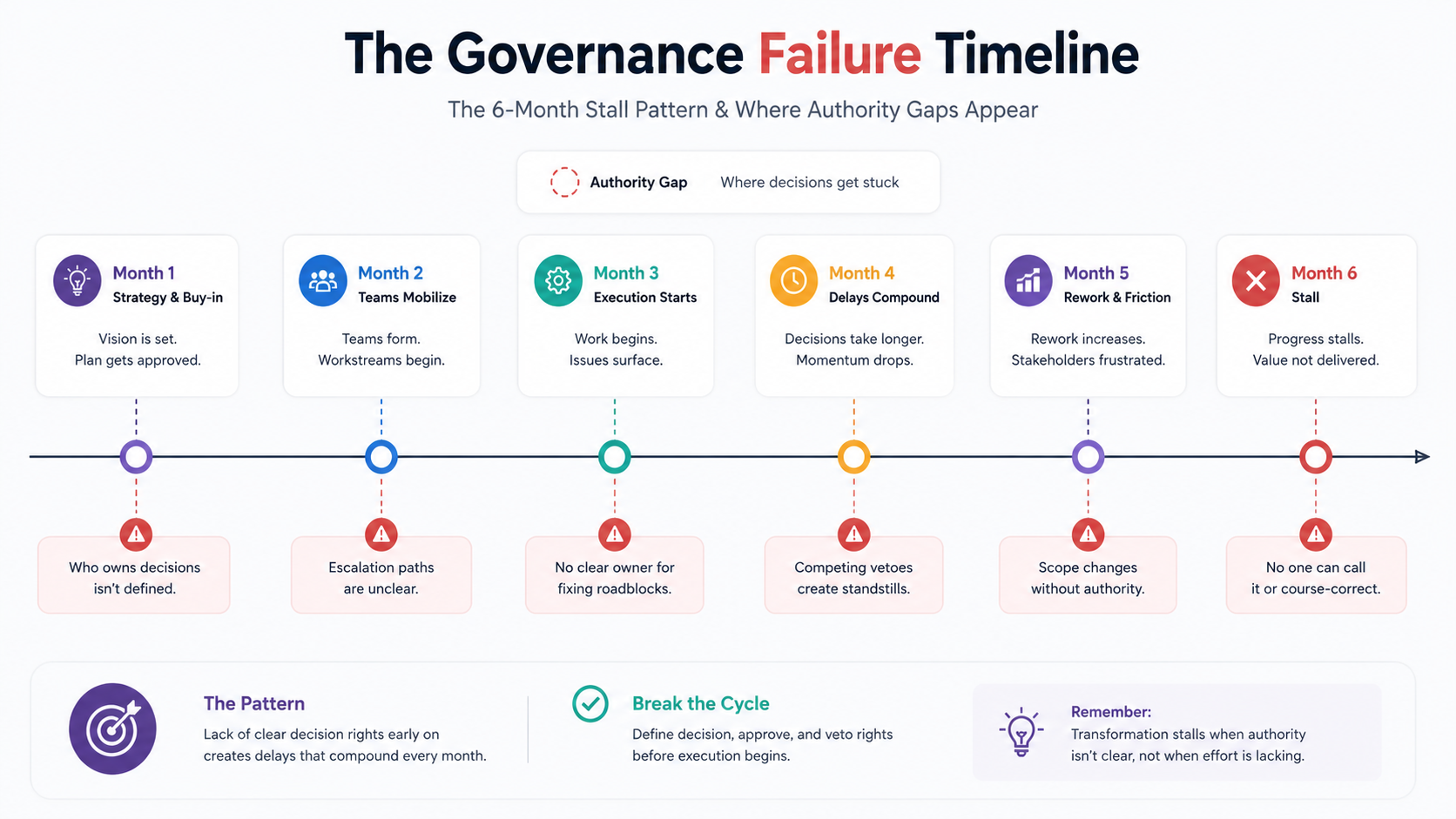
This is the part most blogs skip. They hand you a digital transformation roadmap template and call it done. What they don't cover is the structural reason transformations fail at execution: decision rights are either undefined, wrong-placed, or actively contested. And by the time that becomes obvious, you've burned six months and half the budget.
Here's what governance actually looks like when it works and what execution excellence means when you're deep in it.
Why Your Digital Transformation Plan Stalls Before It Ships
There's a pattern that shows up across organisations of every size. The digital transformation plan gets greenlit. A steering committee forms. Tools get selected. Kickoff happens.
Then six months in, nothing has changed in how anyone actually works.
The reason is almost always the same: the transformation was designed at leadership level and handed downward without the accompanying authority structure. Teams know what's supposed to happen. They don't know who's allowed to make the calls that unblock them when something goes wrong and things always go wrong.
Industry research consistently shows that operating-model complications and lack of internal alignment between digital and traditional business units are among the top barriers organisations report. Expectation of short-term ROI is also falling year over year, not because technology has gotten worse, but because execution problems aren't being fixed; organisations are simply lowering expectations
The Four Digital Transformation Frameworks in Practice
When people search for a digital transformation framework, they usually find generic diagrams. Here's what these models look like when they're actually running inside an organisation:
1. Centralised Governance
A single Digital Transformation Office holds all decision authority, budget, vendor selection, architecture standards, prioritisation across business units. Every function routes requests through this office.
Works well when you genuinely need consistent standards enterprise-wide and when the transformation is architecturally interconnected. Falls apart when the central office becomes a bottleneck with eight people approving changes for 40 departments. If your teams wait two weeks for a decision that should take two hours, this is why.
2. Federated Model
Business units run their own transformation within a framework set centrally. The centre owns shared infrastructure (cloud, security, vendor contracts), individual units own execution.
This is where most mid-to-large organisations land, for good reason. It puts accountability with the people who understand the domain. The failure mode is integration: units make locally smart decisions that create systems that don't talk to each other. A federated model without clear integration governance produces a patchwork.
3. Agile Governance
Decision authority sits as close to the work as possible. Governance moves at the speed of delivery, not the speed of approval cycles. Escalation paths exist but are narrow.
This model works when leadership genuinely delegates decision rights and accepts that team-level decisions will sometimes be wrong. Most organisations say they're running agile governance while reviewing progress in monthly steering committees. Those are different things. Monthly steering committees are centralised governance with agile branding.
4. Hybrid Model
Most real digital transformation projects use this: centralised governance for cross-cutting concerns (security, data standards, architecture), federated execution for domain-specific work, agile delivery at the team level.
The hybrid model fails when boundaries are unclear. If business units don't know which decisions they own vs which need central sign-off, you get constant escalation or rogue decisions that create downstream headaches. Clarity of decision rights matters more than which model you choose.
Decision Rights: The Part Everyone Skips
Most digital transformation frameworks spend substantial time on org charts and very little on decision rights. That's backwards.
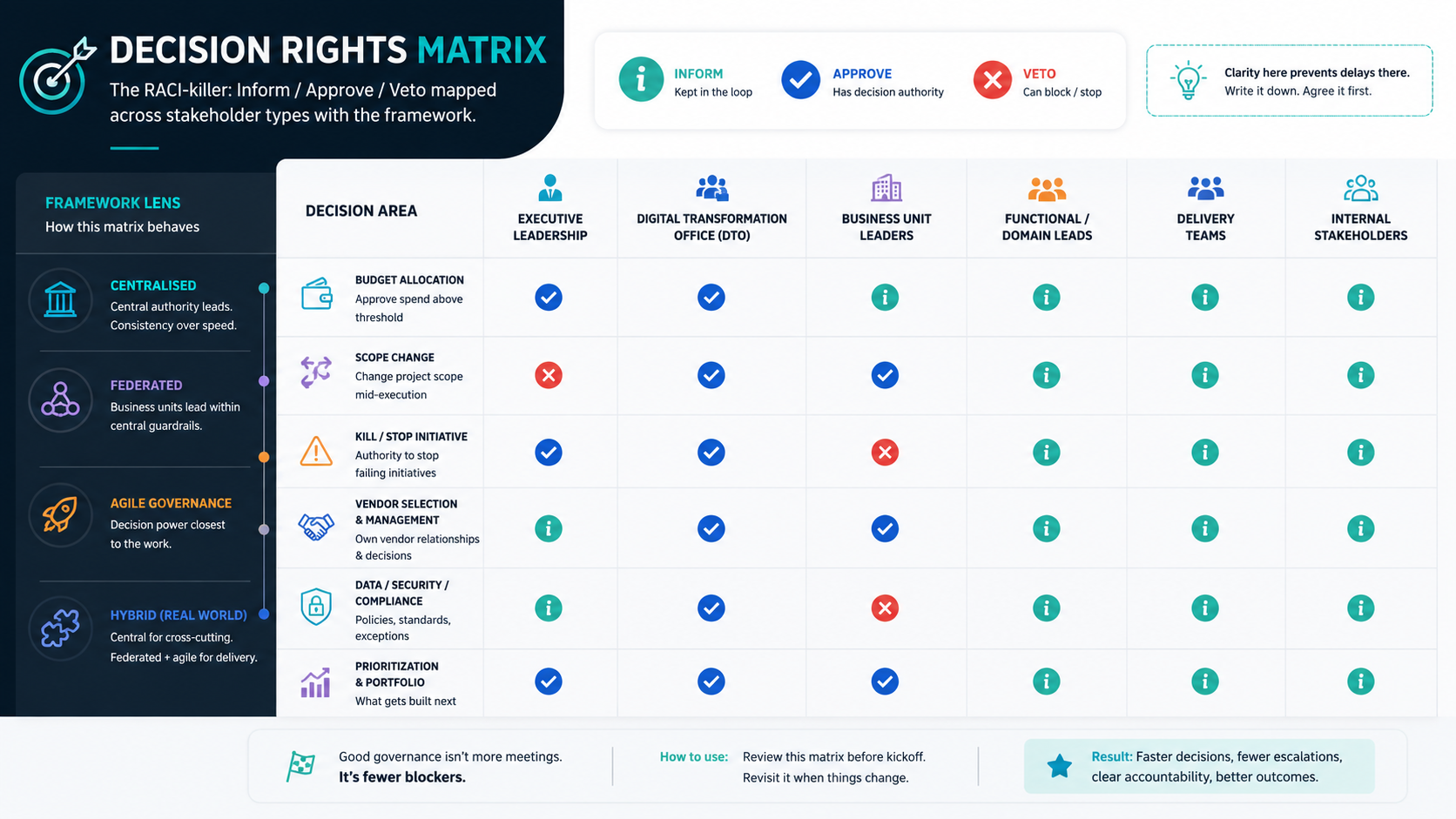
A RACI matrix is a starting point, not a solution. What you actually need to define before the work starts:
- Who can approve spend above a given threshold?
- Who can change project scope mid-execution?
- Who has authority to kill an initiative that's failing?
- Who owns vendor relationships, and what does ownership mean in terms of actual authority?
The organisations that execute well have written, explicit answers to these questions before month one ends. Not because bureaucracy helps, but because ambiguity at decision points causes two-week delays every time something unexpected happens and unexpected things happen constantly.
A useful distinction: separate inform rights from approve rights from veto rights. A lot of governance confusion comes from stakeholders with inform rights acting as if they have veto rights, with nobody having told them otherwise. Write it down. Explicitly. Before the kickoff.
What Digital Transformation Change Management Actually Requires
This is where most digital transformation strategy documentation gets vague. Change management gets reduced to a communication plan. emails from the CEO, town halls, mandatory e-learning modules. That's necessary. It's not sufficient.
What actually moves behaviour is proximity. People change how they work when the people they respect are visibly working differently. When a department head personally pulls reports from the new analytics platform rather than asking an assistant to send the Excel version. When a team lead uses the new CRM in a team meeting instead of referencing a spreadsheet.
If your change management approach is built around messaging rather than visible behaviour from leadership, you'll get surface compliance, people will use the new system when required and find workarounds everywhere else. Adoption metrics will look reasonable. Actual process change won't happen.
As explored in How Agami Technologies Is Driving Digital Transformation, organisations with a strong cultural focus on digital transformation are significantly more likely to achieve breakthrough results. Culture doesn't come from a communication campaign. It comes from what leadership visibly does..
Legacy System Modernisation: The Execution Problem Nobody Advertises
Every digital transformation roadmap shows a clean "future state." What they leave out is the 12-to-24 months of legacy system modernisation required to get there from where you currently are.
Legacy systems derail more transformations than governance failures do. They're expensive to replace, operationally embedded, and impossible to simply ignore. Organisations that handle this well often rely on legacy system modernization consulting to evaluate their options, define the right approach, and commit to a clear modernization strategy:
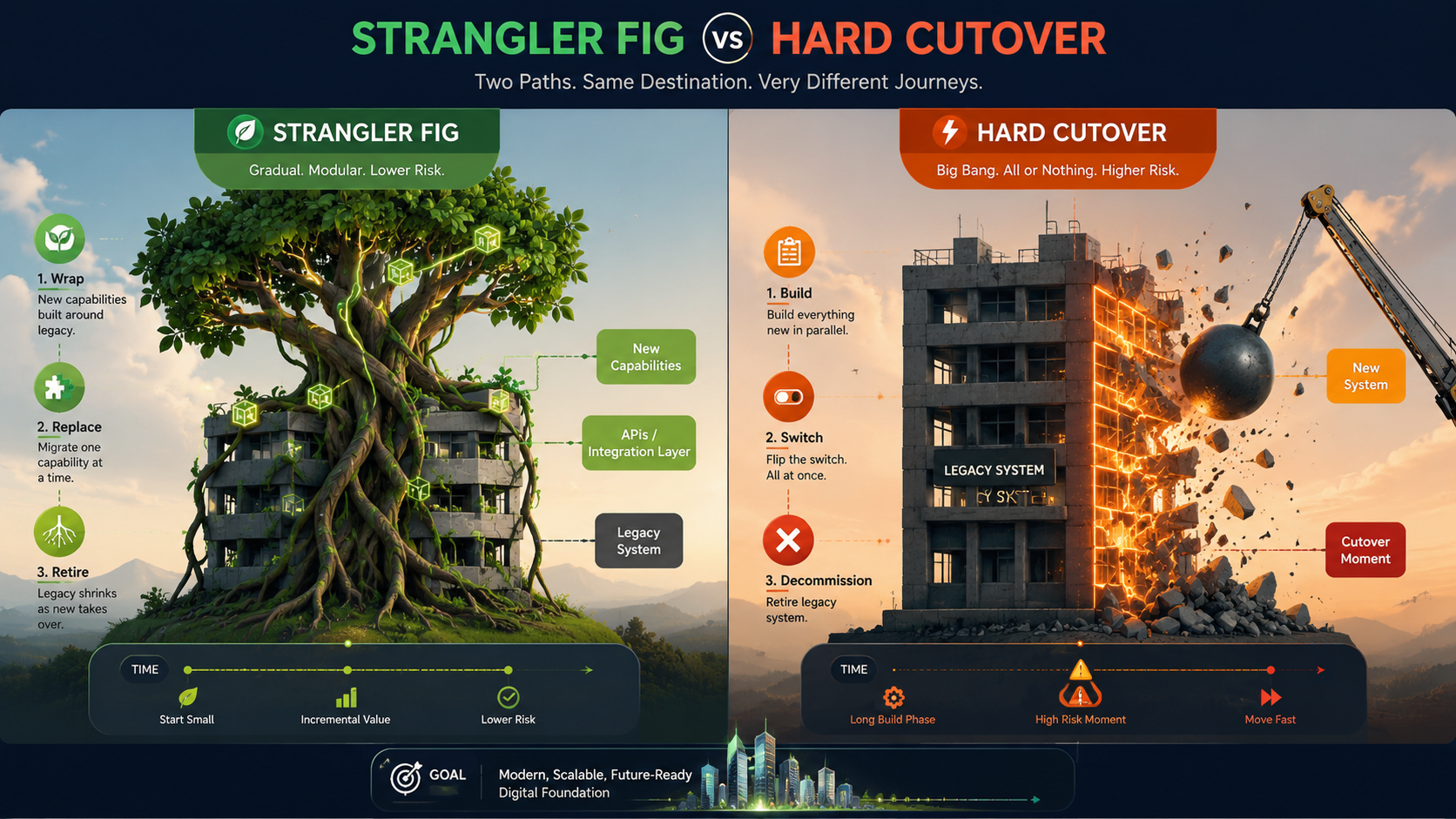
Strangler Fig: Wrap the legacy system with new interfaces, migrate functionality progressively to modern systems, retire the old system in pieces. Slower, lower risk, works well when the legacy system is deeply embedded in daily operations.
Hard Cutover: Replace at a defined date, run parallel operations for a fixed period, then cut. Faster, higher risk, requires excellent preparation and change management to avoid operational disruption.
Most mid-market companies end up in neither. They "integrate" the legacy system but never actually replace it, creating ongoing maintenance burden and a functional ceiling on what the new systems can achieve. If your digital transformation plan doesn't include a specific legacy migration strategy with a named owner and defined timeline, that's not a plan — it's a wish.
Measuring Digital Transformation ROI: The Metrics That Matter
One of the most common search queries around this topic is "how to measure digital transformation ROI" — and the answer most organisations get is wrong.
Transformation dashboards frequently measure inputs: initiatives launched, employees trained, processes "digitised." These feel like progress. They don't measure whether the transformation is creating business value.
Better metrics look like this:
Operational metrics show whether processes actually changed. Cost per transaction before and after. Time to onboard a new customer. Error rates in previously manual workflows. If you can't show a before/after on operational metrics, the transformation may be real on paper and invisible in practice.
Adoption metrics go beyond license counts. Active users vs. licensed users, process compliance rates, how often workarounds are used versus the intended system. A system that 30% of users avoid 60% of the time isn't adopted — it's tolerated.
For a deeper look at how real-time dashboards and analytics platforms surface these metrics operationally, see Turning Raw Data into Strategy with Business Intelligence Software.
Strategic metrics take longer to show up: revenue from new capabilities, customer satisfaction in transformed service areas, speed to market on new products. These are the ones that justify the investment to the board.
Avoid measuring the transformation itself as the outcome. "We completed the ERP implementation" is a milestone. It is not a result. Results are what changed in how the business operates because of the implementation.
Digital Transformation Project Management: Where Execution Actually Gets Done
Good governance gives you a structure. What happens inside that structure is execution, and a few consistent behaviours separate organisations that ship from organisations that plan indefinitely.
Time-boxed decisions. The most effective transformation teams set explicit decision deadlines with a default outcome if the deadline passes without resolution. This sounds arbitrary. The alternative — waiting until everyone is comfortable — produces compounding delays. Discomfort is not a sign the decision isn't ready. It usually means someone doesn't want to own the outcome.
Separated architecture and delivery tracks. One of the most common digital transformation project management failures is letting architecture debates block delivery work. Architectural decisions should run in a parallel track with a specific owner and deadline. They shouldn't pause sprint work while they're unresolved. If your teams are waiting on an architecture decision to build, you have a sequencing problem.
Explicit kill criteria. Define in advance what would cause you to restructure or stop an initiative. Without this, organisations pour resources into failing projects for 18 months before anyone has the authority to intervene. Kill criteria give leaders permission to act. They also force honest early conversations about what success actually looks like.
Choosing a Digital Transformation Consulting Partner
If you're bringing in external expertise for custom software development, process automation, platform implementation, or transformation management — a few questions rarely come up in vendor conversations but should:
How do they handle scope change? Transformations always uncover complexity the initial assessment didn't catch. A partner with a rigid change-order process for every discovered requirement will slow you down and run up costs. A partner who absorbs all scope without process will overcommit and underdeliver. The right answer is defined change management with sensible thresholds.
What does knowledge transfer look like? A transformation that leaves you operationally dependent on the partner isn't a success. Good partners design for handover from the start, not as an afterthought in the final sprint.
Do they work inside your governance or bring their own? Neither is inherently wrong, but you need explicit clarity before the work begins. Partners who ignore client governance create political problems that slow delivery. Partners who defer entirely to client governance with no standards of their own can't tell you when your governance is the bottleneck.
If you're at the stage of selecting a partner or scoping a transformation, Agami's digital transformation services and automation solutions pages cover the implementation models in detail. For organisations building custom platforms as part of their transformation, the custom software development page goes into how scoping and delivery are structured. You can also review case studies from past engagements to see what execution actually looked like.
FAQ: Digital Transformation Strategy
What is a digital transformation strategy?
A digital transformation strategy is a plan for using technology to change how a business operates and delivers value — covering process redesign, technology implementation, organisational change, and how success is measured. It's different from IT modernisation, which focuses on updating technology without necessarily redesigning how work gets done.
How long does digital transformation take?
For a single significant business function, 18 to 36 months is realistic for mid-sized companies. Enterprise-wide transformation is a multi-year commitment. Vendors promising enterprise-wide transformation in under 12 months are either defining scope very narrowly or underestimating integration complexity.
Why do digital transformation projects fail?
The most common causes are unclear decision rights, underestimating legacy system complexity, treating change management as a communication exercise, and measuring inputs instead of outcomes. Technology selection is rarely the root cause.
How do you measure digital transformation success?
Start with operational metrics (cycle times, error rates, cost per transaction), add adoption metrics (active vs. licensed users, workaround frequency), then strategic metrics (revenue from new capabilities, customer satisfaction in transformed areas). Avoid using milestones "we went live" as proxies for outcomes.
What's the difference between digital transformation and automation?
Automation is a component of transformation it eliminates specific manual steps in a process. Digital transformation is broader: it involves redesigning how the business works, not just removing friction from existing processes. You can automate a broken process and make it faster and still broken.
How do we choose between building custom software vs. buying off-the-shelf?
Buy where the function isn't a competitive differentiator HR systems, finance platforms, generic CRM. Build where the function is genuinely distinct to your business model. The mistake most organisations make is buying off-the-shelf for differentiated functions because it feels lower risk, then spending two years customising it at a cost that exceeds what a custom build would have been.
For more on how build-vs-buy decisions play out in practice, including what scoping and delivery actually look like, read App Development Cost Explained: From Idea to Launch.
Where Transformations Win or Lose
The governance model matters. The framework matters. But transformations succeed or fail based on what happens at the execution layer, the daily decisions about scope, priorities, and trade-offs made by people close to the work.
The organisations that come out the other side with something real are the ones that wrote down decision rights before ambiguity became conflict, kept architecture debates from blocking delivery, and refused to let milestone tracking substitute for measuring actual business outcomes.
If you're at the governance design, vendor selection, or scoping stage of a transformation, schedule a conversation with the Agami team. The questions worth asking early about legacy systems, decision authority, and what "done" actually looks like, are the ones that save months later.