AI & Machine Learning for Business in 2026: A Plain-English Guide for Decision-Makers
Artificial Intelligence is no longer something only large technology companies use. Today, businesses of all sizes are using AI to improve customer service, automate repetitive work, analyze business data, and make better decisions. One of the most important technologies behind these solutions is machine learning.
Many business leaders have heard terms like AI machine learning, AI learning, or artificial intelligence and machine learning, but they are often unsure what these terms actually mean. Questions like what is machine learning, what is machine learning ML, and what is learning in machine learning are more common than ever.
The good news is that you do not need a technical background to understand how these technologies work. What matters most is knowing how they can solve real business problems and support long-term growth.
This guide explains machine learning in simple language, highlights where businesses are using it in 2026, and shares practical advice for organizations planning their AI journey.
Why AI and Machine Learning Matter in 2026
Businesses generate more data today than ever before. Customer interactions, sales reports, invoices, emails, and operational records all contain valuable information. The challenge is turning that information into useful insights.
AI is becoming an important part of broader digital transformation initiatives. If your organization is planning to modernize operations, you may also find our guide on Digital Transformation Strategies: 2026 Framework & Best Practices helpful. It explains how businesses can combine modern technologies with clear operational goals.
This is where AI and machine learning make a difference.
Instead of spending hours reviewing reports or performing repetitive tasks, businesses can use AI to process large amounts of data quickly and identify patterns that people might miss.
Organizations are investing in AI because it helps them:
Improve customer experiences
Reduce manual work
Make faster business decisions
Increase operational efficiency
Detect risks before they become major problems
Rather than replacing employees, AI supports them by handling routine work so they can focus on tasks that require creativity, experience, and decision-making.
What Is Machine Learning?
One of the most common questions people ask is what is machine learning.
Machine learning is a branch of Artificial Intelligence that enables computers to learn from data instead of relying only on fixed instructions.
Traditional software works by following rules created by developers. If those rules never change, the software continues to produce the same results.
Machine learning works differently. It studies historical data, identifies patterns, and improves its predictions over time as it receives more information.
For example, an online shopping website can recommend products based on what customers have viewed or purchased in the past. The recommendations become more accurate as the system learns from customer behavior.
If you have searched what is machine learning ML, the answer is simple. ML is just the short form of machine learning. Both terms refer to the same technology.
You may also come across questions like what is learning machine. A learning machine is simply a software system that improves its performance by learning from data. Email spam filters, fraud detection systems, and recommendation engines are all examples of learning machines.
Some people also search for what is artificial learning or artificial learning. While this term is not commonly used in the technology industry, it generally refers to the same concept as machine learning, where computers improve their performance through data analysis.
Artificial Intelligence vs Machine Learning
Many people use Artificial Intelligence and machine learning as if they mean the same thing, but there is an important difference.
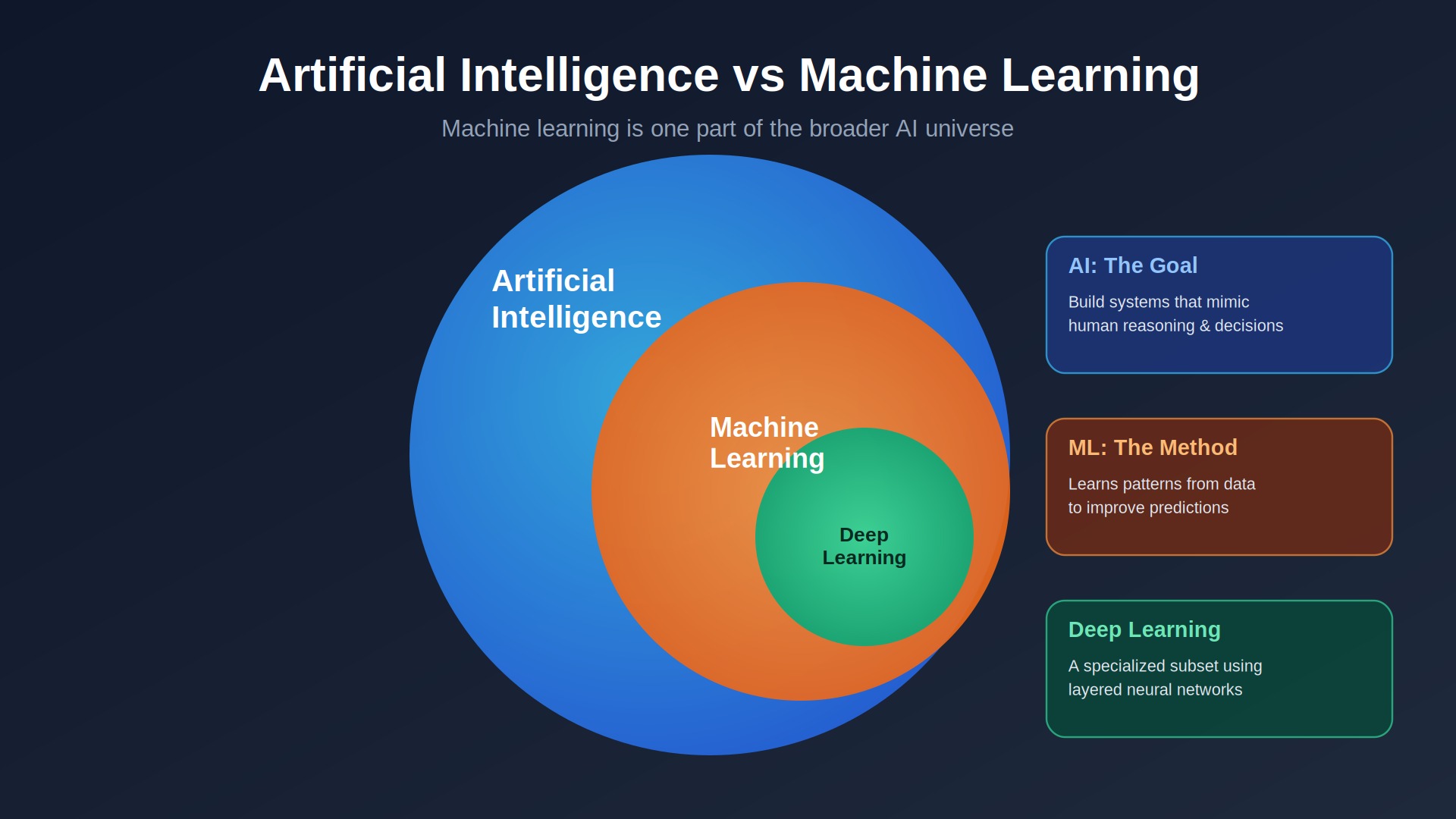
Artificial Intelligence is the broader concept. It focuses on building systems that can perform tasks normally associated with human intelligence, such as understanding language, recognizing images, or making decisions.
Machine learning is one part of AI. It gives these systems the ability to learn from data instead of relying only on predefined rules.
A simple way to understand the relationship is this:
Artificial Intelligence is the overall goal.
Machine learning is one of the methods used to achieve that goal.
That is why you often hear the terms artificial intelligence and machine learning together.
How Machine Learning Works in Simple Terms
You do not need to understand complex algorithms to understand how machine learning works.
The process usually follows four simple steps.
First, the system collects data. This could include sales records, customer feedback, website activity, or financial information.
Next, the data is analyzed to identify patterns and relationships.
The machine learning model then uses these patterns to make predictions or recommendations.
Finally, the system continues learning as new data becomes available, helping improve its accuracy over time.
Think of a delivery company that wants to predict delivery delays. By analyzing weather conditions, traffic, delivery routes, and historical performance, the system can identify which deliveries are likely to be delayed and help managers take action before customers are affected.
This continuous improvement is what makes AI learning valuable for businesses.
Business Benefits of AI and Machine Learning
Companies across different industries are seeing measurable results from AI adoption.
Some of the biggest benefits include:
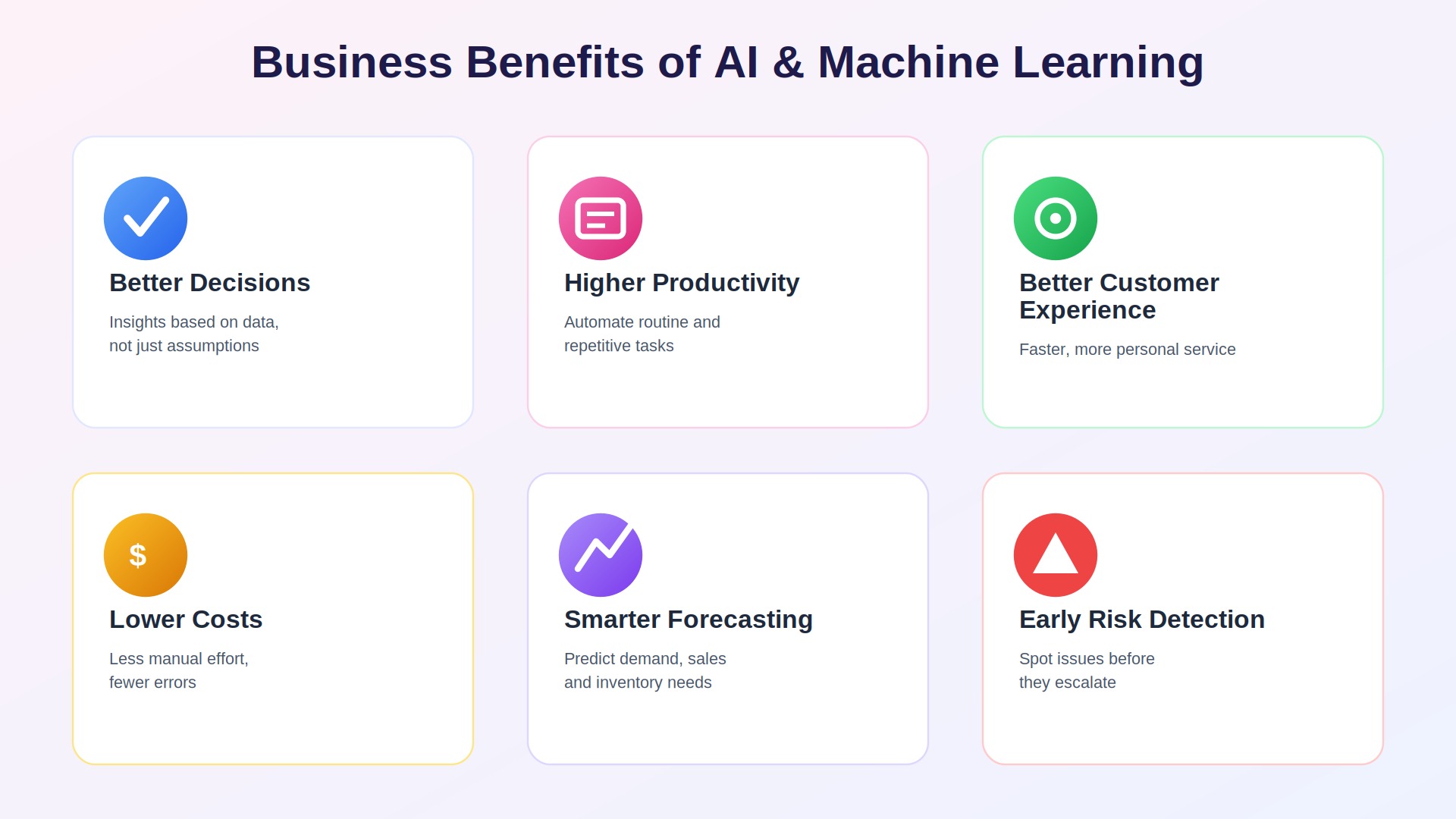
Better Decision-Making
Machine learning analyzes large amounts of data quickly, helping managers make informed decisions based on facts instead of assumptions.
Higher Productivity
Routine tasks such as document processing, report generation, and customer inquiries can be automated, allowing employees to focus on higher-value work.
Improved Customer Experience
Businesses can personalize recommendations, respond to customer questions faster, and deliver more consistent service.
Lower Operating Costs
Automation reduces manual effort, minimizes errors, and improves overall efficiency.
Smarter Forecasting
Machine learning helps businesses predict sales, customer demand, and inventory requirements with greater accuracy.
Common Business Use Cases
Businesses are finding practical ways to use AI machine learning every day.
Some common examples include:
Customer support chatbots that answer common questions
Fraud detection systems that identify suspicious transactions
Sales forecasting based on historical trends
Predictive maintenance for manufacturing equipment
Document processing and data extraction
Product recommendations for online stores
Employee productivity reporting
Marketing campaign performance analysis
These solutions help businesses improve operations while providing better experiences for customers and employees.
AI is already delivering measurable results in industries like mortgage lending, where automation speeds up document verification and loan processing. Read more in AI Automation for Mortgage Companies: How Lenders Are Reducing Processing Time and Scaling Faster
Industries Using AI
Almost every industry is finding value in machine learning.
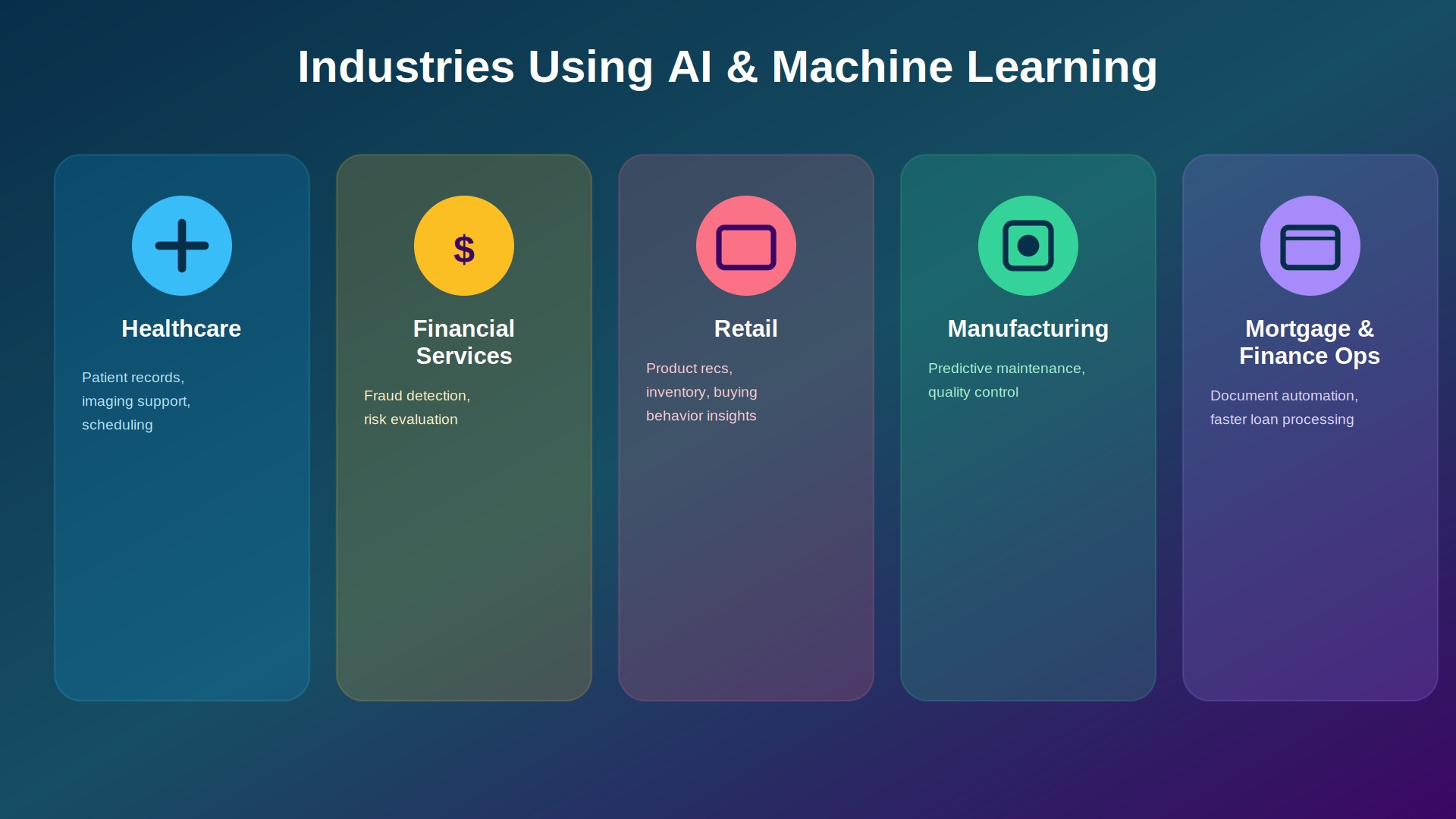
Healthcare
Healthcare providers use AI to organize patient records, support medical imaging, and improve appointment scheduling.
Financial Services
Banks use machine learning to detect fraud, evaluate financial risks, and monitor unusual account activity.
Retail
Retail businesses recommend products, manage inventory, and understand customer buying behavior.
Manufacturing
Manufacturers monitor equipment performance, improve quality control, and reduce downtime through predictive maintenance.
Mortgage and Financial Operations
Mortgage companies use AI to simplify document verification, automate workflows, and improve communication throughout the loan process.
How to Get Started
Businesses do not need to transform every process at once.
A practical approach includes:
Identify one business process that takes significant time.
Define clear goals for improvement.
Collect accurate and organized data.
Start with a small pilot project.
Measure results before expanding to other departments.
Starting small helps organizations understand the value of AI while reducing implementation risks.
Common Mistakes to Avoid
Many AI projects fail because organizations focus on technology instead of business needs.
Some common mistakes include:
Adopting AI without a clear business objective
Using poor-quality or incomplete data
Expecting immediate results
Ignoring employee training
Trying to automate every process at once
Successful AI projects begin with solving a real business problem rather than adopting technology simply because it is popular.
How Agami Technologies Helps Businesses
Every business has different goals, workflows, and operational challenges. A successful AI strategy should reflect those unique requirements.
Agami Technologies helps organizations identify opportunities where AI and machine learning can create measurable business value. From workflow automation and intelligent document processing to custom software development and cloud-based solutions, our team builds technology that supports long-term business growth.
Instead of offering one-size-fits-all solutions, we work closely with businesses to understand their operations and develop systems that improve efficiency, simplify processes, and prepare them for future growth.
You can also explore how Agami helps organizations modernize operations through tailored software in How Agami Technologies Helps Businesses Transform Through Custom SaaS Solutions
Frequently Asked Questions
What is machine learning?
Machine learning is a branch of Artificial Intelligence that enables computers to learn from data and improve their performance without being programmed for every situation.
What is machine learning ML?
ML is simply the short form of machine learning. Both terms describe the same technology.
What is learning in machine learning?
Learning refers to the process of identifying patterns from data and improving predictions over time.
What is a learning machine?
A learning machine is a software system that becomes better at performing a task by analyzing data and learning from previous results.
Is Artificial Intelligence the same as machine learning?
No. Artificial Intelligence is the broader field, while machine learning is one of the technologies used to build AI systems.
Conclusion
Artificial Intelligence is changing how businesses operate, but success does not depend on adopting every new technology. It depends on choosing solutions that solve real business challenges.
Understanding what is machine learning is the first step. The next step is identifying where AI and machine learning can improve efficiency, support employees, and help leaders make better decisions.
Businesses that begin with clear goals, reliable data, and a practical implementation plan are more likely to achieve lasting results. As AI continues to evolve in 2026, organizations that take a thoughtful approach today will be better prepared for tomorrow.
Call to Action
Looking to explore how AI can support your business goals?
Agami Technologies helps organizations build practical AI solutions that improve workflows, automate repetitive tasks, and create scalable software tailored to their business needs.
Contact our team to discuss your requirements and discover how AI and machine learning can help your organization operate more efficiently and grow with confidence.