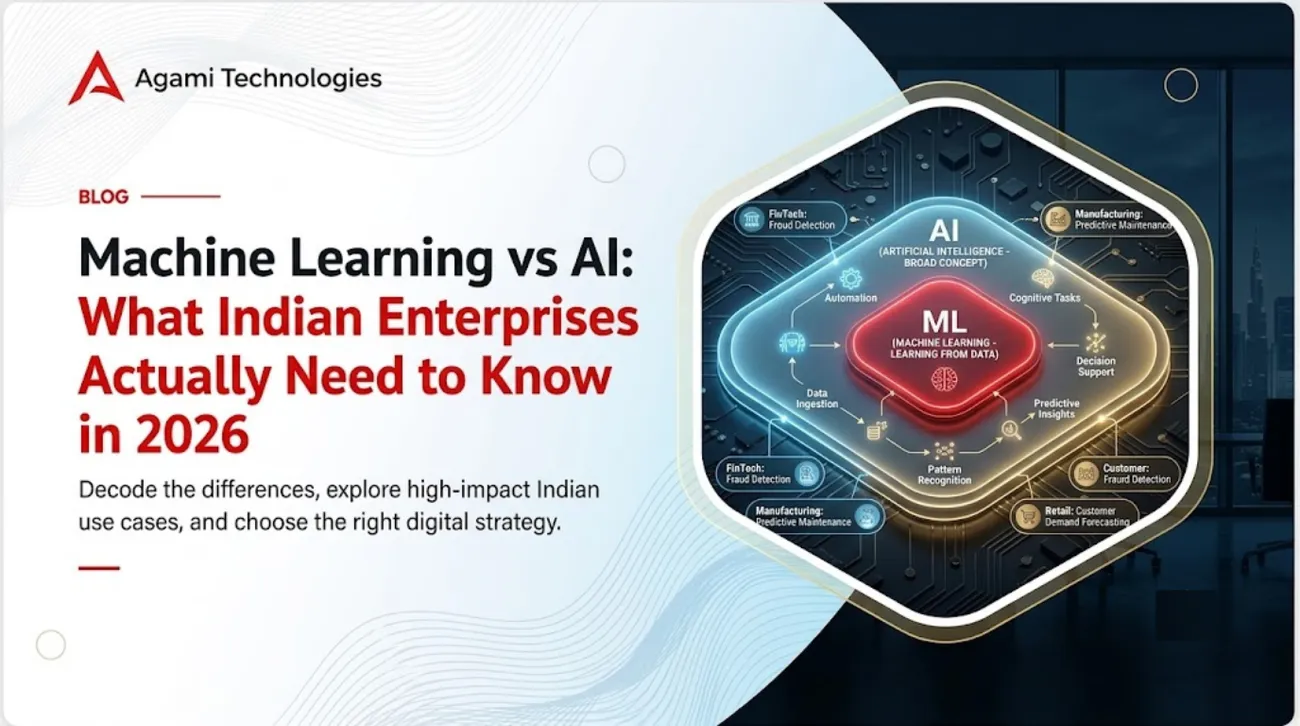
Machine Learning vs AI: What Indian Enterprises Actually Need to Know in 2026
Machine Learning vs AI is one of the most common questions for businesses adopting intelligent technologies. This guide explains the difference between AI and Machine Learning, their key use cases, business benefits, and how Indian enterprises can choose the right solution in 2026. Learn how AI for Business and enterprise AI solutions are helping organizations automate processes, improve decision-making, and drive growth.
Artificial Intelligence (AI) and Machine Learning (ML) are no longer future technologies. They are already changing how businesses operate, make decisions, and serve customers. From banks using fraud detection systems to retailers predicting customer demand, companies across India are investing heavily in intelligent technologies.
However, many business leaders still ask the same question: artificial intelligence vs machine learning what is the difference, and which one does my business need?
The confusion is understandable because the terms are often used interchangeably. But they are not the same thing.
In this guide, we explain the difference between ai and machine learning , how they work, their business applications, and how Indian enterprises can choose the right solution in 2026.
What is Artificial Intelligence (AI)?
Artificial Intelligence is a broad technology that enables machines to perform tasks that normally require human intelligence.
These tasks include:
- Understanding language
- Making decisions
- Solving problems
- Recognizing images
- Learning from data
- Automating repetitive tasks
AI systems are designed to imitate human thinking and decision-making.
Examples of AI in daily life include:
- Voice assistants like Siri and Google Assistant
- Chatbots on company websites
- Recommendation engines on e-commerce platforms
- Fraud detection systems in banking
Today, AI for Business is becoming a major investment area because it helps companies improve efficiency, reduce costs, and make faster decisions.

What is Machine Learning (ML)?
Machine Learning is a subset of Artificial Intelligence.
Instead of being programmed with every rule, machine learning systems learn patterns from data and improve over time.
For example:
A retail company can feed sales data into an ML system. The system analyzes buying patterns and predicts future demand.
A bank can use machine learning to detect unusual transactions and identify fraud.
In simple terms:
AI is the bigger concept. Machine Learning is one way of building AI systems.
Machine Learning vs AI: Understanding the Difference
The biggest confusion among businesses comes from understanding the relationship between artificial intelligence vs machine learning .
Artificial Intelligence
- Makes machines think and perform tasks like humans.
- Focuses on decision-making and automation.
- Includes technologies like computer vision, natural language processing, robotics, and machine learning.
Machine Learning
- Helps systems learn from data.
- Improves predictions without manual programming.
- Mainly focuses on finding patterns and making data-driven decisions.
Simple Example
Imagine a customer support chatbot.
The chatbot itself is an AI application because it interacts with customers.
The recommendation engine behind it that learns customer behavior is powered by Machine Learning.
This is why understanding artificial intelligence vs machine learning is important before investing in technology solutions.
Difference Between AI and Machine Learning
The difference between ai and machine learning can be understood through the following comparison:
| Feature | Artificial Intelligence | Machine Learning |
|---|---|---|
| Definition | Technology that imitates human intelligence | Technology that learns from data |
| Goal | Solve problems and make decisions | Identify patterns and predictions |
| Data Requirement | May or may not need large datasets | Requires large amounts of data |
| Human Intervention | Moderate | Lower over time |
| Examples | Chatbots, Robotics, Virtual Assistants | Recommendation Engines, Fraud Detection |
| Scope | Broad | Subset of AI |
Simply put:
All Machine Learning is AI, but not all AI is Machine Learning.
Why Indian Enterprises Are Investing in AI and ML
India is becoming one of the fastest-growing markets for intelligent technologies.
Businesses are adopting AI and ML because they help:
- Reduce operational costs
- Improve customer experiences
- Automate repetitive work
- Increase productivity
- Make better decisions using data
According to industry reports, AI adoption among Indian enterprises is expected to grow significantly in the next few years, especially in sectors like:
- Banking
- Healthcare
- Retail
- Manufacturing
- Education
- Real Estate
- Logistics
As AI adoption grows, organizations are also looking for professionals skilled in cloud platforms, automation, and CI/CD practices. Those interested in building these practical skills can explore a DevOps Course to understand modern cloud and infrastructure workflows.
AI for Business: Why It Matters in 2026
Businesses generate huge amounts of data every day.
Without intelligent systems, this data often remains unused.
This is where AI for Business becomes valuable.
AI helps organizations:
1. Improve Customer Service
AI chatbots answer customer questions instantly and reduce support costs.
2. Automate Operations
Businesses can automate repetitive tasks such as invoice processing, data entry, and document verification.
3. Improve Decision Making
AI systems analyze large datasets and provide actionable insights.
4. Increase Revenue
Personalized recommendations improve customer engagement and increase sales.
5. Predict Risks
AI can identify fraud, equipment failures, and customer churn before they happen.
AI and ML Use Cases Across Industries
Understanding ai and ml use cases helps businesses identify where these technologies can deliver value.
Banking and Financial Services
AI Use Cases
- Customer service chatbots
- Document verification
- Automated compliance systems
ML Use Cases
- Fraud detection
- Credit risk analysis
- Loan approval predictions
Healthcare
AI Use Cases
- Virtual health assistants
- Medical report generation
- Patient engagement platforms
ML Use Cases
- Disease prediction
- Medical image analysis
- Personalized treatment recommendations
Retail and E-commerce
AI Use Cases
- Customer support bots
- Product recommendations
- Dynamic pricing systems
ML Use Cases
- Demand forecasting
- Inventory management
- Customer segmentation
Manufacturing
AI Use Cases
- Process automation
- Quality inspection systems
ML Use Cases
- Predictive maintenance
- Equipment failure prediction
Education
AI Use Cases
- Personalized learning platforms
- Automated assessments
ML Use Cases
- Student performance predictions
- Learning behavior analysis
Enterprise AI Solutions: What Indian Businesses Need
Not every business needs advanced AI systems.
The right solution depends on business goals.
Modern enterprise ai solutions usually include:
Intelligent Chatbots
For customer support and employee assistance.
Predictive Analytics
For forecasting sales and identifying business opportunities.
Recommendation Engines
For increasing customer engagement.
Document Processing
For automating invoices and contracts.
Workflow Automation
For reducing manual work and increasing efficiency.
AI-Powered Analytics Platforms
For converting business data into actionable insights.
The goal should always be solving a business problem, not adopting AI because it is a trend.
When Does Your Business Need Machine Learning?
Machine Learning is useful when your business has:
- Large amounts of data
- Repetitive decision-making processes
- A need for forecasting and predictions
- Customer behavior analysis requirements
Examples:
- Predicting customer churn
- Forecasting product demand
- Detecting fraud
- Recommendation systems
If your business relies heavily on data, Machine Learning can deliver significant value.
When Does Your Business Need Artificial Intelligence?
AI becomes useful when businesses need:
- Automation
- Intelligent customer interactions
- Decision support systems
- Document understanding
- Language processing
Examples:
- Customer support chatbots
- Voice assistants
- Automated workflows
- Smart document processing
AI focuses more on improving business operations and user experiences.
Machine Learning vs AI: Which One Should Indian Enterprises Choose?
The answer is simple.
You do not always need to choose one over the other.
Most successful companies use both technologies together.
Choose Machine Learning if you need:
- Predictions
- Data analysis
- Forecasting
- Pattern recognition
Choose AI if you need:
- Automation
- Customer interactions
- Intelligent decision-making
- Process optimization
Choose both if you need:
- End-to-end intelligent business systems
- Personalized customer experiences
- Advanced analytics and automation
The future belongs to businesses that combine AI and ML effectively.
Challenges Businesses Face While Implementing AI and ML
Despite the benefits, many organizations struggle with implementation.
Common challenges include:
Poor Data Quality
AI and ML systems require clean and accurate data.
Lack of Skilled Talent
Building intelligent systems requires experienced developers and data experts.
Integration Issues
Legacy systems often make implementation difficult.
High Initial Investment
Some projects require significant technology investments.
Unclear Business Goals
Many companies invest in AI without defining measurable outcomes.
A clear strategy is essential for successful implementation.
The Future of AI and Machine Learning in India
India's digital transformation is accelerating rapidly.
Over the next few years, businesses will increasingly adopt:
- Generative AI solutions
- AI-powered customer experiences
- Intelligent automation platforms
- Predictive analytics
- Industry-specific AI applications
The demand for enterprise ai solutions will continue to grow as organizations seek competitive advantages.
Businesses that start building AI capabilities today will be better positioned for future growth.

Frequently Asked Questions (FAQs)
1. What is the difference between ai and machine learning?
Artificial Intelligence (AI) is a broad technology that enables machines to perform tasks that normally require human intelligence, such as decision-making and language understanding. Machine Learning (ML) is a subset of AI that allows systems to learn from data and improve their performance over time without being explicitly programmed.
2. Which is better for businesses: AI or Machine Learning?
It depends on your business goals. If you need automation, chatbots, or intelligent customer interactions, AI may be the right choice. If you need predictions, forecasting, or data analysis, Machine Learning is often the better option. Many businesses use both technologies together.
3. How are Indian enterprises using AI and Machine Learning?
Indian enterprises are using AI and ML for fraud detection, customer support automation, demand forecasting, predictive maintenance, personalized recommendations, and business analytics across industries like banking, healthcare, retail, manufacturing, and education.
4. What are some common ai and ml use cases in business?
Popular ai and ml use cases include chatbots, recommendation engines, predictive analytics, customer segmentation, document processing, inventory forecasting, and automated decision-making systems.
5. How can a business get started with AI and Machine Learning?
Businesses should start by identifying a specific problem they want to solve, such as reducing operational costs or improving customer experience. The next steps include evaluating available data, selecting the right technology, building a pilot project, and scaling the solution based on measurable results.
Final Thoughts
The discussion around machine learning vs AI is not about choosing one technology over the other.
Artificial Intelligence is the broader concept that enables machines to perform intelligent tasks.
Machine Learning is a powerful subset of AI that helps systems learn from data and make predictions.
Understanding the difference between ai and machine learning allows businesses to make better technology decisions.
For Indian enterprises in 2026, the focus should not be on adopting AI because it is popular. The focus should be on identifying business problems and using the right technology to solve them.
Companies that successfully implement AI for Businesses, leverage ai and ml use cases and invest in the right enterprise AI solutions will gain significant advantages in efficiency, customer experience and long-term growth.
Ready to Explore AI for Your Business?
Looking to explore how AI can support your business goals?
At Agami Technologies, we help organizations build practical AI solutions that solve real business challenges. From workflow automation and predictive analytics to custom AI-powered software, our team develops scalable solutions tailored to your specific needs.
Whether you're just starting your AI journey or looking to enhance your existing systems, we can help you identify the right opportunities and implement solutions that deliver measurable business value.
Contact our team today to discuss your requirements and discover how AI and Machine Learning can help your organization operate more efficiently, make smarter decisions, and grow with confidence.