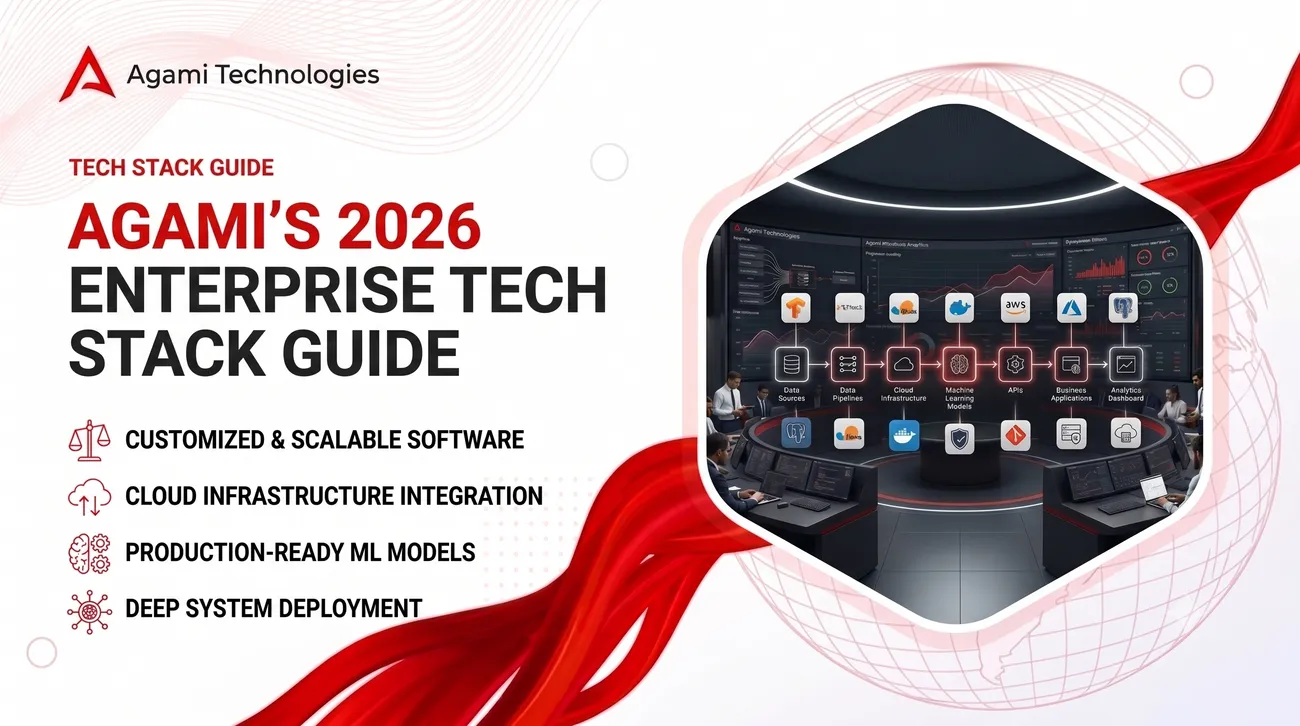
Machine Learning Tools & Solutions: Agami's 2026 Enterprise Tech Stack Guide
Transitioning machine learning from experimental models to enterprise solutions requires rigorous engineering, robust data pipelines, and scalable cloud infrastructure.
Key Takeaways:
- Data is the Foundation: Clean, normalized data pipelines are a mandatory prerequisite for any predictive model.
- Select the Right Framework: Use TensorFlow for large-scale stability, PyTorch for rapid prototyping, and Scikit-learn for structured tabular data.
- Deploy via the Cloud: Success relies on continuous integration, automated provisioning, and proactive monitoring for model drift.
- Focus on Business Value: Predictive logic is only useful when cross-functional teams integrate it into intuitive, custom software that drives measurable operational efficiency.
When evaluating machine learning tools, ml solutions must be judged on their ability to survive in production environments. We have moved past the era of treating predictive algorithms like magic tricks. Today, integrating these systems requires the exact same engineering discipline as building secure payment gateways or robust relational databases. Agami Technologies tackles this challenge by building customized, data-driven software that scales reliably across cloud infrastructure.
This guide breaks down the current enterprise technology landscape. I will share insights gathered from a decade of deploying complex systems, exploring how modern teams turn raw data into measurable business outcomes.For ongoing technical insights and industry observations, you can also explore the Agami Technologies Blog.
The Foundation of a Production Environment
For those exploring machine learning for beginners, the enterprise ecosystem can feel overwhelming. You encounter hundreds of libraries, endless infrastructure options, and overlapping methodologies. It helps to strip away the noise. Learners who want to build a strong foundation in data analysis, statistics, programming, and machine learning can explore professional Data Science Classes that combine essential concepts with practical applications. If your data pipelines are brittle or your tables are filled with null values, your predictive models will fail regardless of how sophisticated the underlying mathematics might be.
A mature stack begins with robust data collection and secure storage. We typically see organizations relying on distributed systems to handle massive datasets. Building customized web applications and scalable backend systems ensures that data flows cleanly from user interactions into centralized repositories. Without this foundational plumbing, advanced analytics remain permanently out of reach.
When clients first approach us and type into an email, "machine learning what is actually required to get started," I always point directly to their existing infrastructure. Modernizing legacy systems is the mandatory first step. You simply cannot run real-time predictive analytics on databases designed two decades ago.
Selecting the Right Frameworks for the Job
The choice of framework dictates how your engineering team will build, test, and deploy models over the next several years. In 2026, the industry has largely consolidated around a few dominant players. The nuances of how these tools are applied make all the difference in a live environment.
TensorFlow continues to dominate when strict production stability is the highest priority. The ecosystem is heavily optimized for deploying models at scale across various devices and server clusters. We see this utilized frequently in environments where latency and reliability are critical, such as processing financial transactions or managing large-scale global logistics.
Conversely, PyTorch has captured a massive share of the market due to its intuitive design and dynamic computation graphs. Python developers generally find it easier to debug when something breaks in the middle of a training run. When an engineering team needs to prototype rapidly or build custom architectures, PyTorch is usually the preferred and most efficient choice.
Scikit-learn remains an absolute necessity for structured data problems. Not every business problem requires a massive neural network. If your team is predicting customer churn or analyzing straightforward tabular sales data, traditional algorithms are often faster, cheaper to run, and much easier to explain to non-technical stakeholders.
Navigating the Complexity of Deep Systems
There is a distinct difference between traditional algorithms and more complex architectures. Traditional systems require engineers to manually define the exact features the algorithm should care about. Deep machine learning changes this dynamic entirely by processing raw data through multiple layers of neural networks to identify hidden patterns independently.
Understanding the relationship between machine learning and deep learning requires looking at specific, practical use cases. If you want to predict housing prices based on square footage and location data, a standard regression model works perfectly. However, if you are trying to extract meaningful diagnostic information from thousands of unstructured medical images, you need a significantly deeper architecture.
We see this complexity firsthand when building natural language processing systems. Creating context-aware interactions requires highly robust infrastructure to handle the immense computational load. The backend servers must process massive arrays of numerical data in milliseconds. This is why artificial learning applications heavily rely on cloud platforms like AWS and Azure to scale resources dynamically based on user demand.
The Intersection of Cloud Infrastructure and Predictive Models
You cannot discuss modern deployments without talking about cloud architecture. Building a statistical model is perhaps twenty percent of the actual work. The remaining eighty percent involves integrating that logic into a live application, securing the endpoints, monitoring performance, and ensuring the system does not collapse under heavy traffic.
At Agami Technologies, the methodology centers on cloud-native development and managing infrastructure as code. By scripting the provisioning of servers, engineering teams can deploy updates rapidly without risking manual configuration errors. We rely on robust continuous integration and continuous deployment pipelines to maintain high code quality. This means when a data scientist improves an algorithm, that update can be pushed to users safely, efficiently, and without downtime.
Model drift is a persistent and expensive challenge in any live environment. A system trained on consumer purchasing behavior from 2024 might make terrible predictions in 2026 due to shifting economic conditions. Ongoing, proactive monitoring is mandatory. You must track not just system metrics like CPU usage, but also the mathematical accuracy of the predictions themselves. When accuracy drops below an acceptable threshold, the system needs to trigger a retraining cycle.
The Reality of Data Engineering and Storage
Before a single prediction is made, teams spend countless hours managing the data lifecycle. Enterprise data is notoriously messy. It lives in fragmented silos, contains formatting errors, and frequently changes shape without warning.
A modern tech stack relies on robust integration tools that pull information from CRM platforms, enterprise resource planning software, and custom web applications. This data must be cleaned, normalized, and stored in a format optimized for analytical processing. We often deploy scalable cloud storage solutions to house both raw and structured data, ensuring that the engineering teams have exactly what they need for feature engineering.
The financial cost of storing and processing this information is significant. Efficient architecture design focuses heavily on resource management. Choosing when to use high-performance solid-state drives versus cheaper archival storage directly impacts the profitability of a project.
Security and Compliance in Predictive Systems
Integrating complex algorithms into enterprise workflows introduces new security vulnerabilities. When systems process sensitive customer information, financial records, or medical histories, strict governance protocols must be enforced.
access control is paramount. Not every engineer needs access to the raw production data. We implement role-based access controls and encrypted data pipelines to ensure compliance with global privacy regulations. Furthermore, the models themselves must be secured against adversarial attacks. Malicious actors can theoretically manipulate input data to force a system into making incorrect or harmful predictions.
Agami supports businesses by maximizing resilience and flexibility while maintaining a comprehensive security posture. Tailored strategies align with specific business objectives, ensuring that technological innovation does not compromise enterprise risk management.
Team Structures for Successful Deployment
Technology alone cannot solve business problems. The success of a deployment depends entirely on the people building and maintaining the systems. In the early days, companies tried to hire a single "unicorn" data scientist to handle everything from database management to algorithm design. That approach consistently fails at the enterprise level.
Today, successful teams are highly specialized. Data engineers focus on building pipelines and managing database architecture. Data scientists focus on statistical analysis and algorithm selection. Software developers focus on integrating these models into user-facing applications. Finally, operations engineers ensure the cloud infrastructure remains stable and secure.
This cross-functional collaboration is critical. A model that achieves perfect accuracy in a laboratory setting is useless if the software developers cannot integrate it into the company's mobile application without causing the app to crash.
Custom Software as the Delivery Mechanism
A predictive model sitting in a developer environment provides zero value to the business. The value is only realized when the insights are delivered to the right person at the exact right time. This is where custom application development becomes crucial.
Organizations need intuitive interfaces that abstract the underlying mathematics. A supply chain manager does not want to see a raw statistical output or a JSON file. They need a clean dashboard that clearly flags which inventory items are likely to run out of stock next week. Delivering these data-driven solutions requires a strong focus on user experience and interface design.
We frequently build customized software platforms that seamlessly connect existing enterprise tools. By integrating these systems, the flow of information becomes uninterrupted. For example, a customer interaction logged in a central database can immediately inform a predictive engine, which then silently updates a priority dashboard for the customer success team.
Measuring Success in Enterprise Deployments
How do you know if your investment in these technologies is actually yielding results? I always advise technical leaders to tie performance metrics directly to tangible business outcomes. An algorithm with ninety-nine percent accuracy is ultimately a failure if it requires ten minutes of processing time to generate a single response.
Success metrics should focus entirely on efficiency gains, error reduction, and improved decision-making speed. Are your logistics teams spending less time routing delivery trucks? Are your financial predictions reducing capital waste? If the technology is not moving these specific, measurable business levers, the entire implementation strategy needs to be reevaluated.
We also have to consider the long-term maintainability of the code. Codebases that are overly complex, undocumented, or heavily reliant on deprecated libraries become a massive corporate liability. Clean architecture, rigorous testing protocols, and clear technical documentation are just as important as the mathematical precision of the algorithms being deployed.
Frequently Asked Questions
What is the fundamental difference between ai and machine learning?
The terms ai and machine learning are frequently used interchangeably in corporate settings, but they represent distinct concepts. The broader field encompasses any computational system designed to mimic human problem-solving capabilities. The specific subset we focus on involves training algorithms to recognize hidden patterns in data without being explicitly programmed with rigid, hard-coded rules.
How do I choose the right ai learning platform for my engineering team?
Selecting an ai learning environment depends heavily on your team's existing technical skill set and your core business objectives. If your engineers primarily write Python, selecting frameworks that integrate smoothly with that language will drastically reduce the learning curve. You should always evaluate community support, available enterprise documentation, and long-term deployment options before committing corporate resources to a specific platform.
Can mid-sized businesses benefit from machine learning and deep learning technologies?
Absolutely. You do not need a massive, dedicated engineering department to see a positive return on investment. Many major cloud providers offer scalable, usage-based services that can be integrated into existing business applications via simple application programming interfaces. Starting with small, highly focused projects is the safest way to prove business value before scaling up your infrastructure.
Why is data quality considered the most critical factor?
Algorithms learn exclusively from historical information. If your historical records are incomplete, mathematically biased, or incorrectly labeled by human operators, the resulting predictions will be fundamentally flawed. Investing heavily in robust data engineering and strict validation processes is a mandatory prerequisite for any successful predictive project.
Conclusion
Building an enterprise-grade technology stack in 2026 requires looking past industry noise and focusing entirely on practical execution. We have officially transitioned from a period of experimental curiosity into an era of rigorous software engineering. Organizations succeed when they treat predictive capabilities as a core, integrated component of their architecture rather than an isolated science project.
By focusing on reliable data pipelines, selecting the appropriate computational frameworks, and relying on resilient cloud infrastructure, companies can turn theoretical concepts into tangible business value. Partnering with experienced teams ensures that these complex systems are built to scale safely, integrate seamlessly with existing workflows, and ultimately drive smarter, faster decision-making across the entire enterprise.
Call to Action
Transitioning from localized scripts to an enterprise-grade infrastructure is a complex engineering challenge. If your organization needs to rebuild its data pipelines or deploy scalable predictive models, explore our custom software solutions at Agami Technologies. For more technical insights and industry observations, you can also read our latest articles on the Agami Technologies Blog
Get in Touch: Agami Consultation.