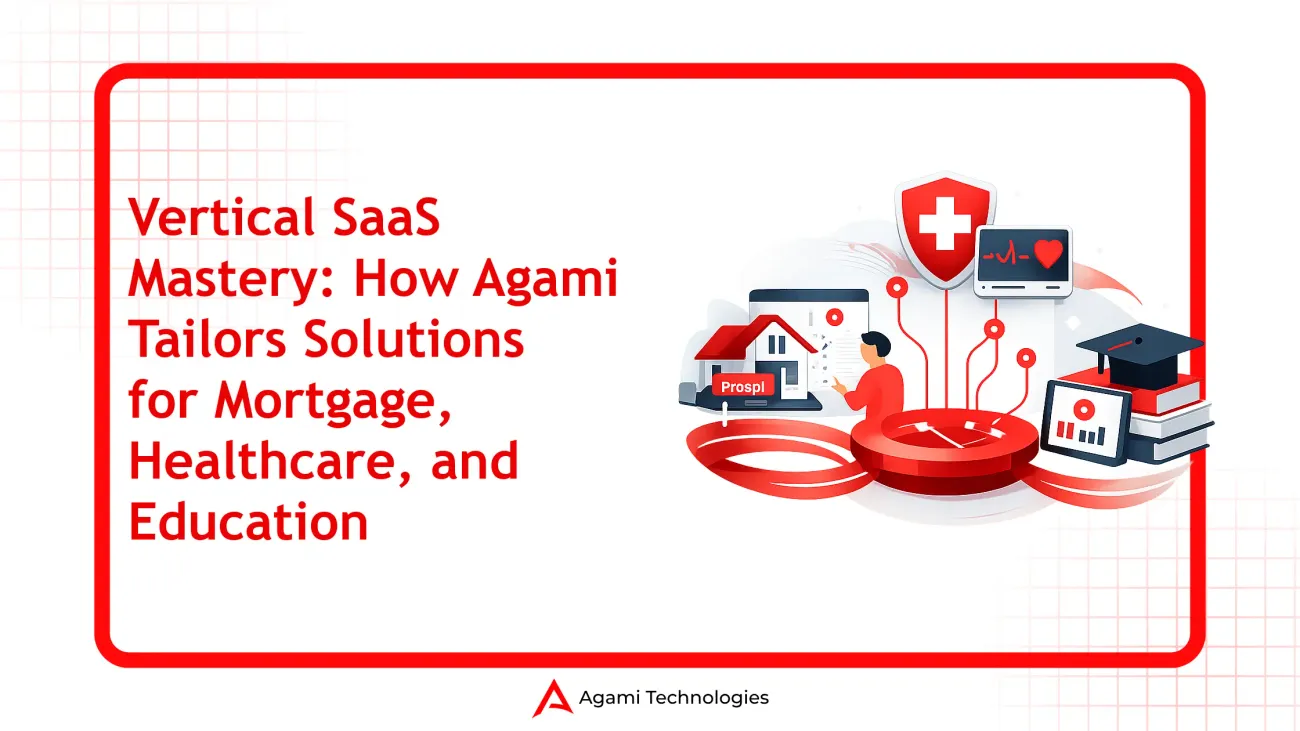
Vertical SaaS Mastery: How Agami Tailors Solutions for Mortgage, Healthcare, and Education
When you’re building software that touches real people in regulated industries, one thing is obvious: generic tools don’t fit. Agami designs domain-specific SaaS that align with how each industry actually works from how data flows to how approvals move through a process. In this piece, you’ll see how we tailor solutions for three representative verticals: mortgage/real estate with Stikkum, education with Schezy, and healthcare with TotalEMR360. You’ll also get a practical framework for crafting your own industry-focused SaaS roadmap and a real-world ROI example that proves the value of vertical depth over vanilla features.
Why vertical SaaS demands domain-specific design
Vertical SaaS begins where productized software meets real-world domain constraints. Mortgage and real estate teams juggle client onboarding, lead prioritization, credit checks, and rate-change notifications, all within strict compliance and consumer data protections. Healthcare brings patient privacy, scheduling, and audit trails into one secure workflow. Education requires admissions, attendance, exams, and parental communication, all with consistent reporting. In each case, the data models aren’t generic they’re tied to regulatory regimes, business rules, and the exact timeliness of information. A cookie-cutter app will feel “good enough,” but it won’t move the needle on speed, accuracy, or user adoption. That’s where Agami’s domain-aware design shows up: tailored data schemas, role-based access, and UX tuned to the way each industry actually operates.
We don’t just assemble features; we shape the architecture around industry realities. That means choosing security controls that reflect regulatory expectations, creating dashboards that surface the numbers stakeholders care about, and building integrations that respect the cash flow cycles and data ownership norms specific to the domain. The payoff is not only a nicer interface—it’s faster workflows, lower error rates, and higher trust in the system from users who must rely on it every day.
Stikkum: Mortgage and Real Estate engagement platform
Stikkum is Agami’s client engagement and retention platform built for mortgage brokers and real estate teams. The product blends automation with carefully designed human touchpoints across the client lifecycle from initial inquiries to refinancing and ongoing relationship management. The platform shines because it speaks the language of lending workflows: real-time credit pull alerts, refinance notifications, and templates that reflect loan stages, regulatory disclosures, and client follow-ups. The value isn’t just fewer clicks; it’s more consistent client contact, faster responses, and a platform that scales as the team grows.
What makes Stikkum a compelling vertical example is its measurable impact. In our client scenarios, teams reported a 30% boost in productivity, a 25% lift in client engagement rates, and a 20% increase in lead-to-client conversion. These aren’t vanity metrics; they translate into shorter sales cycles, steadier revenue, and more predictable monthly results. The ROI comes from a combination of automated outreach, analytics-driven prioritization, and a streamlined CRM integration that eliminates duplicate work and data silos.
Beyond metrics, Stikkum demonstrates the power of aligned UX. Mortgage professionals don’t want to fight with screens; they want to see key triggers (rate changes, credit status, document completion) at a glance. That’s why our UI design emphasizes context-aware workflows, responsive dashboards, and templates that adapt to different loan products and state requirements. The result is a platform that feels “native” to mortgage and real estate practice, not an add-on to a admissions, attendance, fees generic CRM.
Schezy: Education management in the cloud
Schezy brings school administration into a single cloud experience admissions, attendance, fees, exams, and parent-teacher messaging. The core idea is to remove admin overload while keeping parents, teachers, and administrators in lockstep. Clear data models for enrollment, attendance, and grading reduce errors, while automated notifications improve engagement. But Schezy isn’t just a collection of modules; it’s a cohesive platform with role-based access and analytics that reveal how students progress over time, where bottlenecks occur, and how resources are allocated.
Educators and administrators frequently cite the leap from fragmented spreadsheets to a unified data backbone as a turning point. Our education customers report a 70% reduction in administrative tasks and a 60% uptick in parent engagement, along with a 50% reduction in data-entry errors. Those improvements aren’t abstract—they show up as faster admissions cycles, more timely fee collection, and more reliable reporting to district regulators. Schezy is designed to scale from a single campus to a district-wide implementation while keeping data secure and accessible wherever teachers and parents need it.
TotalEMR360: Healthcare information management with security in mind
TotalEMR360 targets practice management, patient care coordination, scheduling, and compliant documentation in a way that respects patient privacy and regulatory requirements. Healthcare workflows demand strong access controls, audit trails, and interoperability with other health IT systems. TotalEMR360 normalizes patient data across encounters, supports secure messaging, and automates routine administrative tasks so clinicians can focus on care. It’s not merely about digitizing records; it’s about ensuring data integrity, traceability, and compliance as core design principles.
In healthcare deployments, we see a clear pattern: improved appointment efficiency, faster documentation, and more reliable regulatory reporting. The platform’s design emphasizes role-based access to protect PHI, a modular approach to permissions, and secure data exchange with external systems. Real-world outcomes include reduced scheduling bottlenecks, faster charting, and a stronger foundation for value-based care programs. TotalEMR360 demonstrates how vertical specificity paired with rigorous security can unlock measurable improvements in patient care and operational efficiency.
How Agami tailors these solutions: a practical framework
Our approach to vertical SaaS isn’t about slapping industry labels on generic software. It’s about building a repeatable, domain-informed process that yields products capable of moving the needle for operators, clinicians, and educators. Here’s a compact framework we apply across mortgage, healthcare, and education:
- Discovery and domain immersion: we map workflows, data models, and compliance constraints with early clients to capture tacit knowledge that lives in the trenches.
- Domain-aware data modeling: we design data structures that mirror real-world entities (loans, students, patients, schedules) and their relationships, preventing later normalization pains.
- Security, privacy, and compliance by design: we bake access controls, auditability, and encryption into the architecture from day one.
- UX designed for practitioners: we co-create interfaces with end-users to ensure the product fits actual daily rituals, not hypothetical workflows.
- Modular integration strategy: we build lean core platforms that can pivot to add domain-specific integrations (CRM, EHR, LMS, payment rails) without rewriting the wheel.
- Pilot, measure, and scale: we run MVPs in controlled environments, quantify ROI, and then expand with governance and change-management plans.
What this means in practice is a predictable path from concept to production. You don’t get a one-off product; you gain a scalable, compliant, and user-friendly platform that grows with your industry-specific needs. This is how Agami translates domain knowledge into durable software assets, and it’s why clients in mortgage, healthcare, and education report faster time-to-value and higher user adoption than with generic tools.
Common mistakes and how we prevent them
Vertical SaaS projects fail when teams chase features instead of workflows. Two recurring missteps stand out: over-customization of every screen and insufficient attention to data migration. The first leads to bloated products that are hard to maintain. The second creates a brittle transition from legacy systems where data quality issues become blockers. Our antidotes are pragmatic scope discipline and phased data migration plans. We emphasize early stakeholder alignment on core use cases, a modular product roadmap, and a strong emphasis on data governance. We also run security and privacy reviews early, so you’re not chasing compliance late in the process.
Another pitfall is assuming one-size-fits-all analytics. Vertical SaaS earns trust by surfacing the exact metrics stakeholders care about. We implement role-based dashboards and industry-specific KPIs that tell a story about adoption, efficiency, and outcomes. The result is a product that stakeholders can actually use to make decisions without needing a dozen spreadsheets to validate the numbers.
Measuring ROI in vertical SaaS: a worked example
ROI isn’t a slogan; it’s a calculation you can verify with your own data. Let’s anchor ROI in a concrete Stikkum scenario. Suppose a mid-market mortgage team implements Stikkum to automate lead follow-ups, alerts, and client communications. Implementation costs: $100,000 (including onboarding and integrations). The improved process yields annual benefits of $180,000, from a mix of productivity gains and increased conversions. That gives an annual ROI of (180,000 - 100,000) / 100,000 = 80% in year one. The payback period is roughly 7 months (100,000 / 180,000). This is not a theoretical figure; it’s grounded in the way the platform tightens cycles and reduces manual tasks. If you scale this to a 2–3 person team expansion, the ROI compounds with marginal cost reductions as you extend automation into new loan products and geographies.
To make the math tangible, consider the components of benefits: a 30% uplift in team productivity (more loans processed per week), a 25% jump in client engagement (more timely follow-ups and refinancing conversations), and a 20% increase in lead-to-client conversion. Each piece compounds across the pipeline. The same framework applies to Schezy and TotalEMR360: the ROI comes not from shiny features but from how the domain-specific workflows reduce friction, improve accuracy, and accelerate outcomes for students, patients, and staff.
Roadmap to vertical SaaS readiness for your organization
If you’re contemplating a vertical SaaS initiative, use this practical checklist to move from concept to pilot and beyond:
- Clarify the core problem and the decision-makers: identify the pain points that matter most to operations, clinical staff, or teachers, and map who will use the solution daily.
- Define industry-specific success metrics: agree on the KPIs that will demonstrate value (time saved, error rate reduction, engagement metrics, revenue impact).
- Prototype with domain data: build a data model that mirrors real-world entities (loans, patients, students) to prevent later migrations.
- Prioritize security and compliance from day one: establish access controls, audit logs, and data retention policies that align with regulatory expectations.
- Run a controlled pilot: deploy in a single department or site, measure ROI, and gather qualitative feedback for refinements.
- Scale with governance: align with IT/Security, set up change management, and implement a staged rollout plan across teams or campuses.
Vertical SaaS is as much about people and processes as it is about code. A disciplined, domain-aware rollout reduces risk and accelerates value realization. The payoff isn’t only reduced costs; it’s a platform your users actually enjoy using because it respects how they work every day.
Conclusion: vertical depth as a durable differentiator
Agami’s vertical SaaS mastery comes from a deliberate blend of domain understanding, robust architecture, and a bias toward measurable ROI. By focusing on mortgage/real estate with Stikkum, education with Schezy, and healthcare with TotalEMR360, we show that the right industry-specific design can unlock faster adoption, better data integrity, and stronger outcomes. If your goal is a software platform that truly fits your operations one that scales with your growth and keeps you ahead of regulatory and market shifts vertical depth isn’t optional.”
Frequently Asked Questions
What makes Agami's vertical SaaS approach different from generic software?
We start with the domain: workflows, data models, and compliance realities that define how industries operate. Our in-house team designs data structures, UX, and integrations to align with practical needs rather than shoehorning industry use cases into a generic product.
How long does it take to implement a vertical SaaS solution like Stikkum, Schezy, or TotalEMR360?
Implementation timelines vary by scope and the complexity of the domain. A tightly scoped MVP can be deployed in a matter of weeks, with full production rollouts over a few months. The framework emphasizes early pilots, measurable ROI, and staged scaling to manage risk and keep stakeholders aligned.
What kind of ROI should a client expect from a vertical SaaS initiative?
ROI is highly context-dependent, but vertical SaaS tends to deliver faster payback than generic software due to domain-aligned workflows and higher user adoption. Real-world examples from Stikkum show productivity gains, engagement improvements, and conversion uplifts that translate into tangible revenue and cost savings within the first year.
Which industries does Agami primarily serve with vertical SaaS?
We focus on mortgage/real estate, healthcare, and education three domains with strong data discipline, regulatory considerations, and large potential efficiency gains. Our approach is adaptable to additional verticals if the workflow and data model align with repeatable processes.
Helpful Links
For a deeper dive into our work and approach, explore the following resources:
Call to Action
Ready to tailor a vertical SaaS platform to your mortgage, healthcare, or education workflows? Let’s design a path that delivers measurable ROI and sustained adoption. Book a time to talk through your setup and start turning industry knowledge into durable software assets.