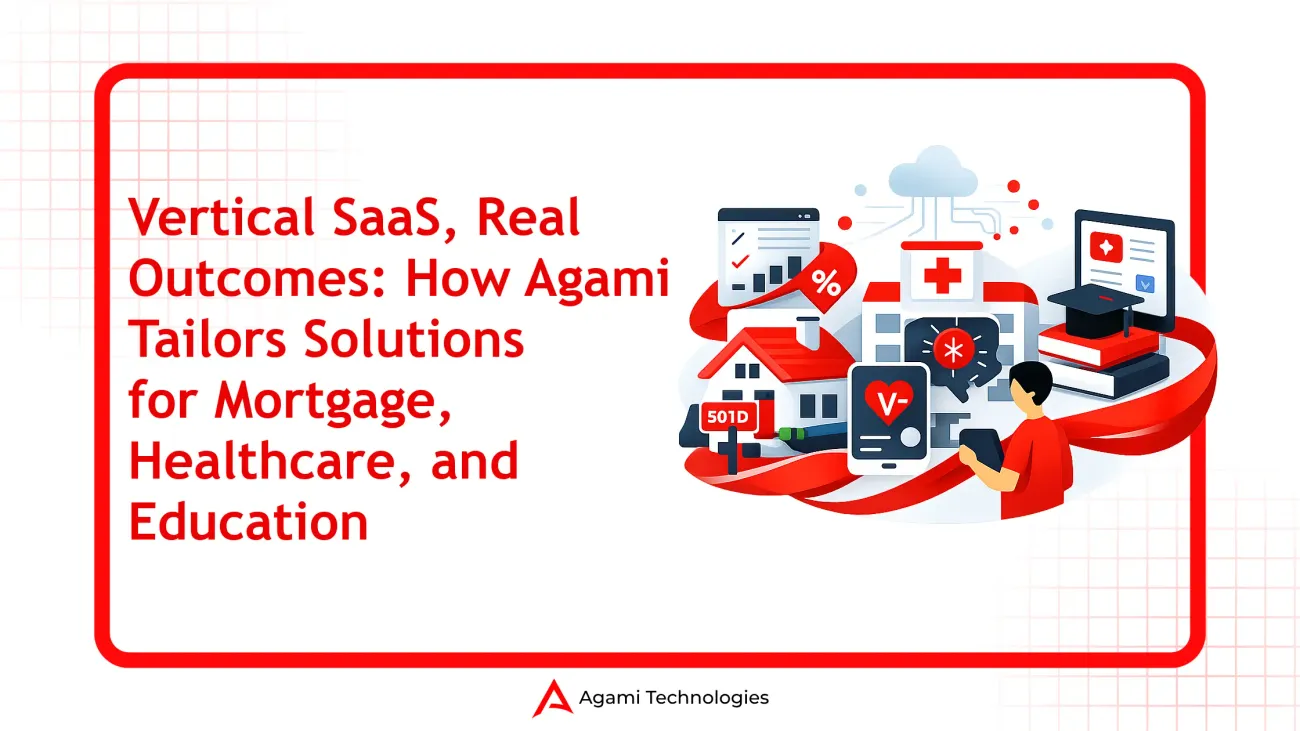
Vertical SaaS, Real Outcomes: How Agami Tailors Solutions for Mortgage, Healthcare, and Education
Vertical SaaS, Real Outcomes: How Agami Tailors Solutions for Mortgage, Healthcare, and Education
Specialization beats generic software whenever the workflows, data models, and regulatory demands are real. This piece digs into how Agami Technologies translates domain knowledge into measurable outcomes for three critical verticals: mortgage/real estate, healthcare, and education.
Why vertical SaaS matters for mortgage, healthcare, and education, and how Agami approaches it
Vertical SaaS is more than a set of features packaged for a specific industry. It is a deliberate alignment of software architecture with domain data models, compliance requirements, and end-to-end workflows. For mortgage and real estate, that means loan origination, credit checks, refinance tracking, and client communications are all woven into one coherent platform. For healthcare, it means patient records, scheduling, secure documentation, and role-based access operate within strict privacy and security norms. In education, admissions, attendance, fees, and reporting must synchronize across multiple stakeholders and devices. Agami’s stance is simple: design from the inside out around the domain, not a generic tech stack slapped onto a vertical label. The payoff shows up in faster time-to-value, fewer integration headaches, and a product roadmap that evolves with real customer feedback rather than hypothetical late-stage needs.
What you’ll gain from a vertical-focused partner is not just a toolkit but a blueprint for scale. Agami brings in-house, full-stack capability to build and tailor products that can stand up to regulatory scrutiny, support complex data flows, and evolve as your business grows. In practice, that translates to platforms sized for a real team, with real customers, and real outcomes without the surprises that come from cobbling together disparate systems.
Mortgage & Real Estate: turning engagement into retention with Stikkum
The mortgage and real estate workflow is a marathon of touchpoints: lead capture, lender follow-ups, document checks, credit pulls, refinance alerts, and client milestones. The pain points are tangible: data silos between origination CRM and credit repositories, slow follow-ups that cost deals, and manual monitoring that drains time from advisory conversations. Stikkum, Agami’s client engagement platform for this vertical, is designed to address these frictions head-on. Key capabilities include lead management and prioritization that surface high-potential opportunities, automated follow-up sequences that keep borrowers in the loop, and customizable messaging templates that ensure compliance and tone are consistent across channels. Real-time credit pull alerts and refinance notifications keep the team synchronized with changing borrower circumstances, while CRM integration and a mobile-accessible interface extend visibility beyond the desk.
In practice, the impact is measurable. Case studies show a 30% uptick in team productivity, a 25% boost in client engagement rates, and a 20% increase in lead-to-client conversion. Those numbers aren’t accidental; they reflect disciplined process automation, better data quality, and a single source of truth for the borrower journey. The Stikkum workflow also acts as a proving ground for Agami’s broader vertical play: the same design discipline that powers mortgage tech informs healthcare and education, ensuring consistency of quality across sectors.
Healthcare: TotalEMR360 and the discipline of compliant care delivery
Healthcare is a data- and process-intensive domain where patient safety, privacy, and care continuity depend on reliable information flows. TotalEMR360 is Agami’s flagship EMR system designed to modernize patient care while meeting stringent security and privacy expectations. The platform covers patient records, scheduling, secure documentation, and role-based access control, all within a data governance framework that supports regulatory compliance and audit readiness. Beyond the basics, TotalEMR360 emphasizes interoperability, enabling secure sharing of critical information across departments and with external providers, without compromising security.
What makes this vertical compelling is the shift from siloed processes to a unified care continuum. Clinics and hospitals gain a single view of patient history, treatment plans, and administrative tasks, reducing duplicate data entry and the likelihood of miscommunication. The result is not just smoother administration but improved patient experiences and safer, more coordinated care. While ROI metrics vary by practice size and specialty, the impact consistently shows up as faster scheduling, streamlined documentation, and stronger data governance that supports compliance and patient trust.
Education: Schezy and VidyaNova bridge administration with engagement
Schools and training institutions struggle with admin overload, inconsistent progress tracking, and fragmented communications between parents, teachers, and students. Schezy addresses this by combining admissions, attendance, fees, exams, and reporting into a cloud-based ecosystem. The platform provides centralized dashboards, automated progress reporting, and instant notifications that keep families and educators aligned. That unity is critical when schedules collide with exam cycles or fee deadlines. In practice, districts and private schools reporting faster admin workflows also experience improved stakeholder engagement, fewer data-entry errors, and clearer visibility into student performance.
Agami supplements Schezy with VidyaNova, an AI-driven video learning platform that brings content to life through lifelike avatars and interactive modules. The pairing matters: Schezy handles institutional operations; VidyaNova enhances learning delivery and engagement. The combination reduces the friction of digital adoption: teachers spend less time producing content, students stay engaged, and administrators can focus on policy and improvement rather than paperwork. Measurable outcomes come from reduced administrative tasks and higher parent and student engagement, which translate into better retention and outcomes across the educational journey.
A practical framework for tailoring vertical SaaS: how Agami translates domain insight into product decisions
Agami’s approach hinges on three core questions: What outcomes matter most in this sector? What data do we need to support those outcomes? And what parts of the product portfolio best fit those needs? From there, a repeatable framework guides engagements across mortgage, healthcare, and education.
- Discover and define outcomes. We start with a collaborative discovery sprint to map the client’s top-line goals (e.g., faster loan closing, fewer no-shows for appointments, higher parent engagement). This creates a target ROI and a roadmap aligned with regulatory and operational realities.
- Map data flows and integrations. We document how data moves between systems CRM, credit bureaus, EMR, SIS and where silos exist. The goal is a clean data fabric, not a stitched-together patchwork.
- Select the right portfolio components. We pick from Agami’s in-house SaaS stack (Stikkum, Schezy, VidyaNova, TotalEMR360, DemoDazzle, Kalnexa, etc.) to assemble a tailored solution that can scale without re-architecting the wheel.
- Prototype and pilot with strict metrics. A phased pilot tests the most critical workflows, with predefined KPIs and a plan to scale once those metrics prove favorable.
- Governance and compliance baked in. Security, privacy, and audit trails accompany every deployment, reducing risk as you scale across departments and locations.
- Scale with continuous improvement. After go-live, we monitor performance, quantify ROI, and iterate on functionality based on user feedback and changing needs.
This framework isn’t theoretical. The same method underpins successful engagements across mortgage, healthcare, and education, turning domain knowledge into practical, measurable software that supports real people at work every day.
What tends to go wrong, and how Agami fixes it early
- Relying on generic modules that don’t align with sector-specific data models. Fix: start with a domain-first design and use in-house components that map directly to real workflows.
- Underestimating data migration and legacy system frictions. Fix: plan governance, data cleansing, and phased integrations from day one.
- Under-appreciating regulatory and privacy requirements. Fix: embed security-by-design and role-based access controls in every layer.
- Over-promising on quick ROI without a rigorous pilot. Fix: adopt a staged rollout with measurable milestones and a clear path to scale.
Agami’s advantage lies in its vertical fluency and its in-house capabilities. We don’t outsource critical components; our teams own the stack from front-end UX to back-end data security. That means a more predictable path to value and fewer surprises along the way.
Measuring success: a concrete ROI-focused example
Let’s run a hypothetical but grounded scenario for a mid-sized mortgage brokerage implementing Stikkum. Suppose the team handles 200 loan leads per month, with typical close rates at 12%. After deployment, lead-to-client conversion rises to 14.5% and follow-up response times drop from 24 hours to under 4 hours. In practical terms, that’s 0.9 additional closed loans per month (roughly 10–11 per year) and a 25–30% reduction in time spent on manual follow-ups per week. If the average loan value is $350k and the brokerage earns a 0.5% commission, the incremental annual revenue crosses into six figures, with savings stacking from time efficiency and improved retention.
Similar math applies in healthcare with TotalEMR360: faster scheduling and better data coordination can reduce no-show rates and administrative overhead; in education, Schezy’s streamlined workflows free staff to focus on instruction and student support, while VidyaNova boosts engagement with AI-enabled content. The common thread is a disciplined integration of people, processes, and software—backed by clear metrics and a plan to scale when the numbers look good.
Putting it into action: how to engage with Agami for vertical SaaS
If your organization is ready to pursue vertical SaaS with outcomes you can verify, the next steps are straightforward. Start with a candid assessment of where you are today: which processes are manual, where are the data silos, and what regulatory constraints govern your sector? Then map those realities to Agami’s portfolio: Stikkum for client engagement, Schezy for school admin, TotalEMR360 for patient management, VidyaNova for learning delivery, and the AI-first tools that tie it all together. From there, we propose a staged plan—pilot a high-impact area first, measure the impact, then expand in phases to achieve broader transformation.
Time to value varies by project scope, but many clients see tangible improvements within 8–12 weeks for a focused pilot, with ongoing optimization every quarter as you scale across departments. The key is alignment on outcomes, a disciplined pilot, and transparent governance that keeps stakeholders engaged and informed.
Frequently Asked Questions
What is vertical SaaS, and why does Agami focus on mortgage, healthcare, and education?
Vertical SaaS is software built around the specific data models, workflows, and regulations of a particular industry. Agami focuses on mortgage/real estate, healthcare, and education to ensure product design, security, and UX resonate with real users and regulatory expectations, delivering measurable outcomes rather than generic capabilities.
Which Agami products best fit these three verticals?
Mortgage/Real Estate: Stikkum for client engagement and retention; Healthcare: TotalEMR360 for care delivery and compliance; Education: Schezy for administration, with VidyaNova enhancing learning delivery. In each case, we pair domain-appropriate modules with AI-enabled enhancements where they add value without complexity.
How long does it take to start delivering value?
A focused pilot typically runs 8–12 weeks, depending on scope and data readiness. Early pilots center on one high-impact workflow (e.g., loan follow-ups, appointment scheduling, or attendance) and use concrete KPIs to validate ROI before broader rollout.
How do you quantify ROI for a vertical SaaS engagement?
ROI is traced through concrete metrics: time saved, productivity gains, and improved conversion or engagement rates. We define target KPIs during discovery, run a pilot with real-world data, and report improvements in monthly or quarterly business metrics, with a clear plan to scale as results prove durable.
Is ongoing support included after go-live?
Yes. Agami provides ongoing support, updates, and governance reviews. The aim is continuous improvement, ensuring the solution adapts to evolving regulations, market conditions, and user feedback across the verticals.
Helpful Links
For deeper exploration of Agami’s capabilities and content, check these resources:
Next steps: ready to start your vertical SaaS journey?
Let’s translate your goals into a practical plan. If you want to discuss specific outcomes for mortgage, healthcare, or education, we’ll tailor a pathway that fits your team and budget.
Book a time to talk through your setup and begin framing your vertical SaaS strategy with Agami.