Cybersecurity Frameworks Every Enterprise Should Implement
This blog argues that cybersecurity is an ongoing program best guided by structured frameworks. It reviews core frameworks—NIST CSF, ISO 27001, CIS Controls, Zero Trust, RMF/FAIR, MITRE ATT&CK and cloud- or industry-specific standards—explaining when to use each. It explains how to choose and combine frameworks based on regulation, business goals, maturity, cloud posture and resources, and offers a practical, phased roadmap (prepare, assess, remediate, mature), common pitfalls, KPIs, tooling recommendations, integration tips, examples and a 90-day checklist. The piece aims to help enterprise security leaders prioritize controls, measure progress, and operationalize frameworks, and notes Agami Technologies can assist implementation.
If you manage security for a mid-to-large organization, you already know this: cybersecurity is not a one-off project. It’s an ongoing program that spans people, processes, and technology. With Agami Technologies, we’ve worked closely with CISOs and IT teams to build resilient security programs that scale. The most successful initiatives are always grounded in clear, structured frameworks. These frameworks transform abstract security goals into actionable, repeatable processes—helping you prioritize investments, ensure compliance, and clearly demonstrate progress to stakeholders and the board.
This article walks through the cybersecurity frameworks every enterprise should consider, why they matter, and how to pick the right mix for your situation. I’ll give practical examples, common mistakes I’ve seen, and an implementation roadmap you can adapt. If you want to skip ahead, Agami Technologies helps enterprises adopt these frameworks in practice, from assessment through implementation.
Why frameworks matter right now
Security teams constantly juggle incidents, audits, cloud migrations, and vendor complexity. A strong framework gives you structure. It makes sure you focus on the highest risks first and that your controls line up with business objectives.
Here are a few reasons frameworks are worth the effort:
- They create a common language between security, IT, and the business.
- They simplify vendor and tooling choices by mapping features to control needs.
- They provide a defensible approach during audits and regulatory reviews.
- They help measure progress. Without a framework you’ll struggle to show improvement over time.
In my experience, teams that skip frameworks end up firefighting. They buy tools, patch selectively, and can’t explain risk to leadership. Frameworks cut through that noise.
Core frameworks to consider and when to use them
There is no single perfect framework. Each one has strengths and use cases. Below I list the frameworks I recommend enterprises evaluate first, what they cover, and a quick example of when to pick them.
NIST Cybersecurity Framework (NIST CSF)
What it is: A flexible, risk-based approach with five core functions - Identify, Protect, Detect, Respond, and Recover. It’s widely adopted in the US and maps easily to controls and standards.
Why use it: It’s practical, technology-agnostic, and great for aligning security to business risk. Teams often use NIST CSF as the backbone of their programs because it scales from small teams to large enterprises.
Typical use case: You’re modernizing security across an enterprise and need a common taxonomy for risk discussions with the board and regulators. Start with NIST CSF to perform a gap assessment and build a prioritized roadmap.
ISO 27001
What it is: An international standard for an information security management system, commonly called ISMS. It requires documented processes, risk assessments, and continuous improvement.
Why use it: ISO 27001 is excellent for proof of program discipline. It’s a good match for organizations with global operations or customers that require third-party certification.
Typical use case: A mid-size enterprise handling customer data wants ISO 27001 compliance to win new customers and streamline vendor assessments. You’ll implement policies, do risk assessments, and set up internal audits.
CIS Controls
What it is: A prioritized set of technical controls that focus on quick wins and measurable security hygiene. They are practical and prescriptive.
Why use it: When you need immediate improvement in your security posture, CIS Controls are your friend. They emphasize fundamentals like asset inventory, secure configurations, and incident response.
Typical use case: Your organization has limited staff and needs to reduce the attack surface fast. Implement the first 18 CIS Controls to get measurable improvement in months, not years.
Zero Trust Security (NIST SP 800-207)
What it is: An architecture and mindset that assumes no implicit trust. Verify every user and device before granting access to resources, and use least privilege tightly.
Why use it: Zero trust is essential for cloud-first organizations and remote work models. It reduces blast radius from credential compromise and supports modern identity-centric controls.
Typical use case: You’re moving critical workloads to public cloud and need to cut lateral movement risk. Start with identity and access improvements, micro-segmentation, and continuous monitoring.
NIST Risk Management Framework (RMF) and FAIR
What they are: RMF gives a structured process for integrating security and risk into system lifecycle management. FAIR is a quantitative model for measuring cyber risk in financial terms.
Why use them: Use RMF when you need disciplined system-level risk decisions, for example in government or regulated sectors. Use FAIR when you want to translate cyber risk into dollars for the board.
Typical use case: A financial firm wants to rank cyber projects by expected loss reduction. Apply FAIR to prioritize investments, then use RMF to ensure systems meet required security posture.
MITRE ATT&CK
What it is: A knowledge base of adversary tactics and techniques. It’s not a compliance framework but it is invaluable for threat modeling, detection engineering, and red team planning.
Why use it: If your detection and response capability needs to mature, map gaps against MITRE ATT&CK to identify missing telemetry and playbooks.
Typical use case: Your SOC is drowning in alerts that miss real threats. Use ATT&CK to simulate attacker behavior and tune detection rules and hunting playbooks.
Cloud and Industry-Specific Frameworks
What they are: Cloud Security Alliance’s Cloud Controls Matrix maps cloud-specific controls. Industry standards like PCI DSS, HIPAA, and SOC 2 target specific data types and compliance needs.
Why use them: When you have cloud-first workloads or regulated data, layer these frameworks on top of your base framework. They fill gaps that big-picture frameworks may not cover.
Typical use case: You run e-commerce and store cardholder data. PCI DSS is mandatory. Use NIST CSF for overall governance, and implement PCI-specific controls for payment systems.
How to choose the right mix for your enterprise
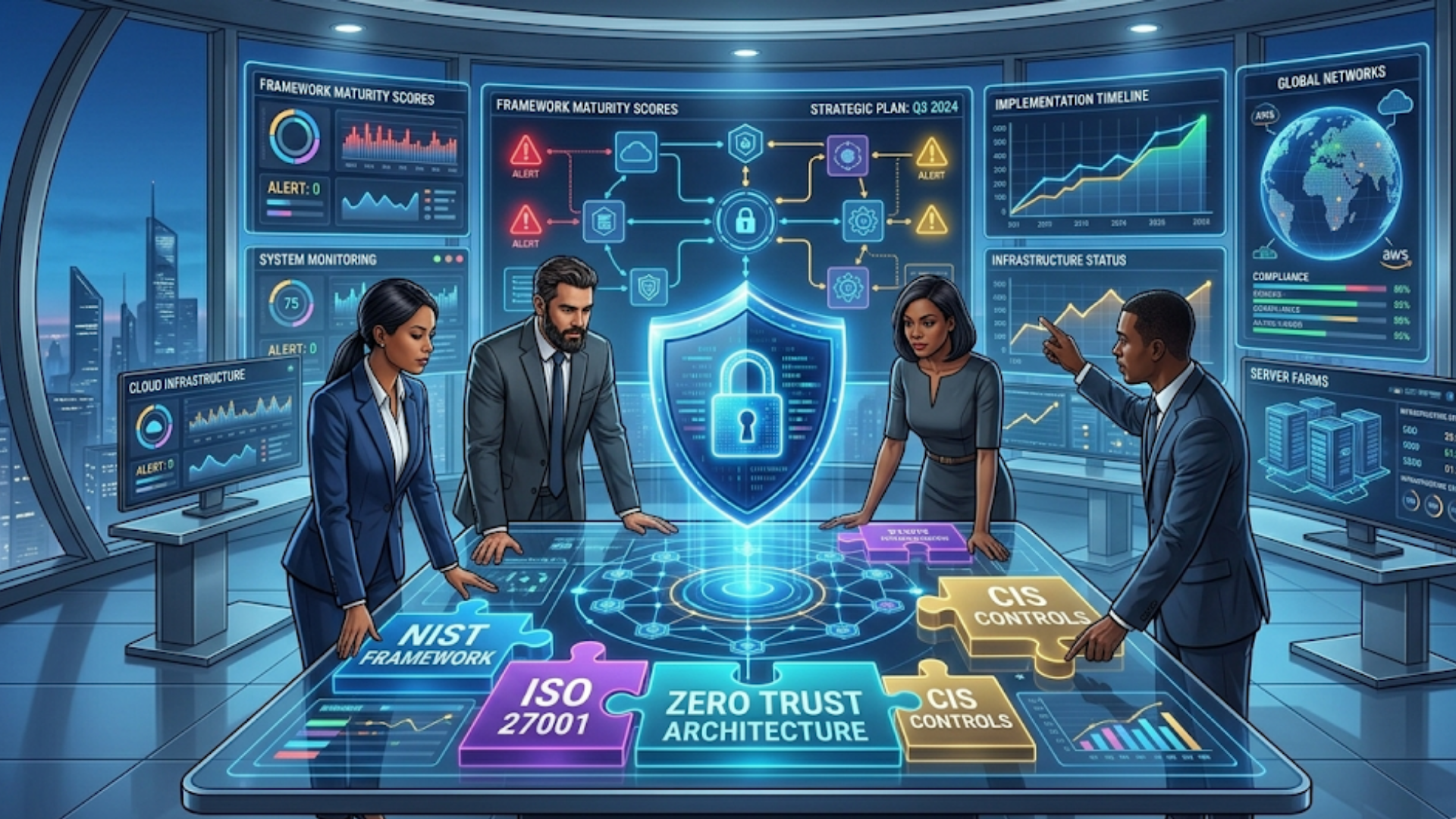
Picking frameworks is a mix of art and science. You need to balance regulatory requirements, risk appetite, business priorities, and available resources. Here are practical criteria to guide your choice.
- Regulatory and contractual needs: Start with frameworks required by regulators or customers. If you need ISO 27001 certification or SOC 2 reports, those jump to the top of your list.
- Business objectives: Protect customer data? Reduce downtime? Prevent fraud? Match frameworks to those goals. NIST CSF is broad; CIS Controls are tactical; ISO 27001 gives certification.
- Current maturity: If you’re starting out, pick CIS Controls for immediate wins. If you have mature processes, ISO 27001 or a risk quantification model might be next.
- Cloud posture: Cloud-first teams should include zero trust, CSA CCM, and cloud provider well-architected guidance.
- Resource availability: Implementing ISO 27001 means people for documentation and audits. CIS Controls require technical work like patching and endpoint detection. Be realistic about staffing.
Often the best approach is layered. Use NIST CSF for governance and risk alignment. Add CIS Controls for technical hygiene. Apply ISO 27001 if you need a certifiable ISMS. Finally, add zero trust and MITRE ATT&CK as you modernize detection and identity controls.
Practical implementation roadmap
Framework adoption looks different at every company, but the steps below reflect what I’ve seen work repeatedly. Keep your roadmap iterative. Deliver value quickly, then expand scope.
Phase 0 - Preparation (0-4 weeks)
- Get leadership buy-in. Show the business what a framework will do for risk and resilience.
- Identify stakeholders across IT, legal, compliance, and business units.
- Inventory critical assets. You cannot secure what you do not know exists.
This phase is often underestimated. I’ve seen teams try to implement controls without a reliable asset list. That creates blind spots and wasted effort.
Phase 1 - Assess and prioritize (1-3 months)
- Run a gap analysis against your chosen framework(s). For NIST CSF, map your current state to the core functions. For ISO 27001, document key processes and risks.
- Prioritize controls by business impact and exploitability. Use risk scoring or a simple high-medium-low matrix.
- Create a 90-day plan focused on high-impact, high-feasibility items like multifactor authentication, patching critical systems, and centralized logging.
Quick wins matter. They build momentum and show leadership that the program is producing results.
Phase 2 - Remediate and enable (3-12 months)
- Implement prioritized technical controls: asset inventory, patch management, endpoint detection and response, identity and access management.
- Formalize processes: change control, incident response, vendor risk management.
- Start measurement: KPIs, SLAs, dashboards for risk and compliance.
Expect another wave of prioritization as you learn more about where the gaps really are. Don’t try to boil the ocean. Focus on defenses that reduce the greatest business risk.
Phase 3 - Mature and certify (12+ months)
- If you’re aiming for ISO 27001 or SOC 2, prepare documentation and run internal audits.
- Shift from project work to program management. Turn policies into repeatable, audited processes.
- Integrate threat intelligence and adversary simulations using MITRE ATT&CK to validate detection and response capability.
Maturity is not a finish line. It’s a rhythm of continuous improvement. You’ll never be done, and that’s okay.
Common mistakes and pitfalls
I see the same traps across enterprises. Knowing them up front helps you avoid costly rework.
- Treating the framework as a checkbox: Compliance is not security. If you implement controls just to pass an audit, you’ll still be vulnerable to real attackers.
- Trying to do everything at once: Spreading teams thin leads to poor implementations. Prioritize high-impact controls first.
- Ignoring asset inventory: Many programs fail because the team never built a reliable list of assets and dependencies.
- No executive sponsorship: Without a sponsor, projects stall for budget or prioritization reasons.
- Poor measurement: If you can’t measure improvement, you can’t defend the investment to the board.
One mistake I want to call out specifically: neglecting identity. If your identity stack is weak, everything else is brittle. Focus on strong authentication, least privilege, and session management early on.
Measuring success and meaningful KPIs
Frameworks should produce measurable outcomes. I prefer simple, business-focused KPIs that show reduced risk and improved resilience.
- Mean time to detect (MTTD). How quickly do you find incidents?
- Mean time to respond (MTTR). How fast do you contain and remediate?
- Percentage of critical assets inventoried. Do you know what needs protection?
- Patching cadence for critical vulnerabilities. How quickly do you remediate exploitable flaws?
- Number of systems with multifactor authentication enforced.
- Audit findings resolved within SLA. Are compliance gaps getting closed?
These metrics map directly to frameworks. For instance, NIST CSF’s Detect and Respond functions tie to MTTD and MTTR. Showing improvement in these KPIs builds credibility for more investment.
Tooling and architecture considerations
Frameworks define what you should do. Tools help you do it at scale. Choose tools that align with your framework goals and integrate well into your environment. As enterprises scale their integrations, having a strong API strategy becomes equally important. A well-implemented API layer ensures secure data exchange, governance, and performance across systems. If you're exploring this area, check out our guide on API Management Platform: A Complete Guide for Modern Enterprises, which explains how to design, secure, and manage APIs effectively while supporting enterprise cybersecurity solutions.
Here are the tool categories to consider and practical notes on integration:
- Identity and Access Management: Centralize authentication. Implement multifactor authentication and role-based access control. If you’re adopting zero trust, start here.
- Endpoint Detection and Response (EDR): EDR is a must for enterprises. It gives you telemetry for detection and the ability to respond quickly.
- Security Information and Event Management (SIEM) or XDR: Centralize logs and alerts. Use MITRE ATT&CK to prioritize detections.
- Cloud Access Security Broker (CASB) and Cloud Security Posture Management (CSPM): These help enforce cloud security controls and identify misconfigurations.
- Vulnerability management: Integrate scanning into CI/CD pipelines and production environments.
- Configuration management: Use automation for secure baselines. Manual configuration does not scale.
Remember: tools are only as useful as the people and processes around them. Plan for tuning, staffing, and continuous improvement.
Integrating frameworks with existing processes
Security teams rarely get a clean slate. You’ll most likely be integrating frameworks into existing IT, development, and compliance processes. Do this deliberately.
- Change management: Update change control processes to include security review steps required by your framework.
- DevSecOps: Shift left. Embed CIS Controls and secure coding checks into pipelines.
- Vendor risk: Use the framework to standardize vendor assessments and contractual security clauses.
- Incident management: Map incident response roles and playbooks to the framework’s guidance and the business’s recovery priorities.
These integrations reduce friction and make compliance less painful. They also create a virtuous cycle: better processes lead to better security tooling outcomes, which in turn provide better telemetry for governance.
Simple examples that show how frameworks work together
Examples help. Here are two short, real-world scenarios that show how to combine frameworks practically.
Example 1 - Mid-size enterprise migrating to cloud
Situation: A 700-person software company is moving most workloads to a public cloud provider. They worry about misconfigurations and data exposure.
Approach: Use NIST CSF for overall governance and risk alignment. Implement CIS Controls for technical hygiene like inventory, patching, and EDR. Use CSA CCM and cloud provider best practices for cloud-specific controls. Begin a zero trust program focused on identity and micro-segmentation.
Result: In six months they reduced high-risk cloud misconfigurations by 80 percent, enforced multifactor authentication company-wide, and introduced continuous cloud posture monitoring.
Example 2 - Regulated financial services firm
Situation: A bank needs to demonstrate compliance and quantify risk for executive reporting.
Approach: Start with ISO 27001 for an ISMS to standardize processes and certify. Use NIST RMF for system-level assessments. Apply FAIR to translate cyber risk into dollar terms so the CFO can prioritize spend. Map detection gaps to MITRE ATT&CK for red team validation.
Result: The bank achieved ISO 27001 certification, won a major corporate client, and built a risk model that justified a multi-year security investment plan.
Quick 90-day checklist
If you’re heading a security program and want a practical 90-day plan to show progress, here’s a no-nonsense checklist.
- Get executive sponsorship and agree a security roadmap with measurable goals.
- Perform an asset inventory and identify your crown jewel systems.
- Run a gap assessment against NIST CSF or CIS Controls depending on maturity.
- Enforce multifactor authentication for all privileged access and high-risk applications.
- Deploy endpoint detection on critical systems and start central logging.
- Patch critical vulnerabilities and fix misconfigurations in the most exposed systems.
- Communicate outcomes to stakeholders weekly. Small wins build trust quickly.
These steps are intentionally focused. You want visible improvement in three months, not a laundry list of low-priority tasks.
Costs, resourcing, and realistic timelines
Costs vary by maturity, size, and the frameworks chosen. Here are ballpark considerations and what I’ve observed from engagements.
- Initial assessment: Few weeks to 3 months, depending on scope. Budget for consultancy or internal analyst time.
- Technical remediation: 3 to 12 months. This includes EDR, IAM upgrades, SIEM tuning, and patch programs.
- ISO 27001 certification: Usually a 9 to 18-month program with audits and documentation work.
- Ongoing operations: Expect to maintain a team for monitoring, engineering, and compliance activities. This is a recurring cost you must budget for.
One trade-off you’ll face is buy versus build. Managed detection and response can accelerate capability but may cost more long-term. In-house builds cost less but need experienced staff. Choose based on your risk tolerance and hiring market realities.
How Agami Technologies can help
At Agami Technologies we help enterprises turn frameworks into action. We’ve guided teams through NIST CSF mappings, ISO 27001 preparation, CIS Controls implementations, and zero trust transformations. Our approach is pragmatic: we prioritize controls that reduce business risk quickly and build processes that scale as your organization grows.
If you want a rapid assessment, we can map your current state to framework controls, produce a prioritized roadmap, and help with implementation oversight. I’ve seen teams accelerate maturity by combining our advisory work with hands-on implementation support.
FAQs
1. What is the best cybersecurity framework for enterprises?
There is no single “best” framework. Most enterprises start with NIST Cybersecurity Framework (CSF) as a foundation, then layer ISO 27001 for compliance and CIS Controls for technical implementation based on their needs.
2. How do I choose the right cybersecurity framework for my organization?
Choose based on your regulatory requirements, business goals, current security maturity, and available resources. For example, use CIS Controls for quick improvements, ISO 27001 for certification, and Zero Trust for modern cloud environments.
3. Can multiple cybersecurity frameworks be used together?
Yes, and in fact, most enterprises use a combination. A common approach is using NIST CSF for governance, CIS Controls for execution, and adding industry-specific standards like PCI DSS or SOC 2 when required.
4. How long does it take to implement a cybersecurity framework?
Implementation timelines vary. A basic framework adoption can take 3–6 months, while full maturity or certifications like ISO 27001 may take 9–18 months, depending on organization size and complexity.
Start simple. Pick a backbone - NIST CSF works well for most enterprises - and add targeted frameworks based on your industry and cloud posture. Prioritize fundamentals: asset inventory, identity, patching, and detection. Measure what matters and iterate often. And don’t treat frameworks as a checkbox. Use them to drive continuous improvement.
If you take away one practical tip from this article, let it be this: begin with your crown jewel systems and protect them first. Who cares about perfect compliance across everything if your most critical data is exposed? Focus on what keeps the business running and what the attackers will try first.
Helpful Links & Next Steps
- Agami Technologies
- Agami Technologies Blog
- Book your free demo today
- Contact Us
- info@agamitechnologies.com
Ready to get started? Book your free demo today and let’s map your security posture to practical, measurable frameworks.