ERP Systems in 2026: Beyond Finance and Operations
Agami Technologies argues that ERP systems in 2026 have evolved from back-office ledgers into strategic, cloud-native platforms that integrate data, AI, automation, and real-time analytics across the enterprise. The blog explains drivers—cloud maturity, practical AI, faster business rhythms—and lists key capabilities such as real‑time reporting, AI forecasting, deep automation, open integrations, low‑code extensibility, user‑centered design. It covers migration strategies, evaluation criteria, implementation pitfalls, KPIs, industry-specific needs, security governance, and partner selection. Practical steps and case examples show how focused pilots and cross‑functional governance turn ERP from a cost center into a strategic enabler. Recommendations emphasize measurable pilots and governance today.
Enterprise resource planning systems have come a long way, and Agami Technologies is at the forefront of this evolution. What once operated quietly in the back office handling finance and inventory through static systems has now transformed into a dynamic, enterprise-wide platform. In 2026, modern ERP systems powered by Agami Technologies go far beyond ledgers and purchase orders. They act as strategic engines that drive decision-making, automate workflows, and seamlessly connect customers with operations in real time.
If you are a CIO, CTO, operations head, or finance leader, you've probably felt this shift. I've noticed teams expect ERP to behave like other cloud apps: fast, intelligent, and integrated. They want ERP to answer questions, not just store data. That expectation changes how we pick, implement, and measure enterprise resource planning system projects.
Why ERP is evolving now
Three big changes pushed ERP past finance and operations. First, cloud adoption matured. SaaS ERP solutions are now common in mid-to-large enterprises. Second, AI and automation became practical at scale, not just theoretical. Third, business rhythms sped up. Customers expect faster response times. Markets change faster. That makes real-time analytics ERP not a luxury but a necessity.
Put those forces together and you get new demands. Business leaders do not want ERP to be a closed system. They want platforms that bring data together, automate routine work, and help people make faster, smarter decisions. Next-gen ERP platforms meet those needs.
From back-office system to strategic platform
Traditionally, ERP was the backbone for finance and operations. It handled accounting, procurement, inventory, and HR. That is still core. But modern ERP systems stretch farther. They now support customer experience, sales enablement, manufacturing optimization, and even product lifecycle management.
Why the expansion? Because data matters everywhere. When finance sees real-time demand signals, procurement can place smarter orders. When production has accurate machine telemetry, maintenance teams shift from reacting to preventing outages. Those connections create value across the whole company.
In my experience, teams that treat ERP as just an accounting tool miss opportunities. They leave efficiency and revenue on the table. A few simple changes, like integrating sales forecasts with supply planning, can cut stockouts and free up cash.
Key capabilities of next-gen ERP platforms
Here are the features that matter most in 2026. I kept this list practical, not theoretical. These are things your ERP should do if you want it to be a strategic enabler.
- Real-time analytics and reporting. Dashboards that update continuously, not nightly. Alerts that tell you when inventory or cash flow deviates from plan.
- AI in ERP. Use cases like demand forecasting, anomaly detection, invoice matching, and guided decision support. AI that recommends actions, not inscrutable scores.
- Deep automation. Automate repeatable processes across finance, procurement, and manufacturing. Think beyond simple workflows to end-to-end process automation.
- Cloud-native architecture. SaaS ERP solutions that scale elastically and reduce upgrade friction. Security and compliance baked in.
- Open integration. APIs and ERP integration tools that connect CRM, PLM, IoT platforms, e-commerce, and niche systems without heavy middleware.
- Low-code extensibility. Business teams can create simple apps or reports without waiting months for IT resources.
- User-centered design. Interfaces that fit roles. Mobile access for field workers. Contextual guidance for complex tasks.
Those capabilities are not bells and whistles. They change how work gets done and where value shows up. For example, combining AI-driven forecasting with automated replenishment reduces both excess inventory and stockouts. That directly improves margins.
The role of AI and automation in modern ERP systems
AI is not magic. It is a set of techniques that help systems spot patterns and make predictions. In ERP, that shows up in predictable ways.
Forecasting is the low-hanging fruit. Human planners spend hours adjusting forecasts. Now AI can process historical sales, promotions, seasonality, and external signals like weather or macro trends to produce better demand plans. The planner still reviews the output, but now they start from a smarter baseline.
Another common use is invoice and payment automation. I've seen teams cut invoice processing time from days to hours by using machine learning to match invoices to purchase orders and spot exceptions. That saves staff time and reduces late payment fees.
AI also helps detect fraud and anomalies. A sudden, unusual supplier payment pattern can trigger an alert for the finance team. The system learns normal behavior and flags deviations. It does not replace the auditor, but it focuses human attention where it matters.
Automation complements AI. Where AI suggests, automation executes. For example, when forecast confidence is high and safety stock is low, a rule can automatically create a purchase order. If exceptions arise, the system notifies the buyer. This combination shortens cycle times and frees teams for higher-value tasks.
Real-time analytics ERP: why latency matters
Data timeliness is a big deal. Batch updates that happen overnight made sense when business moved slower. Today, delayed insights cost money.
Real-time analytics ERP lets decision makers see inventory positions, production status, and cash flow as they happen. That matters in retail when a sudden promotion spikes demand, and it matters in manufacturing when a machine fault threatens a delivery.
I've worked with operations teams who relied on stale reports and reacted too late. After switching to real-time dashboards, they could reroute production, reassign shipments, or adjust pricing quickly. The result was fewer disruptions and happier customers.
Integration is now a design principle
ERP never lives alone. It sits among CRM, warehouse management, analytics, IoT, and third-party marketplaces. Successful ERP projects assume integration from day one.
ERP integration tools are more robust than they used to be. Modern platforms provide open APIs, event streams, and pre-built connectors to popular systems. That reduces custom code and future-proofs your architecture.
Still, integration projects fail for predictable reasons. Teams underestimate data mapping effort. They ignore master data governance. They forget to measure data quality after go-live. Those pitfalls are avoidable if you plan for them early.
Quick example. One company tried to sync five different product catalogs into ERP without a master product reference. The result was mismatched SKUs, duplicated items, and frustrated supply planners. A short investment in a centralized product master and consistent naming rules would have saved weeks of pain.
Cloud ERP solutions: benefits and realities
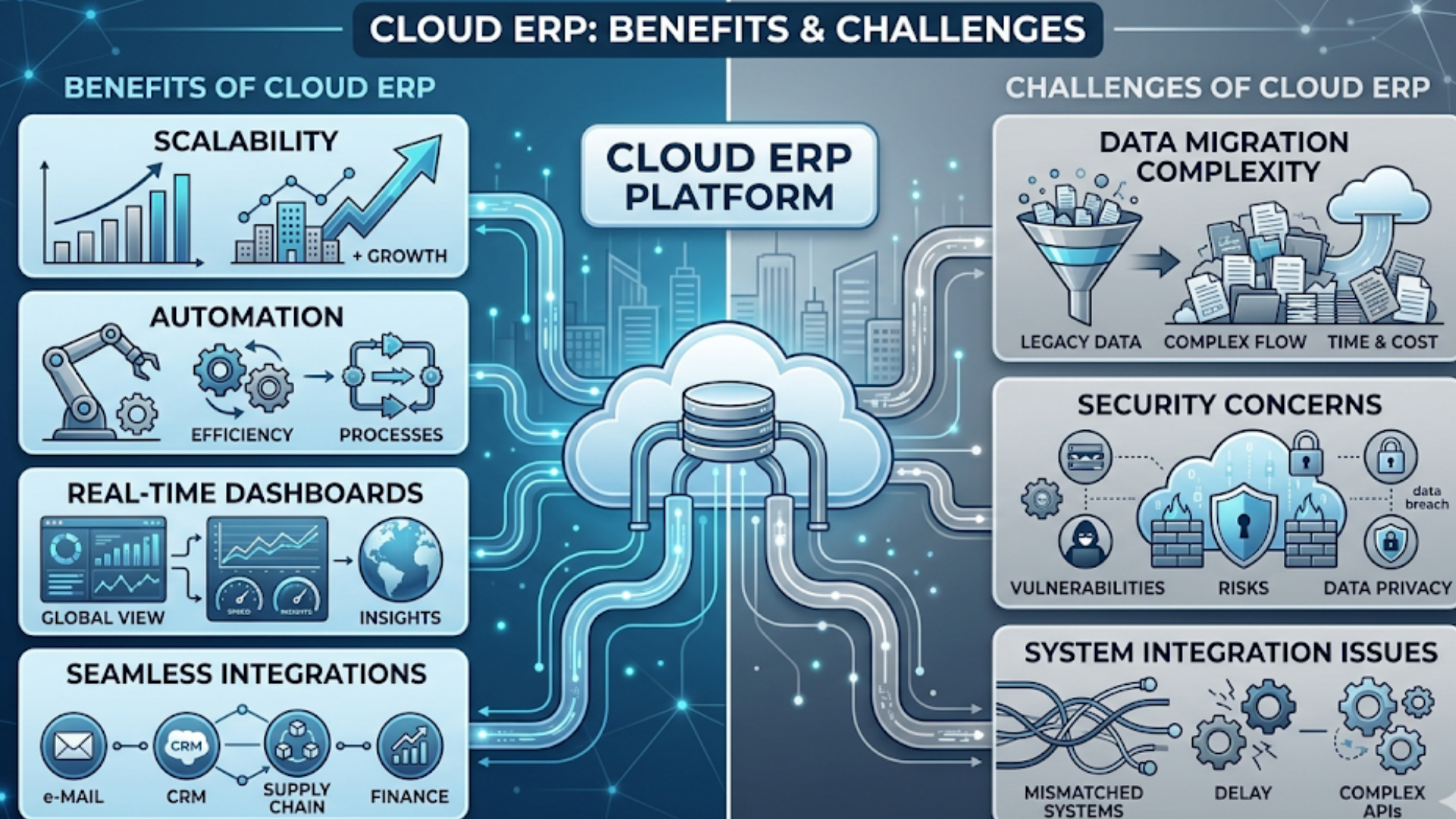
Cloud ERP solutions dominate new deployments. They offer faster updates, lower upfront costs, and simpler scalability. For many enterprises, SaaS ERP solutions are the right choice.
That said, cloud is not a panacea. You still need strong change management, security controls, and integration discipline. Legacy data migration can be messy. Not every on-prem customization translates to the cloud one-to-one. Expect some process rework.
When companies move to the cloud successfully, they get a platform that evolves with them. Vendors roll out new AI features and performance improvements. That reduces the need for heavy customization and keeps the ERP aligned with current ERP trends 2026.
Industry-specific capabilities matter
ERP for enterprises is not one size fits all. Different industries have different rules and rhythms. Manufacturing cares about shop floor scheduling and machine telemetry. Retail needs omnichannel order orchestration. Professional services wants time capture and utilization. A generic ERP can work, but industry-tailored modules speed time to value.
I often recommend starting with core processes and picking specialized modules where they matter most. For example, a pharmaceuticals company I advised prioritized batch traceability and regulatory recordkeeping during selection. That focused approach reduced risk and accelerated compliance.
How to evaluate next-gen ERP platforms
Choosing an ERP is a high stakes decision. Here are practical evaluation criteria I use with clients. These are not vendor marketing points. They reflect what matters after the sale.
- Business fit. Does the platform support your critical processes without heavy customization? Look beyond features to how work actually gets done.
- Extensibility. Can you add lightweight apps or integrations without breaking upgrades? Low-code options are a plus.
- Integration capabilities. Check APIs, event streaming, and pre-built connectors. Ask vendors for examples of integrations similar to yours.
- Data management. How will master data be governed? What tools support data quality and reconciliation?
- AI and automation maturity. Are the AI features production-ready or just experimental? Request references for specific use cases.
- Security and compliance. Make sure the platform meets your regulatory and corporate security requirements.
- Total cost of ownership. Look at subscriptions, integration costs, change management, and future upgrades, not just the initial price.
- Vendor roadmap and community. Is the vendor investing in AI, real-time analytics, and cloud scalability? Is there a partner ecosystem?
Ask for a workshop or proof of value focused on your top business problem. A scripted demo seldom exposes real limits. A small pilot does.
Common implementation pitfalls and how to avoid them
ERP implementations are notorious for overruns. But many failures happen for the same reasons. Anticipate these pitfalls and you will dramatically increase the odds of success.
- Underestimating change management. New processes mean new behaviors. Train early and often. Involve end users in configuration decisions.
- Poor data readiness. Bad data breaks automations and analytics. Clean and reconcile master data before migration.
- Trying to do too much at once. Big bangs are risky. Phase in high-value areas first and iterate.
- Ignoring integration testing. Test full end-to-end scenarios, not just module functionality.
- Failing to define success metrics. If you do not measure outcomes, you cannot prove value. Define clear KPIs tied to business objectives.
- Over-customization. Heavy custom code complicates upgrades. Prefer configuration and extensions that align with vendor best practices.
One common trap I see is letting IT own the project in isolation. ERP impacts finance, operations, sales, and HR. If those stakeholders are not invested, features get ignored and adoption stalls. Bring the business into governance and the project will stay relevant.
Migration strategies: lift and shift, replatform, or rebuild
When moving from legacy ERP, you have choices and tradeoffs. I usually recommend one of three approaches depending on risk tolerance and business need.
- Lift and shift. Move to a cloud-hosted version of your current system with minimal process change. This reduces short-term risk but often keeps inefficiencies.
- Replatform. Move to a modern SaaS ERP and adopt standard processes. This approach balances speed and modernization.
- Rebuild. Redesign processes and fully embrace next-gen ERP features. This gives the most value but requires the largest change effort.
Which path to choose? If your existing processes are a competitive advantage, take time to preserve those differentiators. If your legacy system is a cost center, replatforming or rebuilding is worth the investment.
A practical tactic is to stage the migration. Start with non-core modules or a single business unit. Learn fast, and then scale. That lets you build internal expertise without risking the entire company.
Measuring success: KPIs that matter
ERP projects should be tied to measurable outcomes. Here are KPIs that show whether your investment is working.
- Order to cash cycle time. Faster cycles mean better cash flow.
- Inventory turns. Higher turns indicate more efficient working capital use.
- Forecast accuracy. Improved accuracy reduces overstock and stockouts.
- Invoice processing time. Shorter times reduce costs and payment errors.
- Production uptime. Better maintenance and scheduling yield fewer line stoppages.
- User adoption rates. If people are not using the system, value will not materialize.
- Time saved on manual tasks. Measure the hours reallocated to higher-value work.
Track these KPIs before implementation to establish a baseline. Then measure regularly and adjust. In many ERP digital transformation projects, simple wins in invoice processing and inventory management pay for the first phase of the project.
Security, privacy, and compliance considerations
As ERP expands beyond finance, it touches more sensitive data. That raises the stakes for security and compliance. Modern ERP platforms have strong controls, but you still need governance.
Focus on role-based access, encryption, and continuous monitoring. For regulated industries, ensure audit trails and data lineage are clear. Also consider data residency and cross-border transfer rules if you operate globally.
Don't forget third-party risk. Integrations introduce new attack surfaces. Vet partners and include security requirements in contracts.
How ERP shapes digital transformation strategy
Think of ERP as the operating system for your business. When it works well, it becomes the backbone for digital transformation. It provides a single source of truth for processes, data, and automation.
That means ERP should be central to your digital road map, especially when combined with strong digital product engineering capabilities. Use it to unify data, standardize processes, and expose capabilities via APIs. From there, you can deploy AI, build customer experiences, and automate cross-functional processes.
One easy starting point is integrating your CRM and ERP. When sales sees inventory and lead times in real time, they sell more confidently. When a customer calls support, the agent sees the full order history. These small integrations deliver real improvement quickly.
Choosing the right partners
ERP selection is not just about software. It is also about the people you work with. Implementation partners, system integrators, and consultants shape the outcome more than most vendors admit.
Look for partners who understand both technology and your industry. Check references. Ask how they handled issues like data migration and process change. Avoid partners who promise a perfect, painless rollout. Implementations are complex. You want a partner who can manage that complexity and teach your team along the way.
At Agami Technologies, we help clients navigate these choices and run pilots focused on measurable business problems. That approach avoids long, expensive rollouts that deliver little value. If you want a partner who emphasizes practical results, that is the kind of collaboration to look for.
Simple, real examples that show the difference
Examples help bring abstract benefits to life. Here are three short cases that show what next-gen ERP platforms do.
- Retail chain. They integrated point of sale with inventory and forecasting. Real-time analytics flagged stores with unexpected demand and pushed inventory automatically. Result: fewer stockouts during promotions and a 10 percent increase in same-store sales.
- Discrete manufacturer. By adding AI-driven predictive maintenance to ERP data, they reduced unplanned downtime by 30 percent. The maintenance team moved from reactive fixes to scheduled interventions.
- Professional services firm. They automated time capture and invoice generation. Billing cycle time dropped from 25 days to 5 days, improving cash flow and reducing disputes.
These are straightforward changes, but they compound. Small percentage improvements in several processes become a meaningful outcome for the whole company.
Future-proofing your ERP investment
Technology moves fast. You will not buy a perfect system that lasts forever. So design for adaptability.
Favor platforms that can evolve with new AI capabilities and changing integrations. Keep your architecture modular. Invest in data governance. Train internal teams so you own the roadmap, not just the vendor.
Another tip: build internal champions. Train a small group of super users who can prototype new automations and features. They act as translators between business needs and IT execution. That speeds up innovation without breaking core processes.
ERP trends 2026 and what to watch next
Here are the trends I expect to matter most beyond 2026. They are not speculative buzz. They represent where I see customer demand and vendor investment heading.
- Embedded AI assistants. Expect ERP to include conversational agents that help users complete tasks, find records, and interpret analytics.
- Process graphs and process mining. Tools that map how work really flows across systems and identify bottlenecks automatically.
- Edge-to-cloud integrations. More IoT and machine data will feed ERP in near real time for faster manufacturing and field service decisions.
- Composable ERP. Build-it-yourself ERP where you select modular capabilities and swap them as business needs change.
- Responsible AI. Stronger emphasis on explainability, bias detection, and governance for AI models used in critical business processes.
These trends matter because they focus on two things: improving human decision making and simplifying operational complexity. If your ERP helps people make faster, more confident decisions while reducing friction in processes, you are on the right track.
Practical next steps for leaders
If you are leading an ERP modernization or selection, here are clear next steps that make the work manageable.
- Identify the top three business problems you want ERP to solve in the next 12 months. Be specific and measurable.
- Map existing processes and data flows for those problems. Don’t over-document. Focus on the high-impact steps.
- Run a focused proof of value with a short pilot that targets one problem and measures outcomes.
- Build a cross-functional governance team with IT, finance, operations, and a business sponsor.
- Choose a vendor and partner that can show references for similar work and can run the pilot fast.
- Measure and iterate. Use the pilot results to refine your roadmap and expand incrementally.
Keep senior stakeholders engaged. A little momentum early makes it easier to fund later phases.
Common questions I get from leaders
Here are short answers to the questions I hear most often.
- Is AI in ERP safe to use in production? Yes, but start with constrained, transparent use cases. Use human-in-the-loop reviews for exceptions.
- How much customization is too much? If customization stops you from upgrading, it is too much. Prefer extensibility layers over core modifications.
- Can small teams run ERP modernization? Yes. A focused, empowered team with the right partners can deliver meaningful outcomes quickly.
- How do we measure ROI? Tie KPIs to outcomes like cycle time, inventory turns, invoice processing, and uptime. Those metrics translate directly to cash and margins.
FAQs
1. What is an enterprise resource planning system in 2026?
An enterprise resource planning system in 2026 is a cloud-based, AI-powered platform that goes beyond finance and operations. It integrates data across departments, automates workflows, and provides real-time insights to support faster and smarter business decisions.
2. How is AI used in modern ERP systems?
AI in modern ERP systems is used for demand forecasting, anomaly detection, invoice processing, predictive maintenance, and decision support. It helps businesses reduce manual work, improve accuracy, and make proactive decisions.
3. Why are cloud ERP solutions becoming the standard?
Cloud ERP solutions are preferred because they offer scalability, lower upfront costs, faster updates, and easier integration with other systems. They also enable real-time access to data from anywhere, making them ideal for modern, distributed teams.
4. How do I choose the right ERP system for my business?
To choose the right ERP system, focus on business fit, integration capabilities, scalability, AI and automation features, and total cost of ownership. Running a pilot or proof of value with real use cases is the best way to evaluate whether the system meets your needs.
Final thoughts
ERP in 2026 is less about keeping the books in order and more about connecting people, processes, and data so the business runs smarter. When done right, modern ERP systems become a platform for automation, AI, and real-time insight. They help teams move faster, reduce waste, and make better decisions.
My advice to leaders is simple. Start with real business problems. Run a focused pilot. Protect your data and governance. And choose partners who care about outcomes as much as technology. Those steps will turn an enterprise resource planning system from a cost center into a strategic enabler.
Helpful Links & Next Steps
- Agami Technologies
- Agami Technologies Blog
- Book your free demo today
- Contact Us
- info@agamitechnologies.com